
# Front vs Rear Service LED Display: Design the Access Route First
Pixel pitch and brightness get the brochure pages. Service direction decides whether your team can actually fix a dead module at 2 a.m. without tearing down cladding.
Front service means technicians reach replaceable parts from the viewing side. Rear service means they work behind the screen. Neither choice makes the wall sharper by itself. 2026 buyer guides keep repeating the same rule: design the maintenance route before you lock the cabinet SKU-especially for wall-mounted meeting rooms, churches, retail, and flush indoor installs where a rear aisle was never in the architectural plan.
This guide sits next to our live soft vs hard connection post (locks and connectors between cabinets) and the maintenance / repair guide. Soft/hard answers how cabinets latch. Front/rear answers which side of the wall a human stands on to swap parts.
Quick definitions (no brochure fog)
| Label | What it actually means | What it is not |
|---|---|---|
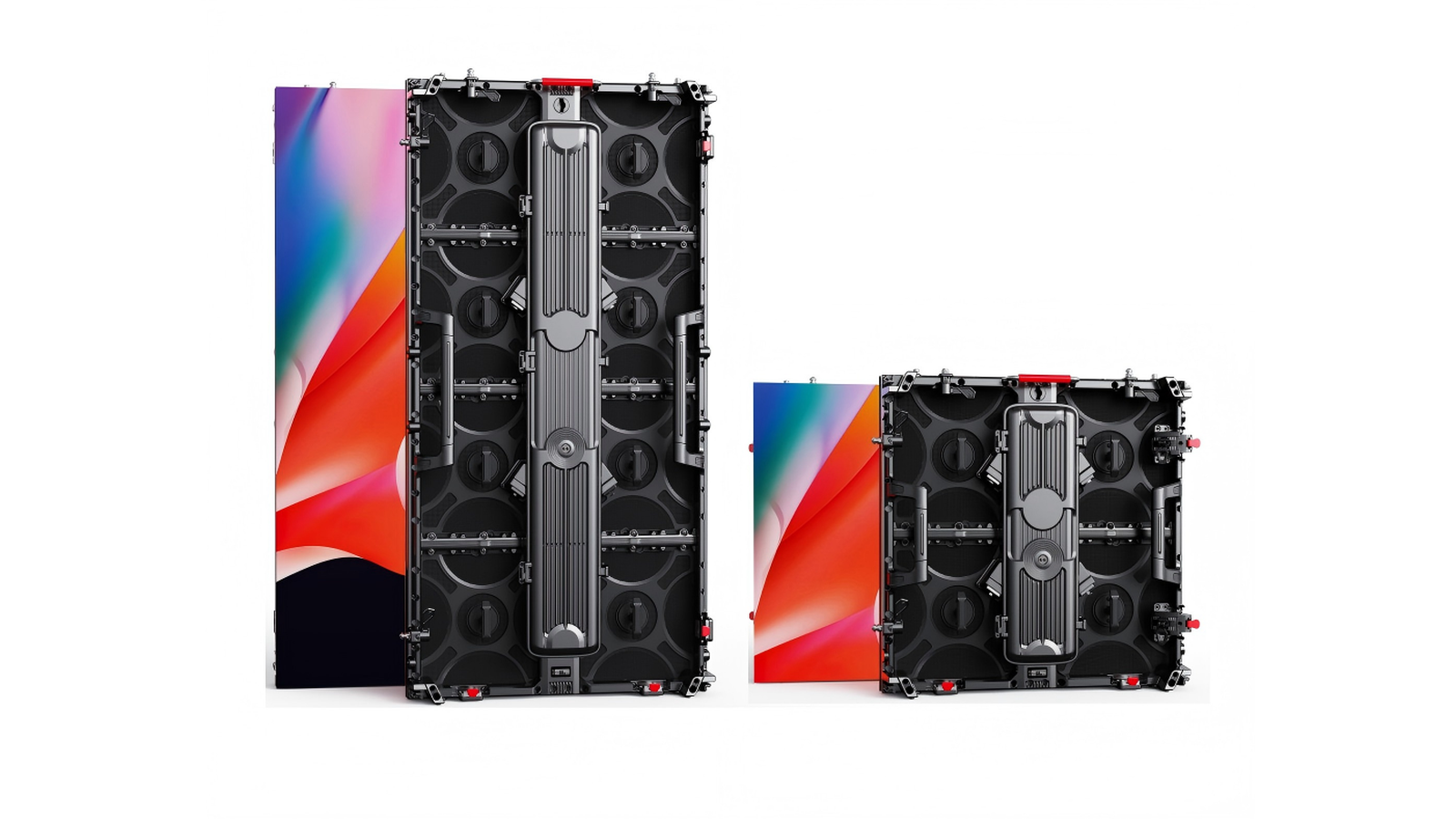
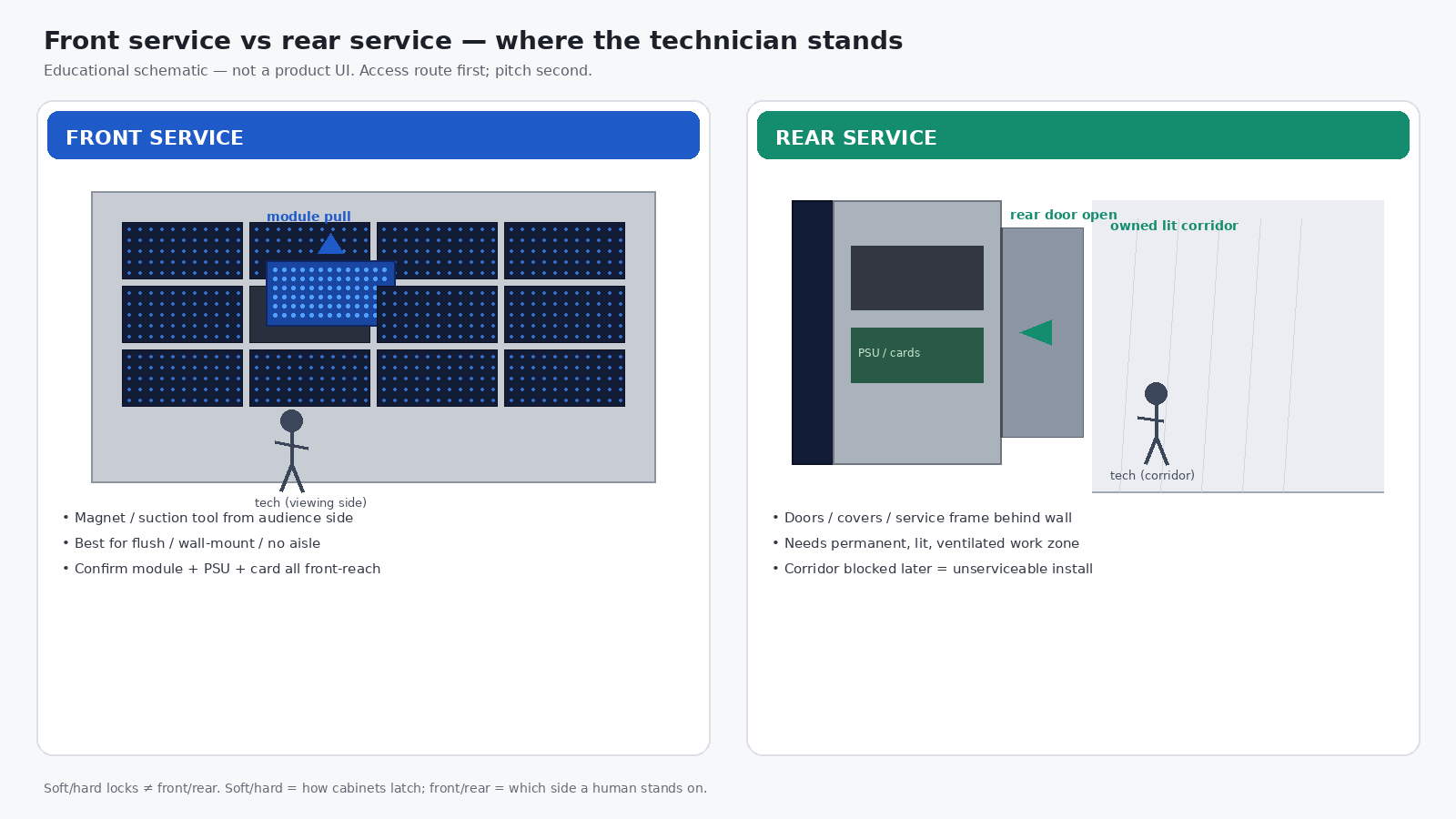
| Front service | Modules (and ideally PSU / receiving card / hub) can be removed from the viewing side-often magnets + suction tool, captive screws, or a dedicated front tool | Not "thinner = better image." Not automatic outdoor weatherproofing. Not a free pass to skip isolation and height safety. |
| Rear service | Cabinets open from behind-doors, covers, or a service frame-so techs work in a corridor / platform | Not "always cheaper." Not usable if the "corridor" gets blocked by fit-out later. |
| Dual / front+rear | Some or all serviceable parts reachable from either side | Not automatically worth the premium-confirm which parts from which side. |
| Soft vs hard connection | How rental cabinets lock and pass power/signal between neighbors | A different decision-see soft vs hard. |
If a quote only says "front maintenance," ask for a written list: module, power supply, receiving card, hub board, cables, fans. A display is only fully front-service when the parts that fail most often are truly reachable from the front.
Why this question is hot for buyers right now
Integrator and OEM explainers in 2026 treat front vs rear as a site and total-cost problem, not a beauty contest. Meeting-room and church wall-mount briefs keep colliding with "rear corridor required" cabinets after the drywall is closed. Outdoor and stadium projects still need protected rear platforms. Rental fleets care about mid-show module swaps when the wall sits against a set or flies with no walkway.
We are not inventing engagement scores. What we can verify: English guides (access route -> installed cost -> timed swap demo) and Chinese 前维护 / 后维护 / 壁挂会议室预留空间 clusters keep asking the same practical question. That is enough heat to write an honest OEM answer.
Side-by-side: what you actually trade
| Decision factor | Front service | Rear service |
|---|---|---|
| Where the tech stands | Viewing side | Behind the display |
| Typical wall depth story | Can support shallow / flush mounts | Needs a usable rear work zone for the life of the wall |
| Best-fit environments | Meeting rooms, lobbies, control rooms, churches, retail walls, glass-adjacent installs | Billboards, stadiums, freestanding outdoor frames, catwalk-served façades |
| Main risk | Incomplete "front" claims; module-edge damage during pulls; no plan for edge/corner modules | Corridor blocked later; unsafe/hot/dark rear space; public-side lift needed when rear fails |
| Cost driver | Front-access hardware + service tools | Steel depth, doors, platforms, lighting, ventilation, fall protection, lost floor area |
| Image quality | Set by pitch, LEDs, drive, calibration, processing-not by service direction alone | Same |
Do not compare cabinet unit price alone. A rear-service line can look cheap until you price the corridor and platforms. A front-service line can look expensive until you price the rentable space you did not give away.
When front service is the honest shortlist
Choose a front-service path when most of these are true:
- The wall is mounted flush or nearly flush-no permanent rear aisle was designed.
- The space behind the screen is another room, glass, retail stock, or finishes you cannot open weekly.
- Downtime must be fixed from the audience / lobby side with a lift or small platform.
- Indoor rooms (boardroom, sanctuary IMAG side screen, hotel ballroom) where a rear corridor wastes expensive floor or conflicts with acoustics and doors.
- You can get a timed swap demo on the exact cabinet: isolate -> pull -> reseat -> power/data check -> brightness check-at center and edge positions.
Front service still needs a heat path, cable plan, and safe working room in front of the wall while a module is out. Shallow depth is not a thermal free lunch-ask for ambient limits and derating, the same way you would for any dense indoor wall (see nits vs lumens for brightness context, not as a substitute for thermal design).
Churches and sanctuaries that hang a permanent wall with no rear access should treat front service as a requirement, not an upgrade-pair it with closest-seat pitch math from our church size + pixel pitch guide and the pixel pitch hub.
When rear service still wins
Rear service is the practical shortlist when:
- The structure already includes a permanent, owned, lit, ventilated service corridor or catwalk.
- The face sits above traffic or a public zone where parking a lift in front is disruptive or unsafe.
- Outdoor billboards, rooftop signs, and stadium fascia were engineered around rear doors from day one.
- Techs can inspect several cabinets from one platform without moving access equipment every time.
- Weather and sealing are designed so opening a rear door does not destroy the protection story-confirm what was IP-tested as assembled, and how gaskets are reseated after service.
"We left 80 cm during install" is not rear access if that volume later becomes storage, cladding, or another tenant’s wall. Document keys, ownership, egress, and the route for a spare module for the full service life.
Dual-service: useful hedge, not automatic gold
Dual-access cabinets help when lower rows open from a rear platform and upper rows are easier from the front-or when the building program may change. Pay for dual service only after you know:
- Which exact parts come out from each side
- Whether both paths keep the same environmental protection
- Weight, depth, cabling, and spare implications
- That the O&M manual names the expected path so crews do not improvise
Rental walls that fly or sit against sets often need front or dual module access even when the brochure shows rear handles-see also outdoor festival rental checklist for site constraints that kill rear access mid-show.
How this fits soft/hard, fixed vs rental, and packaging
Use this order on the RFQ so quote lines stop colliding:
- Map the human route from entrance to every cabinet (doors, lifts, glass, cladding, public zones). Service direction first.
- Fixed vs rental mechanics. Touring walls need fast locks and flight-case logic-see 500×500 vs 500×1000 and soft vs hard connection. Fixed flush walls often need front service + clean structure-browse indoor series, fixed mounting, and rental series as category examples, not universal specs.
- Closest seat -> pitch. Access cannot invent pixels-use the pitch hub.
- Packaging family (SMD / GOB / COB / MIP) only after access and pitch are honest-see COB vs SMD, GOB guide, MIP vs COB.
- Structure load if you hang: 4K wall weight / hang.
- Spare and acceptance plan-same-batch modules, seam/flatness expectations, brightness you will actually run.
If you are still shaping a custom footprint, start from how to customize and how to choose.
What to put on the RFQ (copy/paste)
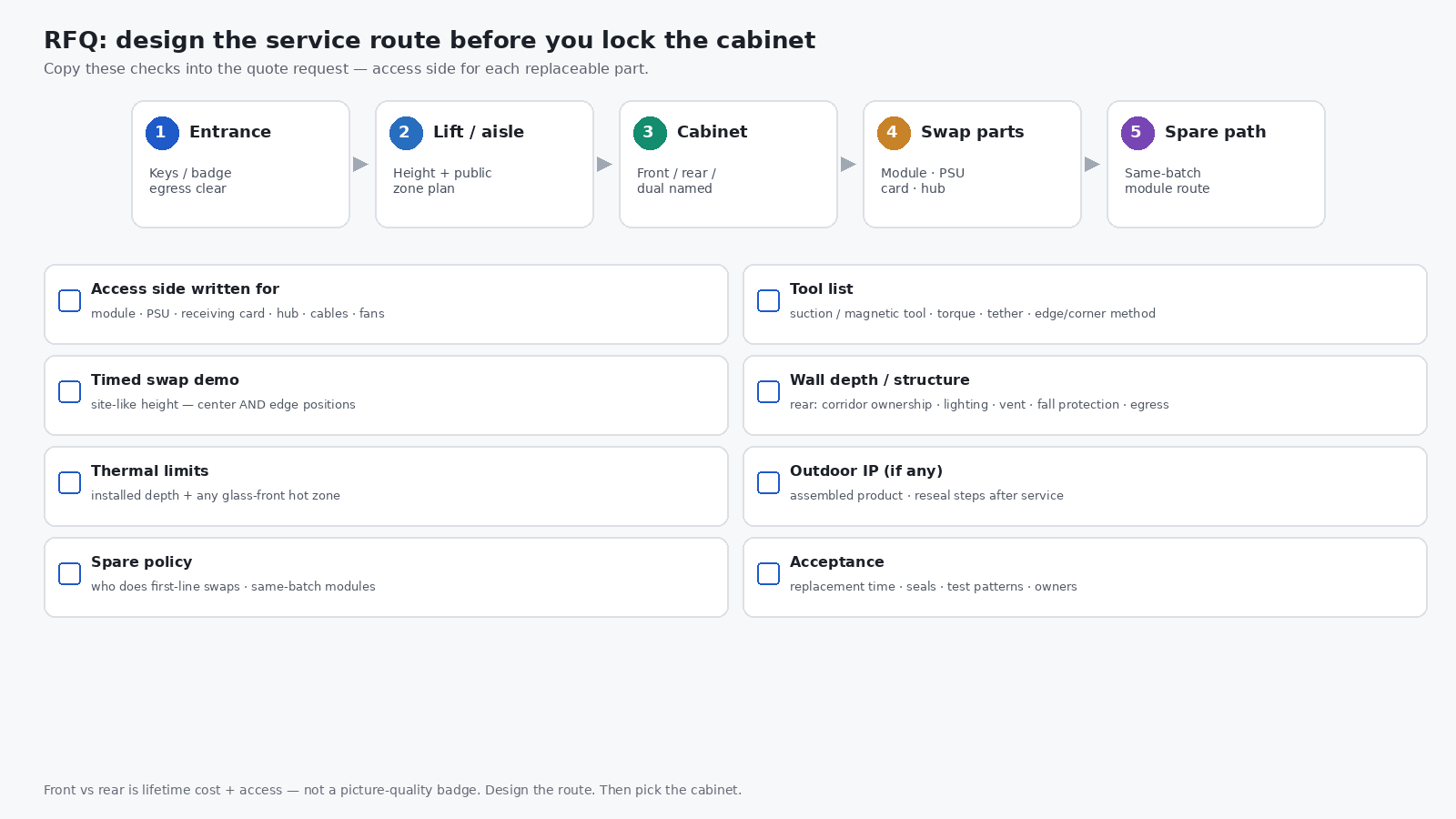
Ask the factory / integrator for all of these in writing:
- Access side for each replaceable part: module, PSU, receiving card, hub, cables, fans.
- Tool list (suction / magnetic tool, torque, tether) and whether edge/corner modules use a different method.
- Timed replacement demo under site-like height-not only a factory table video.
- Wall depth, structure, and (for rear service) corridor ownership, lighting, ventilation, fall protection, egress.
- Thermal limits for the installed depth and any glass-front hot zone.
- For outdoor: IP statement for the assembled product, reseal steps after service, drainage / corrosion notes.
- Spare module policy and who performs first-line swaps (owner staff vs vendor).
- Acceptance checklist: replacement time recorded, seals checked, test patterns, responsible parties.
Bottom line
Front vs rear service is an access and lifetime-cost decision, not a picture-quality badge. If rear access cannot be guaranteed for the life of the display, specify front service (or dual) and prove it with a real swap. If a protected rear corridor is already engineered and owned, rear service can be faster and safer-protect that corridor in writing.
Design the route. Then pick the cabinet.
Does front service make the LED wall look better?
No. Service direction describes how parts are reached. Pitch, LEDs, drive, calibration, processing, and install flatness set the image.
How much rear clearance do I need?
There is no universal safe number for every project. Clearance depends on door swing, component size, body movement, tools, lighting, ventilation, egress, and local rules. Have the project engineer and safety lead approve the zone-do not copy a brochure centimetre into the building permit.
Is front service always more expensive?
Cabinet hardware may cost more; total project cost can be lower when you avoid a rear corridor, deeper steel, and recurring lift rentals. Compare installed and five-year service cost, not panel price alone.
Can we convert a rear-only wall to front service later?
Usually not as a simple site mod. Modules, fasteners, hubs, openings, wiring, and sealing may all differ. Ask the original maker-do not assume magnets alone create full front service.
Is this the same as soft vs hard connection?
No. Soft/hard is how cabinets lock and interconnect. Front/rear is which side a technician stands on. You still need both decisions on a rental or fixed RFQ.
Should every church or meeting room buy front service?
If the screen is wall-mounted with no permanent rear aisle, front service (or proven dual) should be the default shortlist. Measure closest seat for pitch separately.
—