# MIP vs COB LED: Dual Track, Not a Replacement War
If you have been shopping fine-pitch indoor LED in 2026, you have heard two slogans. One says COB won. The other says MIP replaces COB. Both oversell.
COB (chip on board) and MIP (usually Micro LED in Package) are two packaging routes for packing more pixels into a smooth indoor face. Industry research and integrator guides increasingly treat them as a dual track-coexistence, not a knockout. Your job as a buyer is not to pick the newest buzzword. It is to match closest viewing distance, pitch band, repair model, and whether the wall is fixed or rebuilt often.
This guide sits next to our live COB vs SMD and GOB LED guide. SMD vs COB answers "packaged lamp or encapsulant face." GOB answers "do we coat an SMD face for bumps." MIP vs COB answers the fine-pitch indoor question after SMD has already left the shortlist.
Quick definitions (no brochure fog)
| Label | What it actually means | What it is not |
|---|---|---|
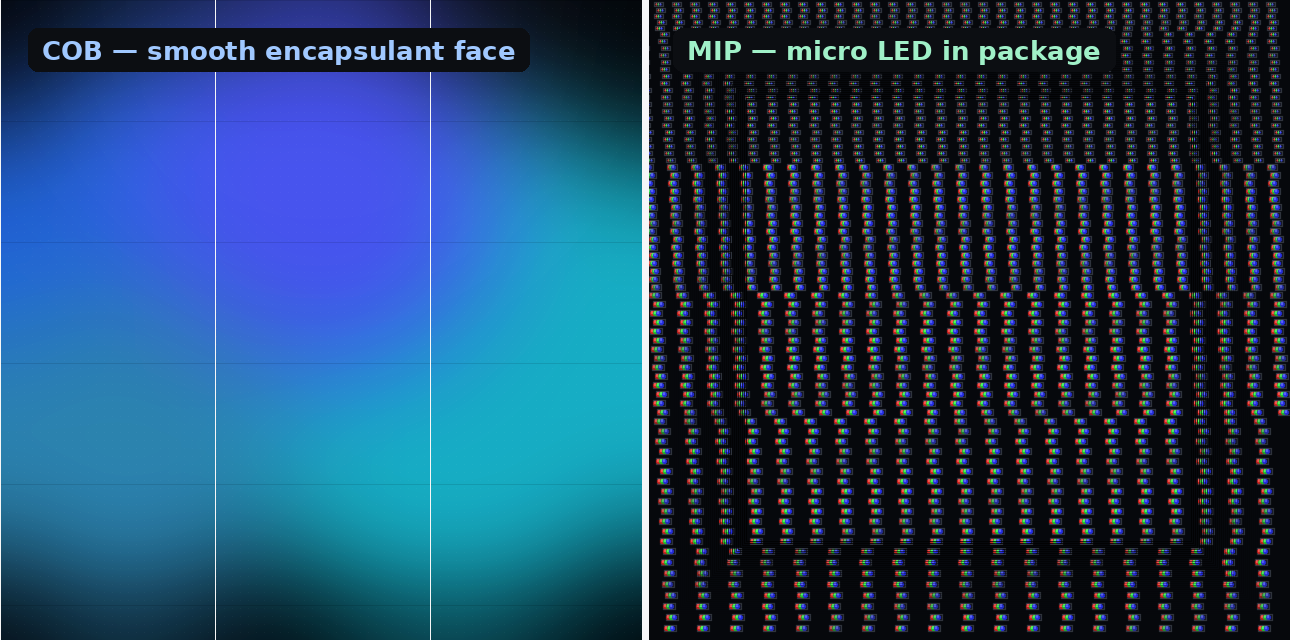
| COB | Bare LED chips bonded to the PCB, then covered with encapsulant so the face reads as a smooth tile | Not a pitch. Not automatically outdoor. Not "no seams forever." |
| MIP | Very small LED chips packaged into tiny surface-mount-style units first, then placed on the module (SMT-compatible flow) | Not a protective glue layer on classic SMD (that is closer to GOB). Not one universal SKU. |
| SMD | Packaged RGB lamps soldered to the board | Still the workhorse for many rental / outdoor / coarser indoor jobs-see COB vs SMD |
| GOB | Cured protective face on an SMD module | A protection process, not a Micro LED package |
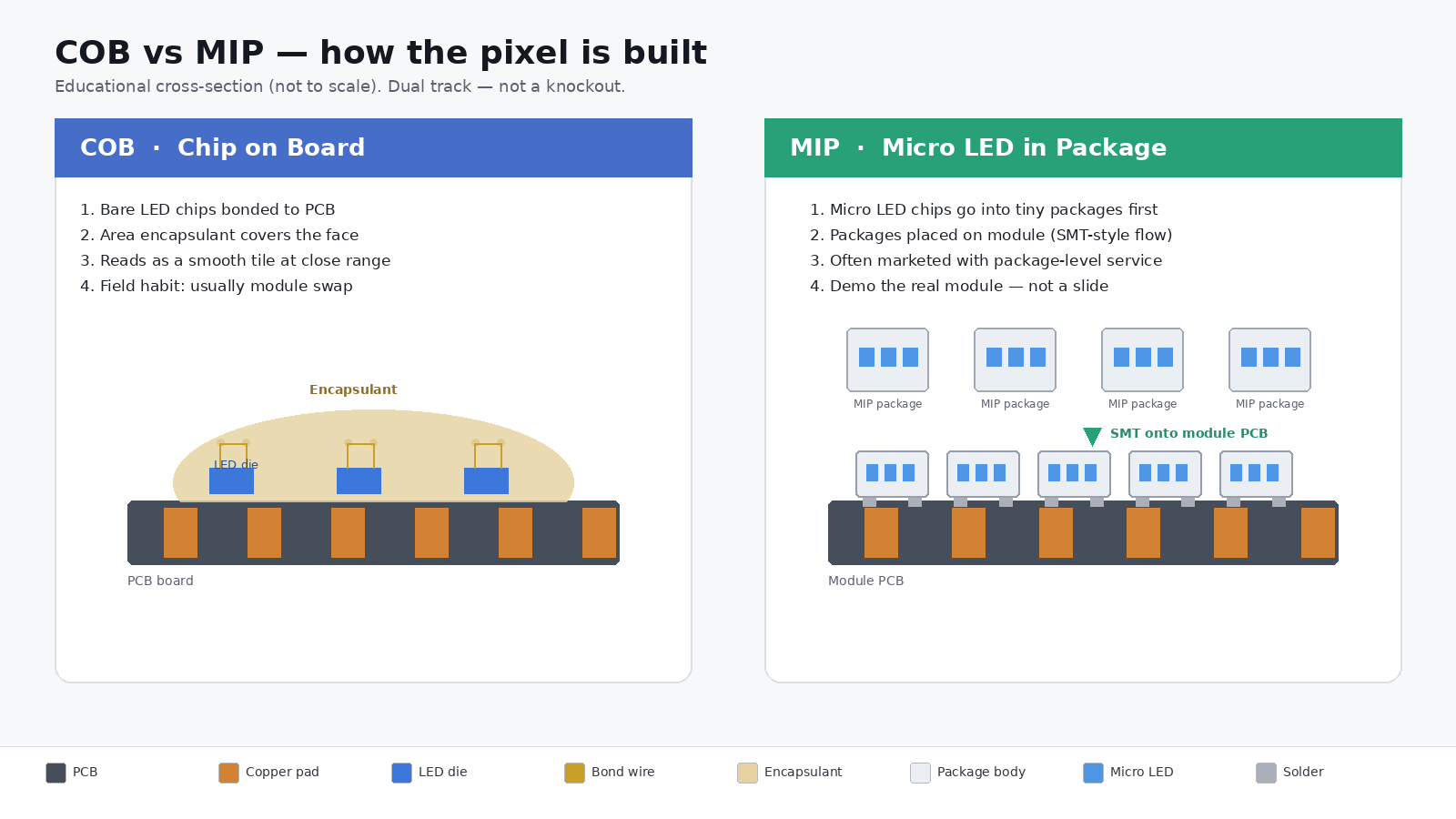
Pitch still comes from viewing distance. Packaging decides how the pixel is built, how it fails, and how your team services it. Start distance with our pixel pitch by viewing distance hub (and the meeting-room P1.2 / P1.5 / P1.8 post once it is live).
Why 2026 language sounds like a "war"
Chinese industry media around the 2026 COB/MIP research cycle (e.g. 行家说Research coverage on OFweek / eefocus) frames COB and MIP as parallel upgrade routes, not a single winner. English integrator guides in the same season tend to say something compatible: COB is the mature default for many indoor fine-pitch fixed walls; MIP is asked for when you need ultra-fine pitch, package-level service options, or an SMT-style manufacturing / inspection story.
Treat published market-share forecasts as industry report language, not as a promise on your PO. What belongs on your RFQ is the exact package, pitch, sample, spare plan, and repair path-not a slide about 2030.
Side-by-side: what buyers actually feel
| Decision factor | COB (typical indoor fine-pitch story) | MIP (typical 2026 ask) |
|---|---|---|
| How the pixel is made | Chips on PCB + area encapsulant | Micro chips -> small package -> module assembly |
| Look at close range | Smooth face, strong "tile" black when well made | Aims at fine / ultra-fine pitches with packaged micro-pixels; still demo the real module |
| Field repair habit | Usually module swap; no normal tweezer pixel job | Often marketed with package / pixel-unit service options-confirm tooling, training, and turnaround in writing |
| Where it usually wins | Fixed indoor walls (boardrooms, control rooms, lobbies, sanctuaries with close walk-up) that value a mature process and a tough smooth face | Projects already in the ultra-fine conversation, or fleets that need a repair model closer to packaged components |
| Where it is often the wrong spend | Distant viewers who already blend on good SMD / GOB at a coarser pitch | Buying "MIP" as a logo while the room only needs P1.8-P2.5 and lamp-level SMD service |
Do not copy vendor hardness scores, dead-pixel percentages, or "always X% cheaper" tables into your RFQ without the test file for that cabinet. Ask for the sample and the service SLA instead.
When COB is still the honest shortlist
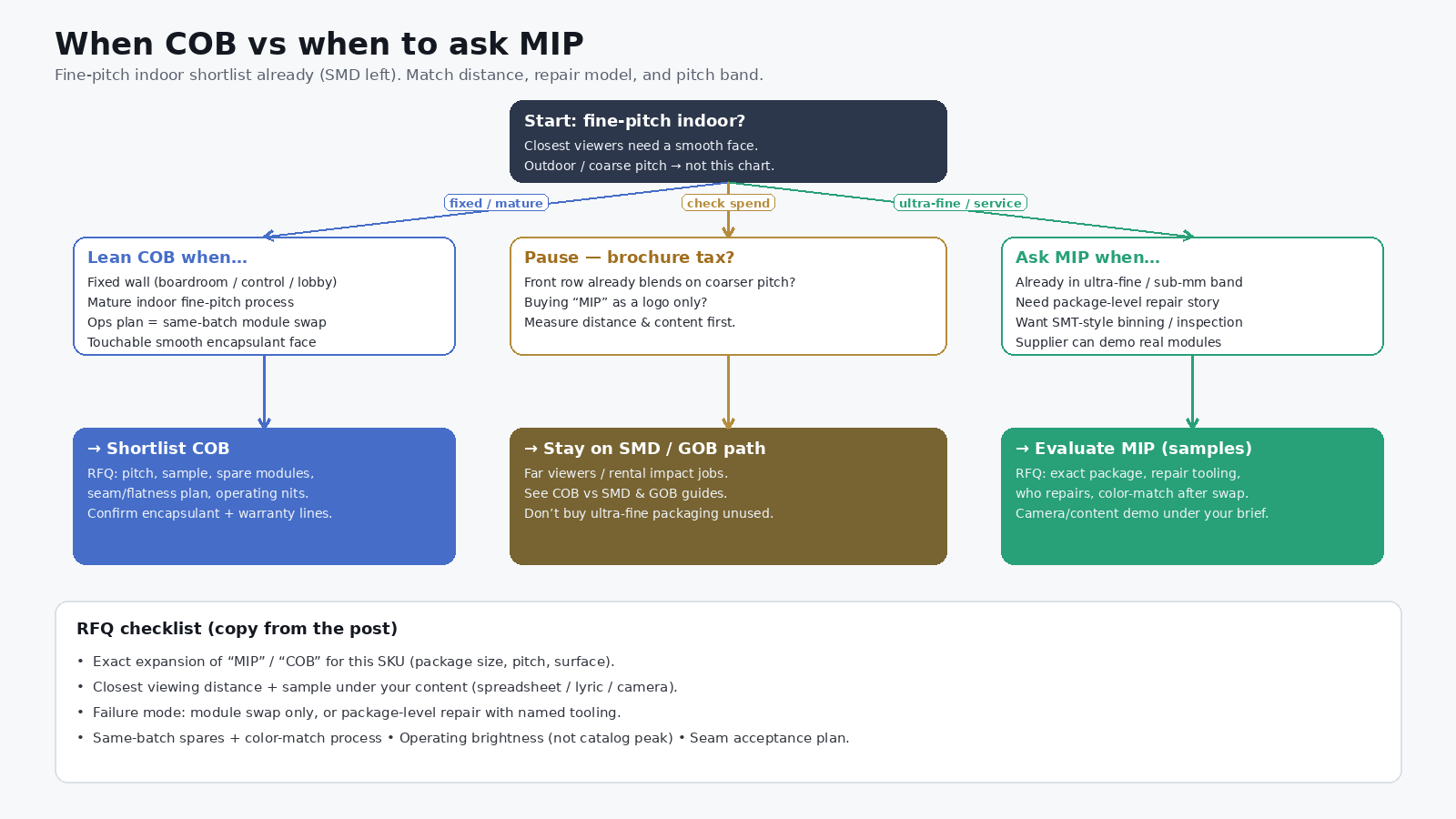
Choose a COB path when most of these are true:
- Closest viewers sit or stand close enough that a packaged lamp grid would distract (often the indoor fine-pitch band-see COB product overview as a category example, not a universal spec).
- The wall is fixed or rarely rebuilt-control room, boardroom, lobby, studio background.
- Your ops team already plans same-batch spare modules and module-level swap.
- You care more about a mature indoor fine-pitch process than about chasing the smallest marketed pitch name.
- People can touch the face; a continuous encapsulant surface is part of the brief.
COB does not cancel wall flatness or seam work. Fine-pitch joints still fail from geometry first-see our seam draft once published, and keep maintenance / repair in the spare plan.
When to ask for MIP (and what to verify)
Ask for MIP-or at least force a MIP vs COB sample day-when:
- The brief is already sub-millimetre / ultra-fine, and the supplier’s COB line does not cover that pitch honestly.
- Broadcast, XR, or color-critical work needs a packaging story with binning / inspection before final assembly-then demo under your cameras, do not buy from a slide.
- Your service contract assumes package-level repair, not only whole-module swap. Get the tool list, who does the work, and how color match is checked after a pixel swap.
- Manufacturing continuity with SMT-style lines matters to the factory you trust (yield and spare logistics), and they can show you real modules-not a renamed SMD.
MIP is not a reason to skip pitch math. If the front row is four metres back and content is full-bleed video, paying for ultra-fine packaging is often a brochure tax. Measure first.
How this fits SMD and GOB (so quotes stop colliding)
Use this decision order on the RFQ:
- Indoor or outdoor? Outdoor weather and touring IP still point at purpose-built SMD (or clearly quoted outdoor designs)-not indoor COB/MIP resin stories. See nits vs lumens and indoor vs outdoor thinking on the site.
- Closest seat -> pitch. Packaging cannot invent pixels. Use the pitch hub.
- SMD vs fine-pitch encapsulant family. Far viewing + field lamp rework -> SMD (ask GOB if impact is the pain). Close indoor fine pitch -> COB and/or MIP shortlist.
- Inside the fine-pitch family: COB vs MIP. Fixed mature indoor wall -> lean COB. Ultra-fine / package-service / SMT-package story -> evaluate MIP with samples.
- Spares and acceptance. Same-bin modules, seam / flatness plan, brightness you will actually run (not catalog peak), camera test if you stream.
SFxDisplay will keep answering COB vs SMD and GOB questions from the live guides above. For MIP, treat this page as buyer language for the RFQ: we will quote what we can support honestly on the exact model-never a vague "MIP upgrade" line with no pitch, sample, or repair path.
What to put on the RFQ (copy/paste)
Ask the factory for all of these in writing:
- Exact expansion of "MIP" / "COB" for this SKU (package size, pitch, surface finish).
- Closest recommended viewing distance and a sample under your content (spreadsheet / lyric / camera).
- Normal failure mode: module swap only, or package-level repair with named tooling.
- Same-batch spare policy and color-match process after a swap.
- Brightness and power at the operating level you will use, plus dimming quality at 20-30% for indoor rooms.
- Flatness / seam acceptance plan for the install surface (software seam tools optimize; they do not fix a crooked wall).
- Warranty language that covers encapsulant / package defects, dead pixels, and impact-separately.
Bottom line
COB and MIP are dual tracks for fine-pitch indoor LED, not a morality play. COB remains the practical shortlist for many fixed close-view walls with a mature encapsulant face and module-level service. MIP belongs on the shortlist when you truly need ultra-fine pitch, a packaged-micro repair / SMT story, and a supplier who can prove it with samples-not slogans.
Start with distance and content. Then pick the package that your crew can actually service at 2 a.m.
Is MIP the same as GOB?
No. GOB is usually a cured protective layer on an SMD module. MIP packages micro LED chips into tiny components before module assembly. Different problem, different quote line.
Does MIP replace COB in 2026?
Industry coverage increasingly says coexistence, not total replacement. Many fixed indoor projects still shortlist COB; MIP is evaluated when ultra-fine pitch or package-level service is part of the brief.
Can I repair a single dead pixel on COB?
Not as a normal field job. Plan module swap and same-batch spares. MIP is often marketed with package-level options-confirm the exact process before you buy.
Should a church or meeting room automatically buy MIP?
No. Measure closest seat, choose pitch, then decide packaging. Many sanctuaries and conference rooms are still well served by the right SMD / GOB / COB choice without ultra-fine MIP.
Will a finer package fix seams or moiré?
No. Seams are mostly geometry and calibration. Moiré is pitch, camera, lens, and content. Demo the real wall.