

# Front vs Rear Service LED-экран: сначала спроектируйте маршрут доступа
Pixel pitch and brightness get the brochure pages. Service direction decides whether your team can actually fix a dead module at 2 a.m. without tearing down cladding.
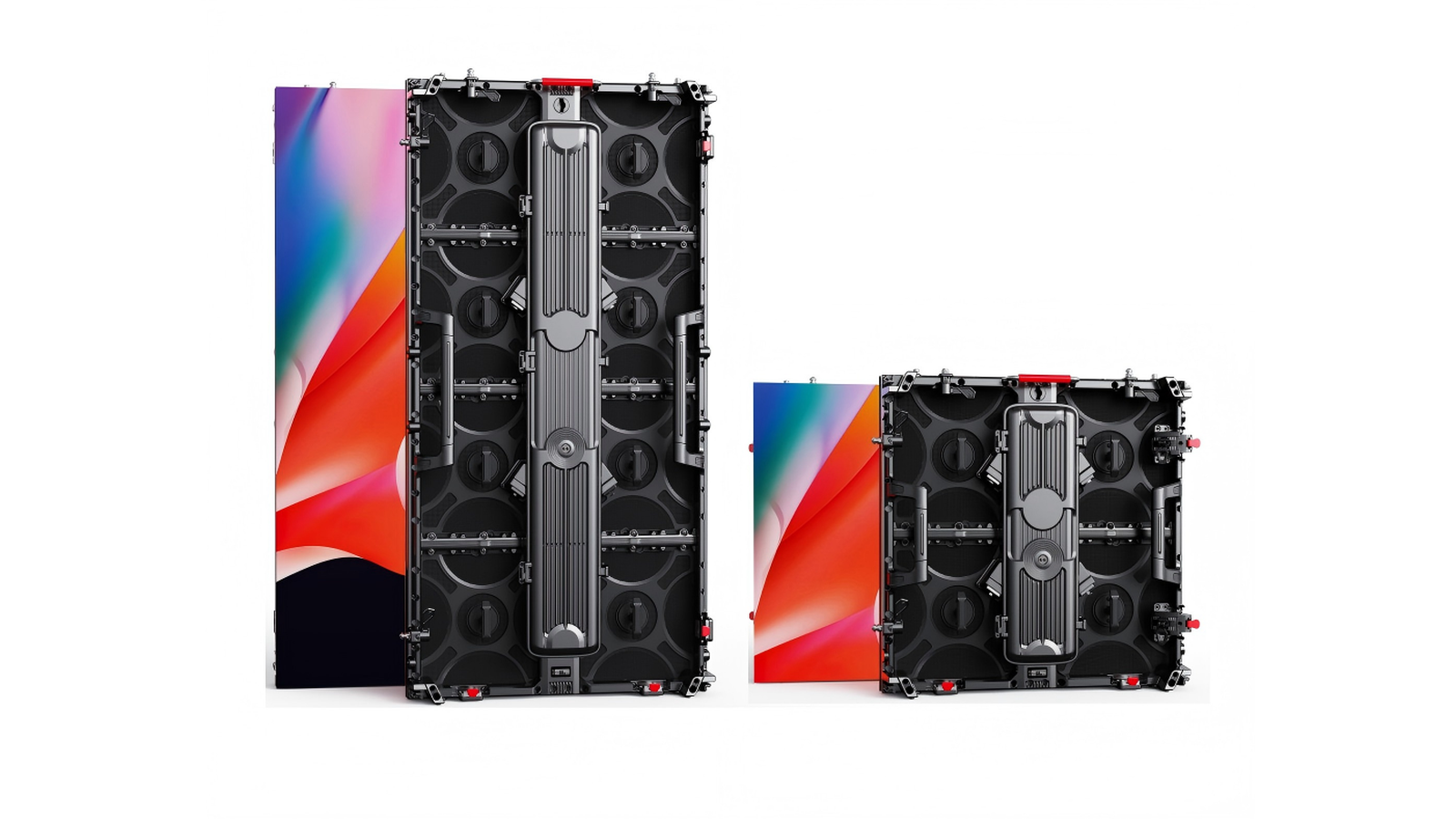
Front service means technicians reach replaceable parts from the viewing side. Rear service means they work behind the screen. Neither choice makes the wall sharper by itself. 2026 buyer guides keep repeating the same rule: design the maintenance route before you lock the cabinet SKU-especially for wall-mounted meeting rooms, churches, retail, and flush indoor installs where a rear aisle was never in the architectural plan.
This guide sits next to our live soft vs hard connection post (locks and connectors between cabinets) and the maintenance / repair guide. Soft/hard answers how cabinets latch. Front/rear answers which side of the wall a human stands on to swap parts.
Быстрые определения (без тумана брошюр)
| Label | What it actually means | What it is not |
|---|---|---|
| Front service | Modules (and ideally PSU / receiving card / hub) can be removed from the viewing side-often magnets + suction tool, captive screws, or a dedicated front tool | Not "thinner = better image." Not automatic outdoor weatherproofing. Not a free pass to skip isolation and height safety. |
| Rear service | Cabinets open from behind-doors, covers, or a service frame-so techs work in a corridor / platform | Not "always cheaper." Not usable if the "corridor" gets blocked by fit-out later. |
| Dual / front+rear | Some or all serviceable parts reachable from either side | Not automatically worth the premium-confirm which parts from which side. |
| Soft vs hard connection | How rental cabinets lock and pass power/signal between neighbors | A different decision-see soft vs hard. |
If a quote only says "front maintenance," ask for a written list: module, power supply, receiving card, hub board, cables, fans. A display is only fully front-service when the parts that fail most often are truly reachable from the front.
Почему вопрос горячий для покупателей сейчас
Integrator and OEM explainers in 2026 treat front vs rear as a site and total-cost problem, not a beauty contest. Meeting-room and church wall-mount briefs keep colliding with "rear corridor required" cabinets after the drywall is closed. Outdoor and stadium projects still need protected rear platforms. Rental fleets care about mid-show module swaps when the wall sits against a set or flies with no walkway.
We are not inventing engagement scores. What we can verify: English guides (access route -> installed cost -> timed swap demo) and Chinese 前维护 / 后维护 / 壁挂会议室预留空间 clusters keep asking the same practical question. That is enough heat to write an honest OEM answer.
Сравнение: чем вы реально платите
| Decision factor | Front service | Rear service |
|---|---|---|
| Where the tech stands | Viewing side | Behind the display |
| Typical wall depth story | Can support shallow / flush mounts | Needs a usable rear work zone for the life of the wall |
| Best-fit environments | Meeting rooms, lobbies, control rooms, churches, retail walls, glass-adjacent installs | Billboards, stadiums, freestanding outdoor frames, catwalk-served façades |
| Main risk | Incomplete "front" claims; module-edge damage during pulls; no plan for edge/corner modules | Corridor blocked later; unsafe/hot/dark rear space; public-side lift needed when rear fails |
| Cost driver | Front-access hardware + service tools | Steel depth, doors, platforms, lighting, ventilation, fall protection, lost floor area |
| Image quality | Set by pitch, LEDs, drive, calibration, processing-not by service direction alone | Same |
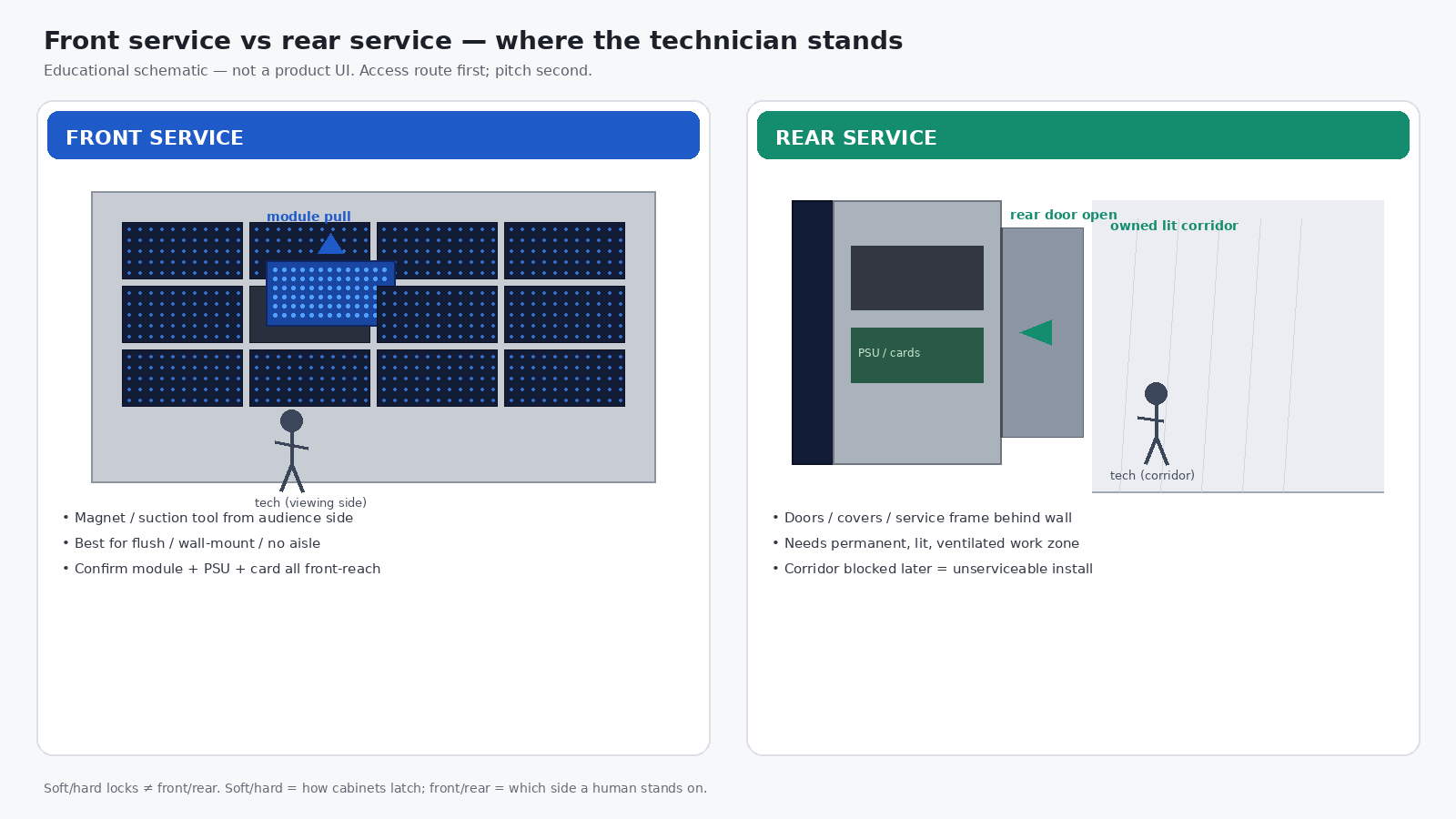
Do not compare cabinet unit price alone. A rear-service line can look cheap until you price the corridor and platforms. A front-service line can look expensive until you price the rentable space you did not give away.
Когда front service — честный шортлист
Выбирайте путь front-service, когда верно большинство пунктов:
- The wall is mounted flush or nearly flush-no permanent rear aisle was designed.
- За экраном — другая комната, стекло, товар ритейла или отделка, которую нельзя открывать еженедельно.
- Простой нужно устранять со стороны зала / лобби с подъёмником или маленькой площадкой.
- Indoor-помещения (переговорная, боковой IMAG в sanctuary, бальный зал отеля), где задний коридор съедает дорогой пол или конфликтует с акустикой и дверями.
- You can get a timed swap demo on the exact cabinet: isolate -> pull -> reseat -> power/data check -> brightness check-at center and edge positions.
Front service still needs a heat path, cable plan, and safe working room in front of the wall while a module is out. Shallow depth is not a thermal free lunch-ask for ambient limits and derating, the same way you would for any dense indoor wall (see nits vs lumens for brightness context, not as a substitute for thermal design).
Churches and sanctuaries that hang a permanent wall with no rear access should treat front service as a requirement, not an upgrade-pair it with closest-seat pitch math from our church size + pixel pitch guide and the pixel pitch hub.
Когда rear service всё ещё выигрывает
Rear service — практический шортлист, когда:
- The structure already includes a permanent, owned, lit, ventilated service corridor or catwalk.
- Лицо экрана над проходом или общественной зоной, где парковать подъёмник спереди мешает или небезопасно.
- Уличные билборды, крышные знаки и stadium fascia с первого дня спроектированы вокруг задних дверей.
- Техники могут осмотреть несколько кабинетов с одной площадки без перестановки доступа каждый раз.
- Weather and sealing are designed so opening a rear door does not destroy the protection story-confirm what was IP-tested as assembled, and how gaskets are reseated after service.
«Мы оставили 80 см при монтаже» — не rear access, если этот объём потом станет складом, облицовкой или стеной другого арендатора. Документируйте ключи, владение, эвакуацию и маршрут запасного модуля на весь срок службы.
Dual-service: полезный хедж, не автоматическое золото
Кабинеты dual-access помогают, когда нижние ряды открываются с задней площадки, а верхние проще спереди — или когда программа здания может измениться. Платите за dual service только когда знаете:
- Which exact parts come out from each side
- Сохраняют ли оба пути ту же защиту среды
- Вес, глубину, кабели и последствия для ЗИП
- Что в O&M-мануале назван ожидаемый путь, чтобы бригады не импровизировали
Rental walls that fly or sit against sets often need front or dual module access even when the brochure shows rear handles-see also outdoor festival rental checklist for site constraints that kill rear access mid-show.
Как это стыкуется с soft/hard, fixed vs rental и упаковкой
Держите такой порядок в RFQ, чтобы строки КП перестали конфликтовать:
- Map the human route from entrance to every cabinet (doors, lifts, glass, cladding, public zones). Service direction first.
- Fixed vs rental mechanics. Touring walls need fast locks and flight-case logic-see 500×500 vs 500×1000 and soft vs hard connection. Fixed flush walls often need front service + clean structure-browse indoor series, fixed mounting, and rental series as category examples, not universal specs.
- Closest seat -> pitch. Access cannot invent pixels-use the pitch hub.
- Packaging family (SMD / GOB / COB / MIP) only after access and pitch are honest-see COB vs SMD, GOB guide, MIP vs COB.
- Structure load if you hang: 4K wall weight / hang.
- Spare and acceptance plan-same-batch modules, seam/flatness expectations, brightness you will actually run.
If you are still shaping a custom footprint, start from how to customize and how to choose.
Что писать в RFQ (copy/paste)
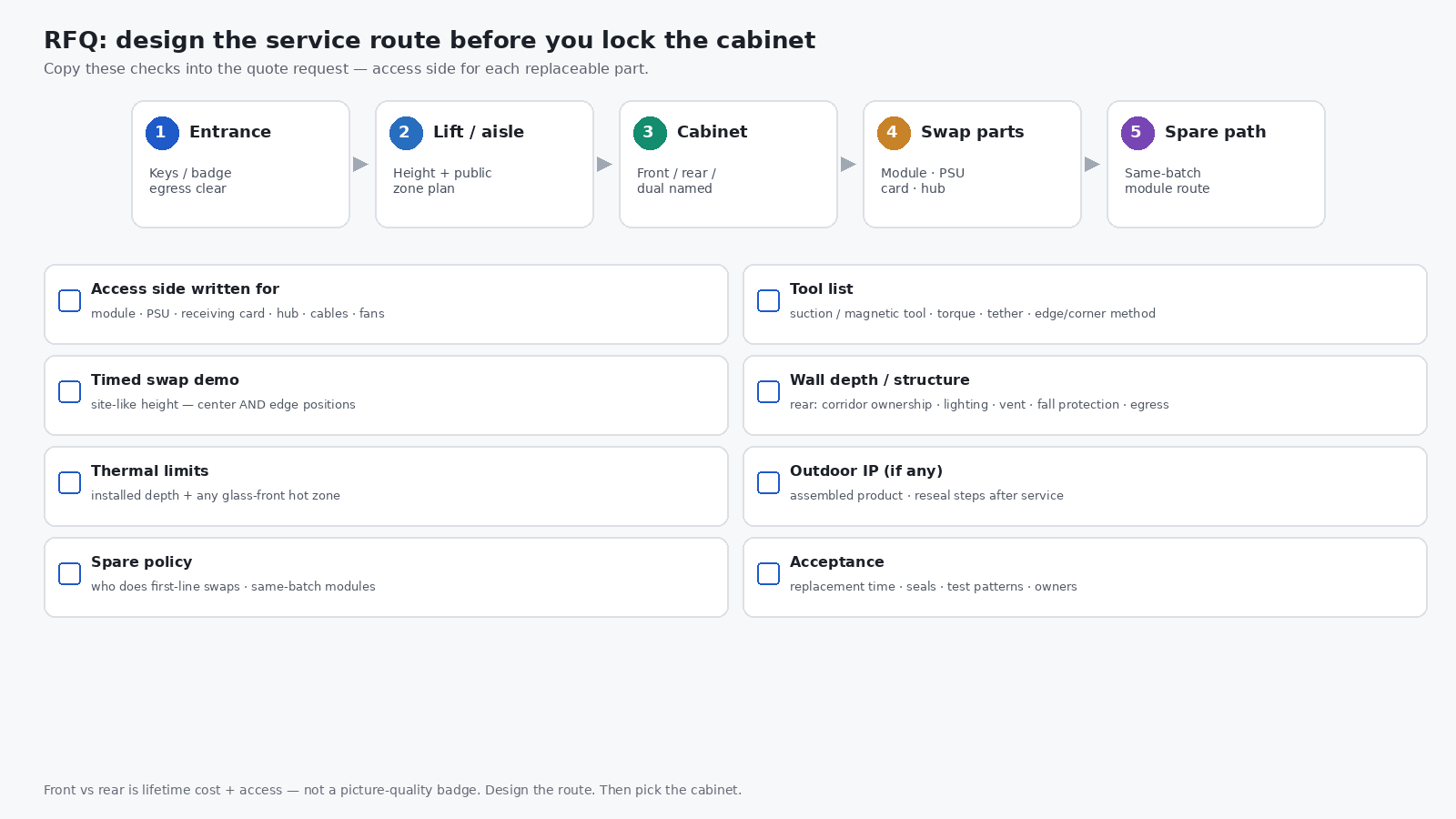
Попросите завод / интегратора всё это письменно:
- Access side for each replaceable part: module, PSU, receiving card, hub, cables, fans.
- Список инструментов (присоска / магнитный инструмент, момент, страховочный трос) и отличается ли метод на краевых/угловых модулях.
- Демо замены по времени на высоте, близкой к объекту — не только видео со стола на заводе.
- Глубина стены, конструкция и (для rear service) владение коридором, свет, вентиляция, защита от падения, эвакуация.
- Тепловые лимиты для установленной глубины и любой горячей зоны у стеклянного фасада.
- For outdoor: IP statement for the assembled product, reseal steps after service, drainage / corrosion notes.
- Политика запасных модулей и кто делает замены первой линии (персонал владельца vs вендор).
- Чеклист приёмки: время замены зафиксировано, уплотнения проверены, тестовые паттерны, ответственные стороны.
Итог
Front vs rear service is an access and lifetime-cost decision, not a picture-quality badge. If rear access cannot be guaranteed for the life of the display, specify front service (or dual) and prove it with a real swap. If a protected rear corridor is already engineered and owned, rear service can be faster and safer-protect that corridor in writing.
Спроектируйте маршрут. Затем выбирайте кабинет.
Делает ли front service LED-стену красивее?
Нет. Направление сервиса описывает, как достают части. Картинку задают шаг, светодиоды, драйв, калибровка, процессинг и плоскость монтажа.
Сколько заднего зазора нужно?
Универсальной безопасной цифры для каждого проекта нет. Зазор зависит от хода двери, размера компонентов, движения тела, инструментов, света, вентиляции, эвакуации и местных норм. Зону должен утвердить инженер проекта и safety lead — не копируйте сантиметры из брошюры в разрешение на строительство.
Всегда ли front service дороже?
Железо кабинета может стоить больше; полная стоимость проекта может быть ниже, если вы избегаете заднего коридора, более глубокой стали и регулярной аренды подъёмников. Сравнивайте установленную и пятилетнюю стоимость сервиса, а не только цену панели.
Можно ли позже переделать rear-only стену в front service?
Обычно не как простой site-mod. Модули, крепёж, hub, отверстия, проводка и уплотнения могут отличаться. Спросите исходного производителя — не считайте, что одни магниты дают полный front service.
Это то же, что soft vs hard connection?
Нет. Soft/hard — как кабинеты запираются и соединяются. Front/rear — с какой стороны стоит техник. На арендном или fixed RFQ нужны оба решения.
Должна ли каждая церковь или переговорная брать front service?
Если экран на стене без постоянного заднего прохода, front service (или доказанный dual) должен быть шортлистом по умолчанию. Шаг от ближайшего места измеряйте отдельно.
—