On 22–23 October 2026, an outdoor LED energy-saving white paper hit the trade press and was quickly recirculated in European AV coverage: a system-wide pitch (light sources, power conversion, control, fanless cooling, cloud monitoring), a claim of more than 50% overall energy savings under the paper’s own test conditions for a named outdoor series, and case language that includes a major UK transport DOOH operator cutting about one-third of site energy plus a third-party product-carbon footprint certificate (vendor white-paper page, 22 Oct 2026; Digital AV Magazine recirculation, 23 Oct 2026 — OEM, series, and operator names de-branded here). A World Out of Home Organization news frame aimed at media owners repeated the operational pain: electricity often accounts for more than 30% of outdoor display operating cost, and “dimming is not saving” if the rest of the chain is ignored (WOO news page). Days later, an ownership-planning article put the buyer question in plain English: before you trust a savings percentage, ask whether the quoted watts are max, typical, or content- and brightness-specific — and compare vendors on the same assumptions (ownership-planning article, 28 Oct 2026). That is the news. The RFQ question underneath it is simpler: what should you ask so two “energy efficient” quotes are actually comparable?
What the dated public signal actually published
Treat these as dated vendor / trade examples under stated conditions, not an SFxDisplay guarantee:
| Item | Public example (late 2026 cluster) | Buyer read |
|---|---|---|
| White paper date | Outdoor LED energy-saving paper 22 Oct 2026; trade recirculation 23 Oct | Fresh industry news, not evergreen brochure fluff |
| Claim band | >50% overall savings under white-paper test conditions for a named outdoor series | Ask for the test protocol — hours, content, brightness, environment |
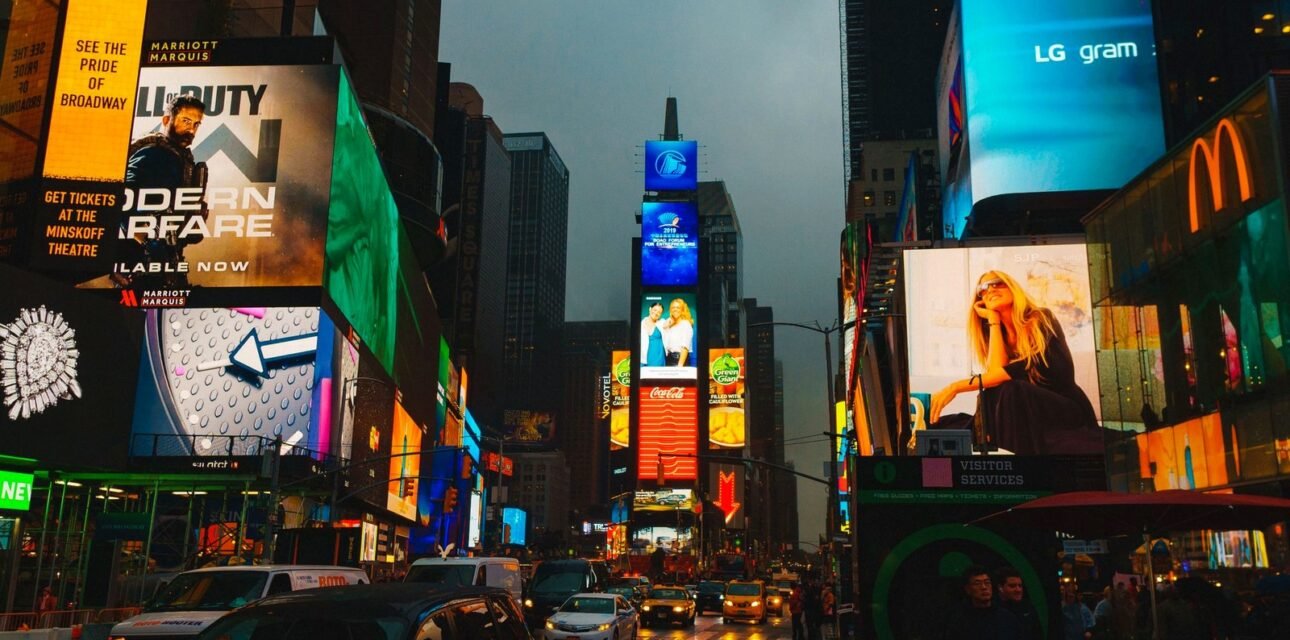
| DOOH opex frame | Electricity often >30% of outdoor display operating cost; “dimming is not saving” | Tenders and owners want evidence beyond a slider |
| Descriptive W/m² test | Traditional ~300 W/m² vs ~112 W/m² in a described 14-hour adaptive-dimming test | Vendor test window — useful as a comparison method, not a universal site bill |
| Operator case | Major UK transport DOOH operator: about ~1/3 site energy cut (vendor-reported) + third-party PCF language | Case study ≠ your facade / stadium / church wall |
| Ownership checklist (28 Oct) | Ask max vs typical vs content-specific W; same-assumption compare; day/night schedules; documented kWh assumptions; no generic % | This is the RFQ hygiene layer |
| Soft vendor trend (25 Aug) | Another outdoor line: low-voltage architecture; claimed up to ~60% / ~135 W/m² rated average (AV Magazine — series name de-branded) | Trend support only — not today’s sole hero |
Forum and CN literacy soft-support the same pain (indoor walls left “on black,” meeting-room bills, standby when not unplugged). Social trade wires on ProAV LED energy were honestly thin in the two weeks around this cluster — we are not inventing a viral spike.
Why two “50% energy saving” quotes can mean different things
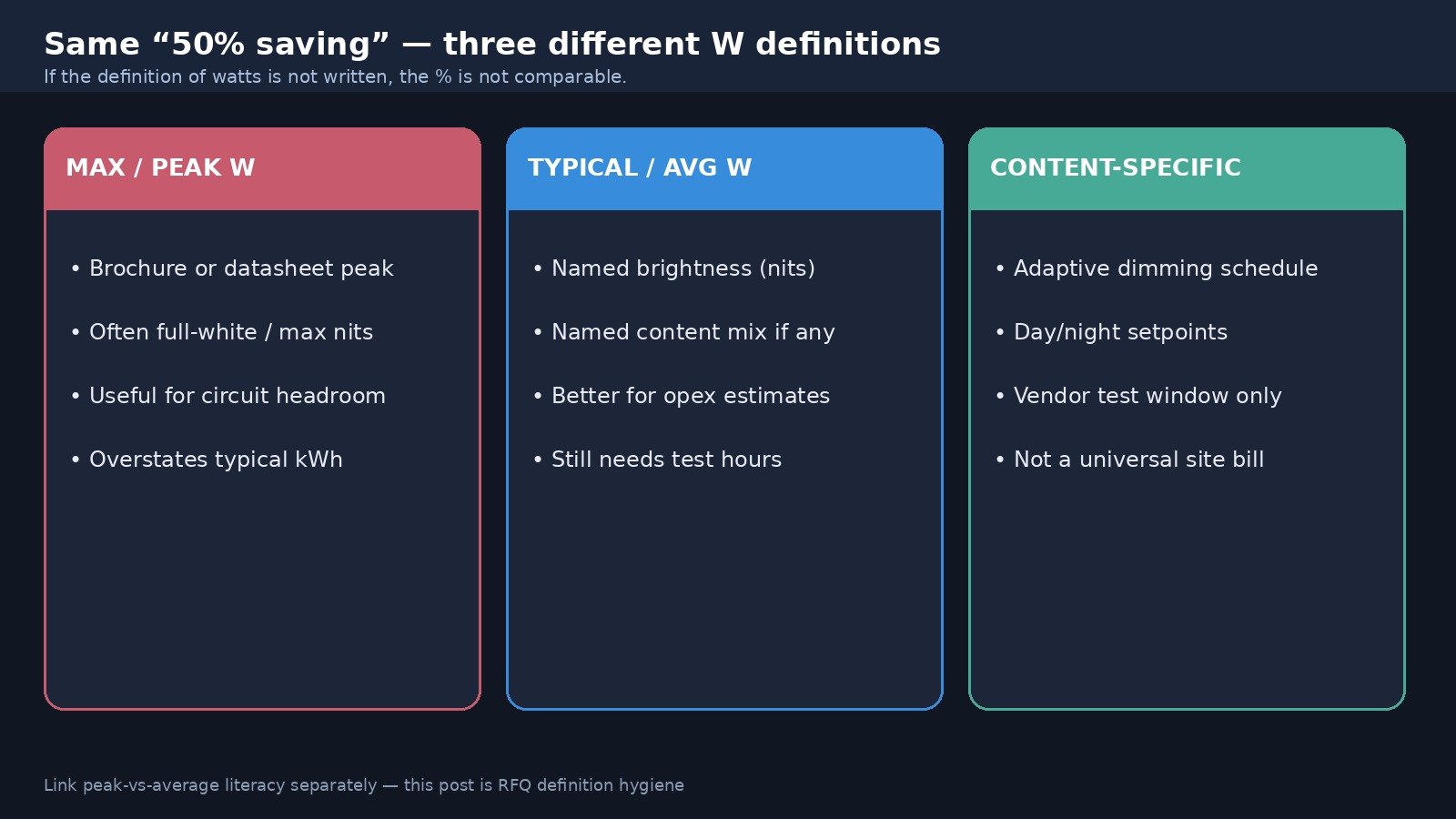
A savings percentage is a ratio. If the denominator (baseline watts) and numerator (new watts) are defined differently, the same “50%” is not the same offer.
- Max / peak watts.
Often full-white or brochure peak at maximum nits. Critical for circuit headroom — which is why we already published peak vs average power as a separate literacy piece. Using peak as your kWh forecast will usually overstate the bill. - Typical / average operating watts.
Better for opex — but only if the quote names the brightness (nits) and whether the number is measured or estimated. “Typical” without nits is marketing fog. - Content- or schedule-specific watts.
Adaptive day/night dimming, APL (average picture level), and a 14-hour test window can produce impressive charts. Those charts are still test conditions. Your DOOH playlist, stadium replay loop, or church Sunday schedule may not match. - What “saving” is measured against.
Against last year’s cabinet? Against a theoretical always-max wall? Against a competitor’s peak number while quoting your own typical? Force both sides onto the same baseline definition before you celebrate the percentage. - Idle, black, and standby.
A wall that draws meaningful power showing black content is not “off.” Day-to-day levers (auto brightness, when black ≠ off, when to cut mains) belong in a separate ops checklist — not this post. Today’s job is to make sure the RFQ claim states idle/standby policy in writing.
Eight RFQ checks before you trust the savings %
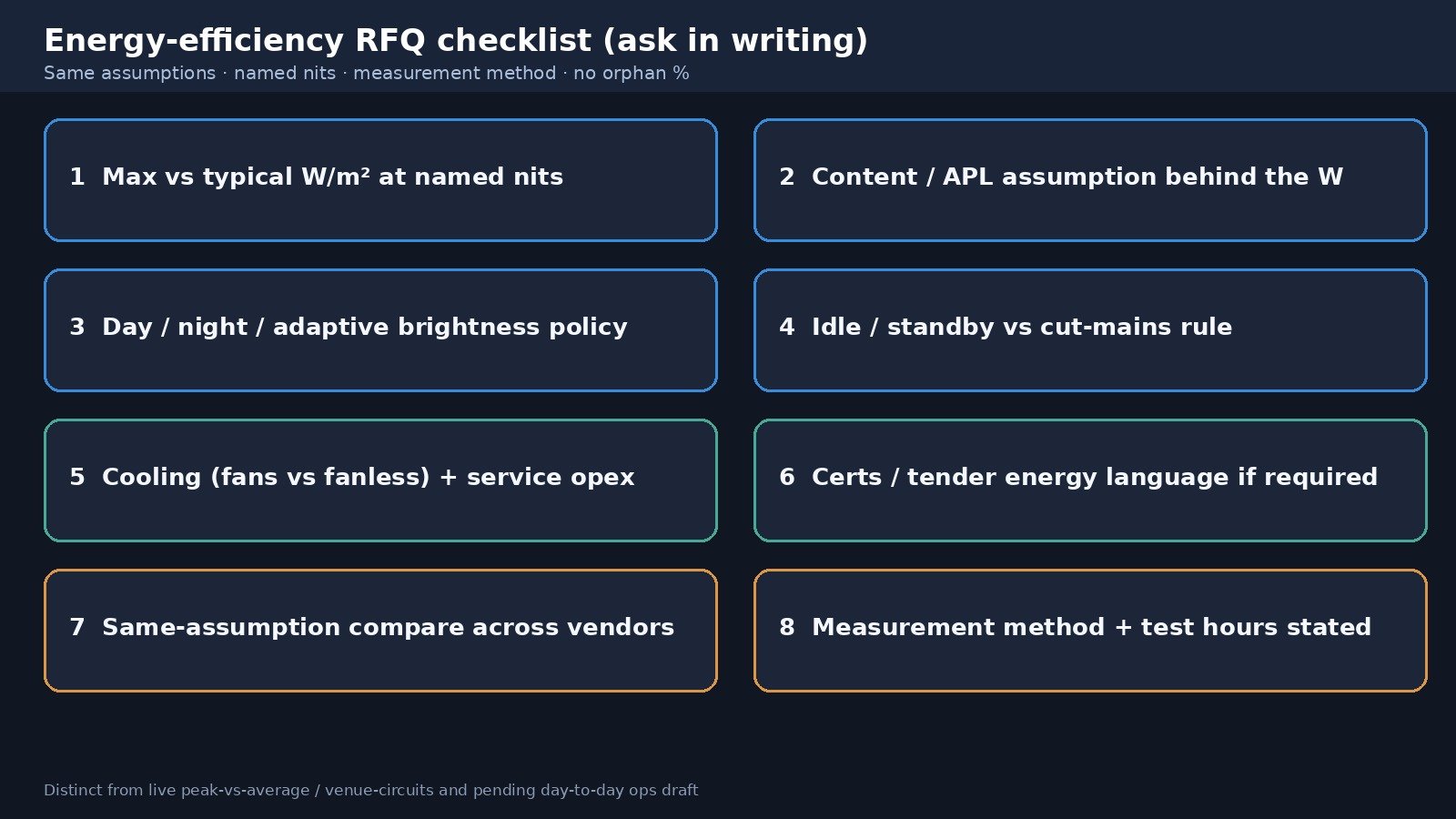
- Max vs typical W/m² at named nits.
Ask for both numbers, and write the target brightness you will actually run (day and night if outdoor). - Content / APL assumption behind the watts.
Full white, 30% APL video, static DOOH creative, or “adaptive schedule”? If they cannot say, the % is not comparable. - Day / night / adaptive brightness policy.
Who sets the schedule — the processor, a light sensor, a cloud rule, or a manual operator? Get it as a written policy, not a demo-day slider. - Idle / standby vs cut-mains rule.
What does the wall draw when content is black? When the controller is on but the wall is “sleeping”? When is hard power-off allowed without harming warm-up / warranty language? - Cooling architecture as opex + service.
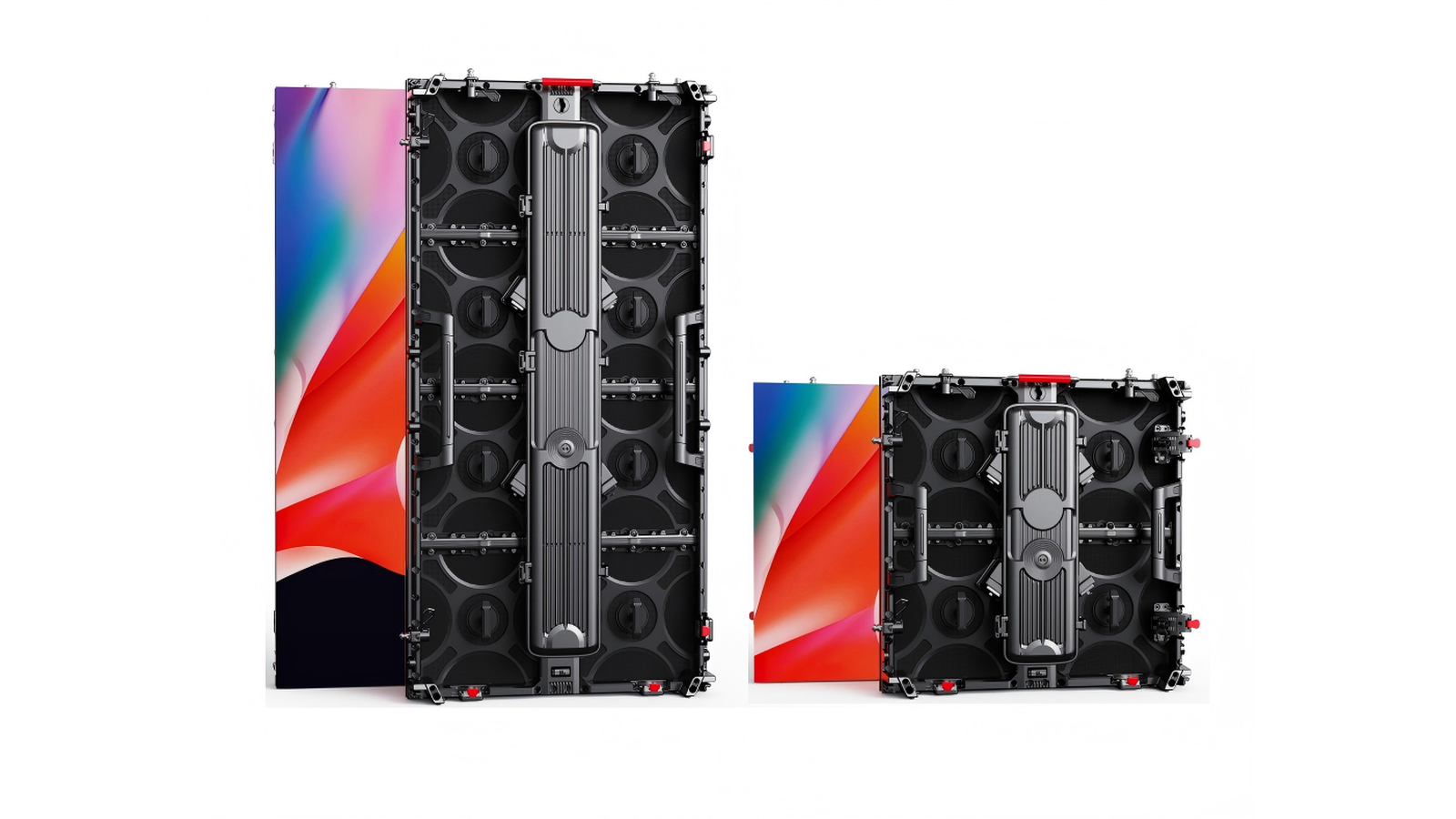
Fans vs fanless (or hybrid) changes electricity and filter/dust/service visits. Outdoor fixed walls feel this for years, not just on opening night. - Certifications / tender energy language (if your project needs them).
Some owners and public tenders ask for carbon-footprint paperwork, efficiency declarations, or named test methods. Ask early whether the bid package includes the evidence your evaluator will file. - Same-assumption compare across vendors.
Rebuild every quote on: size, pitch class, indoor/outdoor, target nits, hours/day, content mix, idle policy. Then compare watts and estimated kWh — not orphan percentages. - Measurement method + test hours stated.
Lab, factory sample, installed site, how many hours, what ambient temperature, what content. A white-paper chart without a method is a poster, not an RFQ answer.
For venue electrical infrastructure (circuits vs outlets, how the hall is wired), stay with our live venue power: circuits vs outlets guide. This post is about claim hygiene on the quote, not how many breakers the building already has.
How to run an energy-aware RFQ without chasing a magic %
- Freeze the operating brief first. Indoor vs outdoor, size, hours/day, day/night nits, content type, whether the wall must stay warm for instant-on, climate extremes.
- Require a one-page power sheet with max W, typical W at your nits, idle/standby W, and the measurement note.
- Estimate annual kWh with your hours, then sensitivity-test ±20% brightness or hours — still with documented assumptions, not a vendor’s marketing %.
- Separate capital from opex questions. Component-cost pressure on the panel price is a separate topic (not published yet). Rent-vs-buy utilization is another (not published yet). Do not mash those into “is this energy claim honest?”
- Outdoor vs indoor still changes the physics. Start with indoor vs outdoor LED wall and nits vs lumens if the brightness target itself is still fuzzy.
Honest boundaries
- This is not a product review of any OEM cabinet, driver brand, AI controller, or named DOOH operator install. Names are left out on purpose.
- Percentages and W/m² figures are dated public vendor/trade examples under stated conditions, not a promise that your city, pitch, playlist, or climate will move by the same amount — and not SFxDisplay guaranteed savings.
- This post is industry-news + RFQ claim hygiene for energy-efficiency language in late 2026. It is not a rewrite of live peak vs average power (how to read datasheet peak vs average), not a rewrite of live venue power circuits vs outlets, not a day-to-day auto-brightness / black≠off / when-to-cut-mains ops checklist, and not a component-cost quote-pressure piece.
- Cheapest “green” line is not automatically honest — undocumented % is how opex surprises show up in month three.
- If the real question is LED vs projector for the event, start with our live LED wall vs projector for events framing instead of forcing an energy-claim fight.
- Project cost still has many non-power lines — see LED video wall cost 2026.
Related reading (already live)
- LED Wall Peak vs Average Power
- LED Wall Venue Power: Circuits vs Outlets
- LED Wall vs Projector for Events in 2026
- Indoor vs Outdoor LED Wall
- LED Nits vs Lumens
- LED Video Wall Cost 2026
FAQ
Is “50% energy saving” a standard number in 2026?
No. Dated late-October trade coverage cites vendor test conditions (including a >50% band for a named outdoor series under that paper’s protocol). Treat it as a prompt to demand the protocol — not as a universal field result.
What is the single most useful RFQ line?
“Give max and typical W/m² at these day/night nits, with content assumption, idle watts, and how you measured — then estimate annual kWh on our hours.”
Does this replace peak-vs-average literacy?
No. Peak vs average explains why datasheet peaks and operating averages diverge for circuit and kWh math. This post asks whether an efficiency marketing claim used a definition you can re-run.
Should we leave the wall on black overnight to “save”?
Black is not always off. Idle/standby policy belongs on the RFQ; day-to-day operating levers are a separate ops topic (not published here).
Will a fanless outdoor design always cut my bill?
Fanless can reduce cooling electricity and some service points, but only inside a whole-system design (brightness policy, power conversion, content). Ask for the measured operating watts at your nits, not the cooling buzzword alone.
Is this the same as component-cost quote pressure?
No. Upstream BOM inflation (chips, driver ICs, PCBs, PSUs) is why some purchase quotes moved in October reporting. Energy-efficiency RFQ hygiene is about opex claim definitions on the power sheet.
Comparing outdoor or fixed LED quotes that all claim big energy savings, and the watts definitions will not line up? Share your size / indoor-outdoor target, day and night nits, daily hours, and whether the wall must stay warm for instant-on — we will help you turn the marketing % into a same-assumption power sheet before you lock a deposit.
WhatsApp +86 150 1911 0341 · molly@sfxdisplay.com · Get a quote
SFxDisplay — LED factory for rental & fixed cabinets. Industry commentary from dated public energy white papers and ownership checklists; not an SFx savings guarantee. Two “50%” claims can mean different watt definitions — lock assumptions before you compare.