Two rental LED quotes can both say “fast install” and still diverge by hours at the dock. The gap is rarely the pixel pitch on page one. It is unmeasured system friction: awkward locks, heavy cabinets, cases unloaded in the wrong order, power not ready when the wall is, signal mapping improvised under pressure, or a venue that blocks the freight path while the LED crew stands ready.
Our live outdoor festival checklist owns weather, nits, IP, wind, and crew tech habits. Our live rental spare parts post owns what to stock. This post owns only one thing: what actually moves the load-in clock so “fast install” becomes a countable RFQ conversation before the truck rolls.
Quick definitions (clear the name collision)
| Term | What it means | What it is not |
|---|---|---|
| Setup / load-in time | Wall time from first case on the dock to a stable, mapped, content-ready wall | Not “cabinets locked” alone – commissioning counts |
| Build time | Physical assemble + lock + rough cable | Not the full show-ready clock |
| Commissioning | Power-up, map, test patterns, brightness/color sanity, content raster check | Not optional “if we have time” |
| Strike / pack-down | Reverse build + cable coil + case map | Not free time after doors |
| Tool-free / quick-lock | Cabinet-to-cabinet latch designed for hand operation without screws | Not automatic proof of a fast system if cases and power are chaotic |
| Case pack logic | How cabinets and accessories are ordered in flight cases so unload matches build | Not “everything fits in the truck” |
| Check-as-you-build | Verify power, data, and locks row by row / section by section instead of waiting for the full wall | Not slowing down – it usually prevents late rebuilds |
| Mounting method | Ground stack, flown/hanging, curved, or scenic integration | Not the same labor clock for the same product |
Industry language is blunt: more hands do not fix a messy system.
Why this question stays hot for buyers
2026 rental trend writing keeps repeating the same shift: clients still ask about pitch and brightness, but rental companies themselves are buying for setup efficiency, camera performance, transport cost, and power. Labor is expensive; schedules are compressed; saving a few hours on a large production is real money in Europe and North America especially.
Dedicated setup-time explainers frame the clock as a wider system – panel design, mounting method, transport flow, power and signal planning, rigging readiness, access constraints, and preproduction quality – not “crew was too small.” Assembly guides emphasize that the difference between a short build and a long one is often decided before the first cabinet leaves its flight case. Touring posts make the same operational point in different words: know the system, check as you build, correct small faults before they become show faults.
Buyers comparing two “lightweight quick-lock” quotes still need a checklist that turns brochure speed into assumed hours, assumed crew, assumed venue, assumed prep.
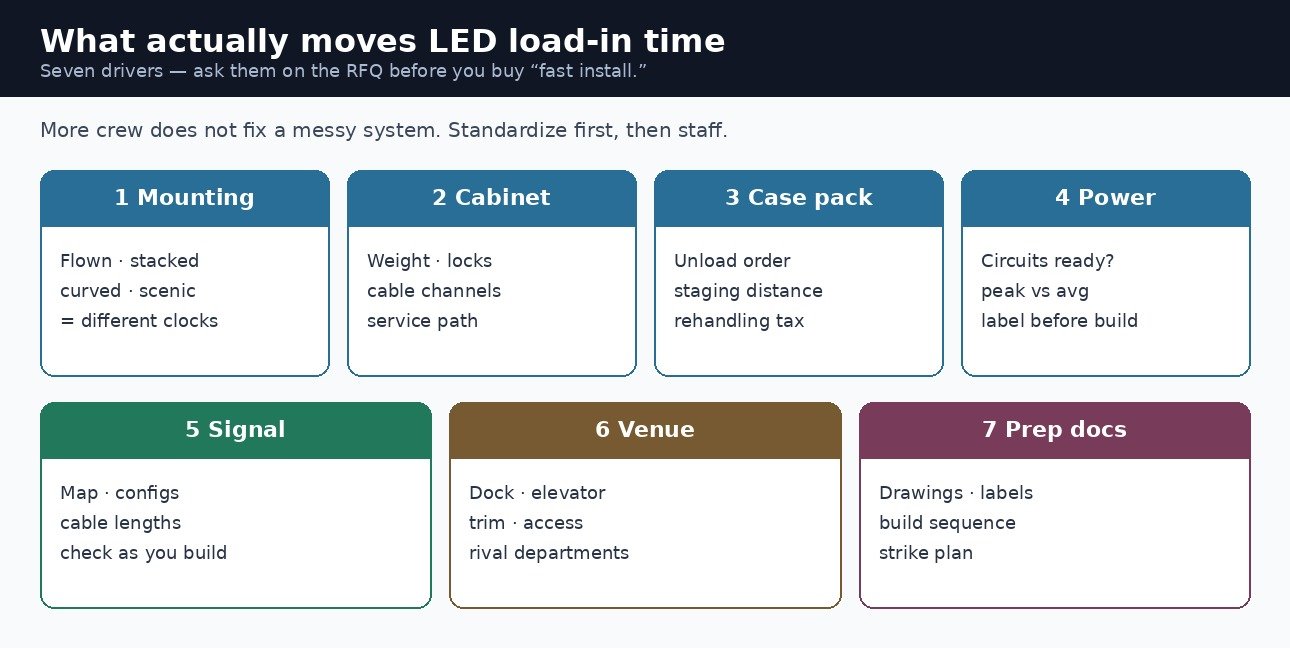
The seven drivers that actually move the clock
1) Mounting method sets the baseline
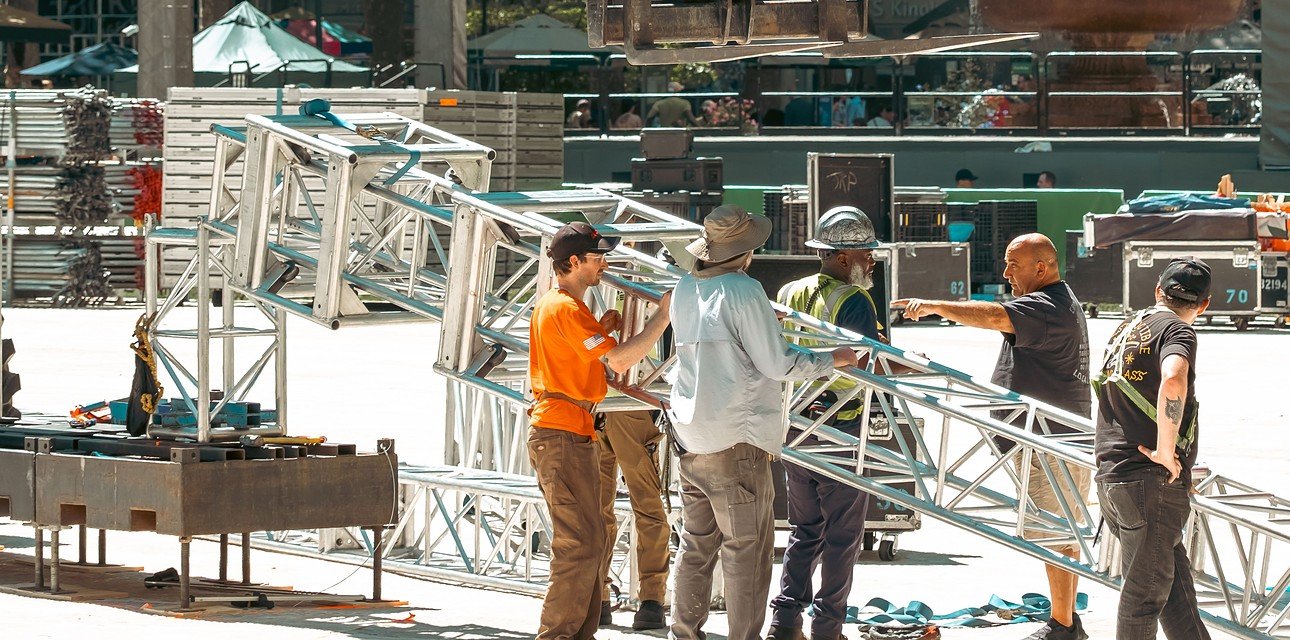
A ground-supported wall, a flown wall, a curved wall, and a scenic integration do not share one clock, even on the same product family. Flown work waits on motors, truss, and certified rigging readiness. Stacked work waits on floor flatness, bracing, and depth behind the screen. Curve and creative formats add alignment and angle checks. If the RFQ never names the mount method, “fast install” is an empty adjective.
2) Cabinet mechanics: weight, locks, cable path, service access
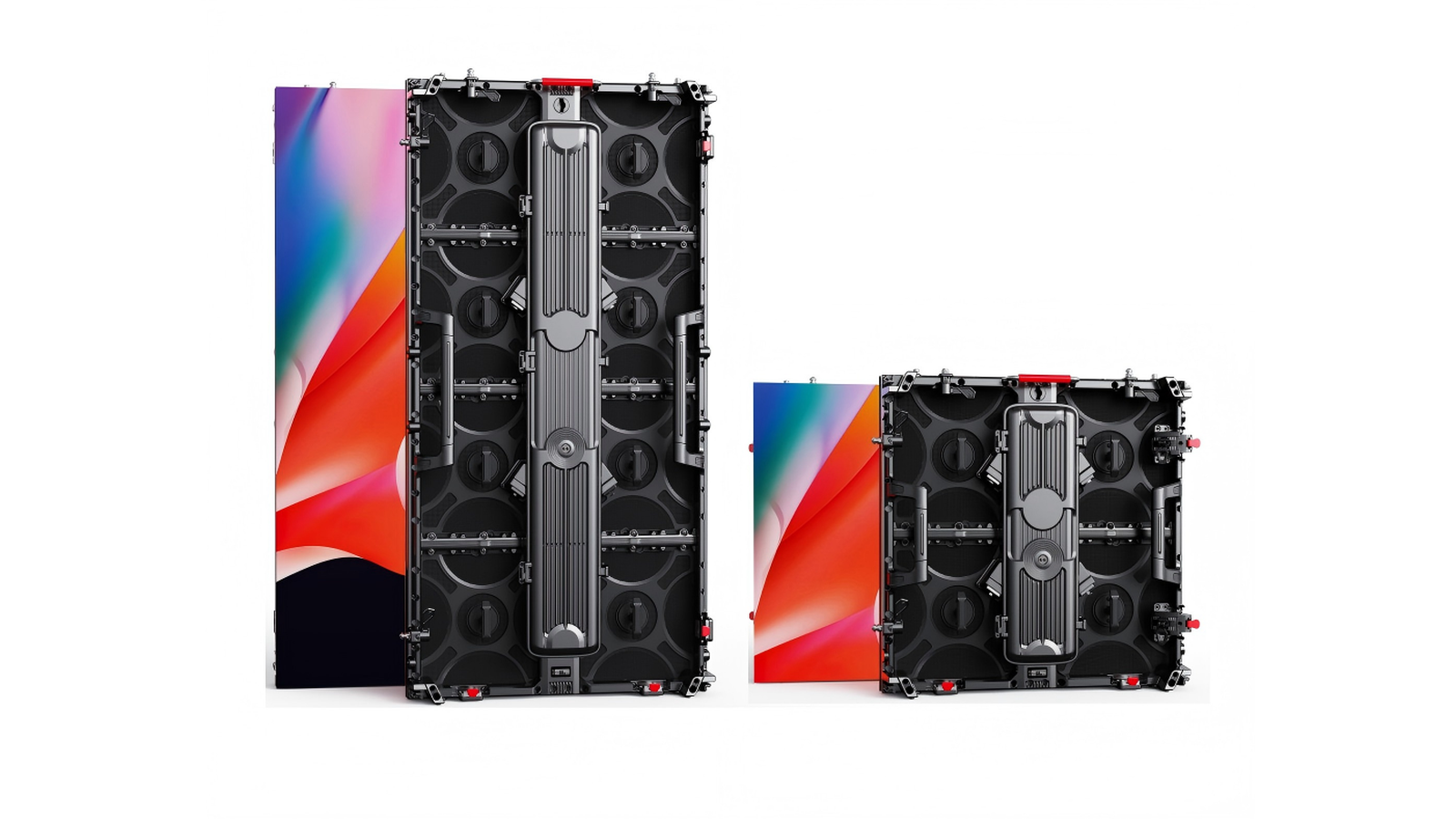
Lightweight cabinets and tool-free locks matter because crews handle hundreds of connections on a touring week. Industry assembly guides commonly describe modern rental cabinets with hand-operated quick locks and internal cable channels that reduce rear spaghetti. What matters for the buyer is not a single manufacturer’s “0.5-second lock” marketing line – it is whether your quoted cabinet:
- has a stated weight band the crew can plan around
- uses locks that seat fully (partially rotated levers are a classic late-fault)
- routes power/data so commissioning is not a cable hunt
- allows fault isolation without tearing down finished rows
Heavy steel-era touring stock and screw-only joins still exist in some fleets. Compare mechanics honestly; do not compare pitch alone.
3) Case pack and unload order (the hidden tax)
If cases arrive in the wrong order, if wall sections stage too far from the build area, or if processing gear arrives after the structure is up, the crew pays in waiting and rehandling. Standardization wins: repeatable cabinet sizes, known case maps, labeled cable lengths, consistent processor workflows. A “fast” cabinet in a random pack order still loses the afternoon.
4) Power readiness
A wall that is locked but waiting on circuits is not done. Peak and average draw, circuit count, distro ownership, and whether house power or show power is the path all belong on the first planning page. Our live peak vs average power post owns the electrical sizing math. Here we only insist: power plan before full build, or commissioning becomes idle time.
5) Signal and mapping prep
Improvised mapping under pressure is a common way to “lose” the last hour even when physical build looked fine. Preload processor configurations where the workflow allows, define the content raster early, label data paths, and keep known-good spare jumpers. Progressive section checks beat a single end-of-build surprise. Dual power / dual data design is a sister topic on our live redundancy post – here the ask is simply: is the signal plan ready before the dock opens?
6) Venue reality beats brochure speed
Tight docks, narrow freight elevators, blocked backstage circulation, unfinished trim height, or a rival department still owning the hang points can stall an efficient product. Temporary-event guidance treats site conditions as part of installation risk and speed. Write venue assumptions on the quote: dock window, elevator size, trim ready-by, who owns house power and house rigging.
7) Preproduction documents
Build drawings, patch plans, case-pack sheets, cable labels, signal-flow diagrams, and venue-specific rigging notes reduce field decisions. The more the team decides before arrival, the less the load-in becomes a debate club.
Traps that look like “fast install”
| Trap | What goes wrong | What to ask |
|---|---|---|
| Brochure speed only | “Quick-lock” with no weight, pack, or mount assumptions | Name mount method + kg band + lock type + case logic |
| More crew = faster | Congestion, duplicated work, no sequence | Sequence + case order first; then staff the sequence |
| Build ≠ ready | Cabinets up, wall dark or unmapped | Include commissioning in the time ask |
| Locks half-seated | Vibration unlock / seam open mid-show | Visual + pull check that levers are fully home |
| Signal after structure | Repatch under pressure | Config + map + labeled cables before truck |
| Power later | Idle wall waiting on circuits | Peak/avg + circuit owner on page one |
| Venue ignored | Product ready, dock not | Dock / elevator / trim / rig ready-by assumptions |
| Comparing unequal bids | Cheap panel wins; labor overrun billed later | Normalize the seven drivers before comparing totals |
| Guaranteed hours from a PDF | Third-party “2-3 hours for 6×4 m” treated as your PO promise | Treat published ranges as heuristics; write your crew model |
Honesty on numbers: some 2026 assembly guides publish example crews and hour bands for specific cabinet sizes (for example, a few-person crew completing a mid-size 500×500 wall in a couple of hours under good conditions). Those are illustrative industry heuristics, not an SFxDisplay guarantee for every venue. Your clock depends on mount method, venue, prep, and fault rate.
How this post divides labor with sister articles
| Sister topic | What it owns | What this post owns |
|---|---|---|
| Outdoor festival checklist | Weather, nits, IP, wind, generator habits | Speed drivers that still apply indoors |
| Spare parts / hot-swap | What to stock and when hot-swap matters | How fast you can reach and swap without rebuild |
| Front vs rear service | Access route to the part | Whether service forces teardown of finished rows |
| 4K weight / hanging | Structure, hang math, crew handling fatigue | Weight as one input to setup speed |
| Power & signal redundancy | Failover design | Prep and topology so commissioning is not chaos |
| Peak vs average power | Electrical sizing numbers | Power readiness on the load-in clock |
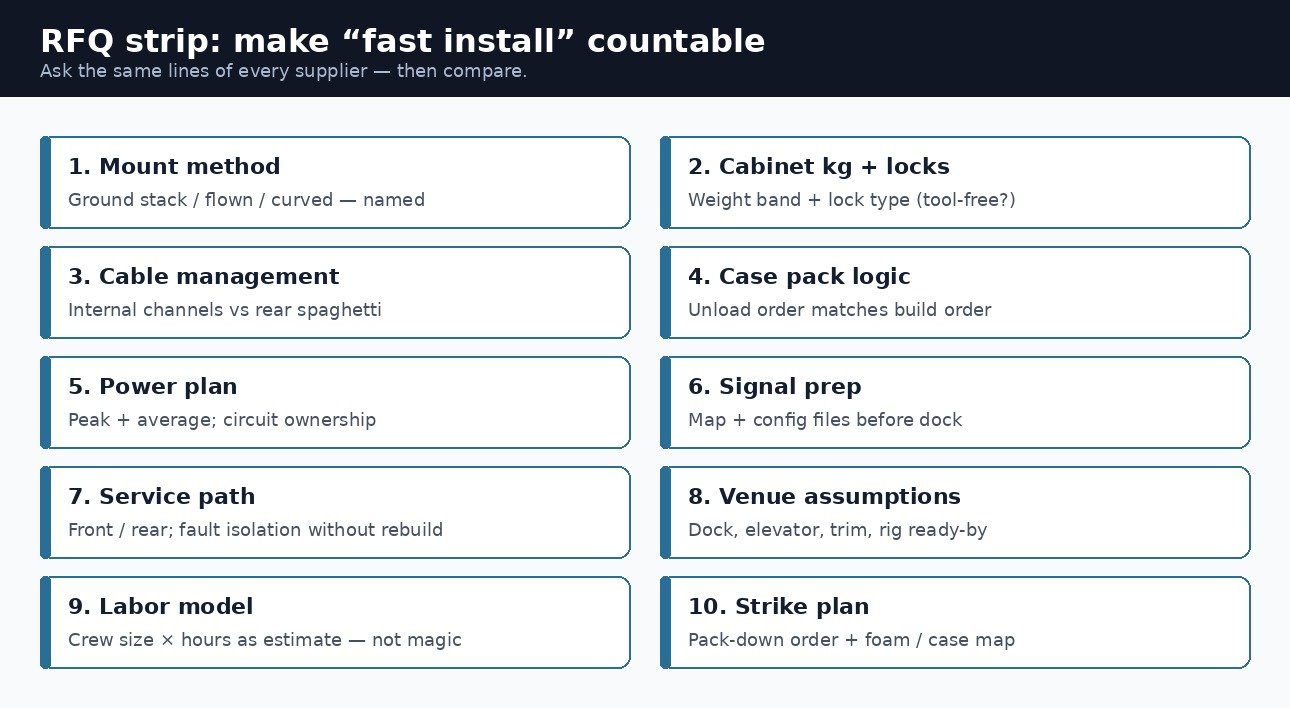
RFQ checklist (copy onto the PO)
Ask every supplier the same lines so “fast install” is comparable:
- Mount method – ground stack, flown, curved, or scenic – named on page one.
- Cabinet weight band – kg per cabinet (and per m² if quoted that way).
- Lock type – tool-free quick-lock or screw; how many locks per side; how crew verifies full seat.
- Cable management – internal channels / blind-mate plates vs rear jumpers only.
- Case pack logic – does unload order match build order? Who owns the case map?
- Power plan – peak and average assumptions; circuit count; who owns distro.
- Signal prep – mapping files, processor config ownership, spare known-good data jumpers.
- Service path – front / rear; can a dead module be swapped without reopening finished rows?
- Venue assumptions – dock window, elevator, trim height, rig ready-by, house vs show power.
- Labor model – proposed crew size × hours as an estimate, including commissioning – not a magic slogan.
- Strike plan – pack-down order, foam protection, cable coil standard.
- Check-as-you-build – will sections be powered/tested progressively?
- Do not compare panel price alone until the seven drivers and venue assumptions match.
- Do not treat a third-party “X hours” PDF line as your contractual guarantee without writing venue and prep assumptions.
Related reading (live SFxDisplay)
| Post | What it owns vs this article |
|---|---|
| Outdoor festival checklist | Weather, nits, IP, wind, generator, crew tech |
| LED rental spare parts / hot-swap | Inventory math + hot-swap verify |
| Front vs rear service | How you reach the part |
| Power & signal redundancy | Failover paths |
| Peak vs average power | Electrical sizing |
| LED video wall cost 2026 | Panel vs turnkey CapEx framing |
| How to choose | Broad selection framing |
| Rental series | Product starting point after the clock assumptions are clear |
| Contact | Quote with mount method + venue + prep asks |
SFxDisplay honest boundary
We build and quote rental and fixed LED systems for buyers who need clear load-in language, not a sticker that says “fast.” We will help you list mount method, cabinet weight and locks, case-pack expectations, power and signal prep, venue assumptions, and a crew-hour estimate that includes commissioning when you ask. We will not invent a public guarantee in this post that every SFxDisplay wall finishes in a fixed number of hours. We will not pretend more crew always shortens a chaotic sequence. We will not push named competitor panel brands. If your show is flown overnight, dock-limited, curved, or camera-critical, say so early – that changes the system design more than it changes the brochure tagline.
Browse rental series and how to choose an LED display, then paste the checklist onto the PO. Or contact SFxDisplay – WhatsApp +86 150 1911 0341 · molly@sfxdisplay.com.
Bottom line
“Fast install” only means something when the system is named. Mount method, cabinet mechanics, case-pack order, power readiness, signal prep, venue access, and check-as-you-build move the clock more than headcount alone. Treat third-party hour bands as heuristics. Normalize the RFQ lines before you compare totals. Keep weather on the festival checklist; keep spare math on the spare-parts post; keep load-in honesty here – so the wall you buy is the wall your crew can actually put up on time.