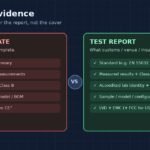
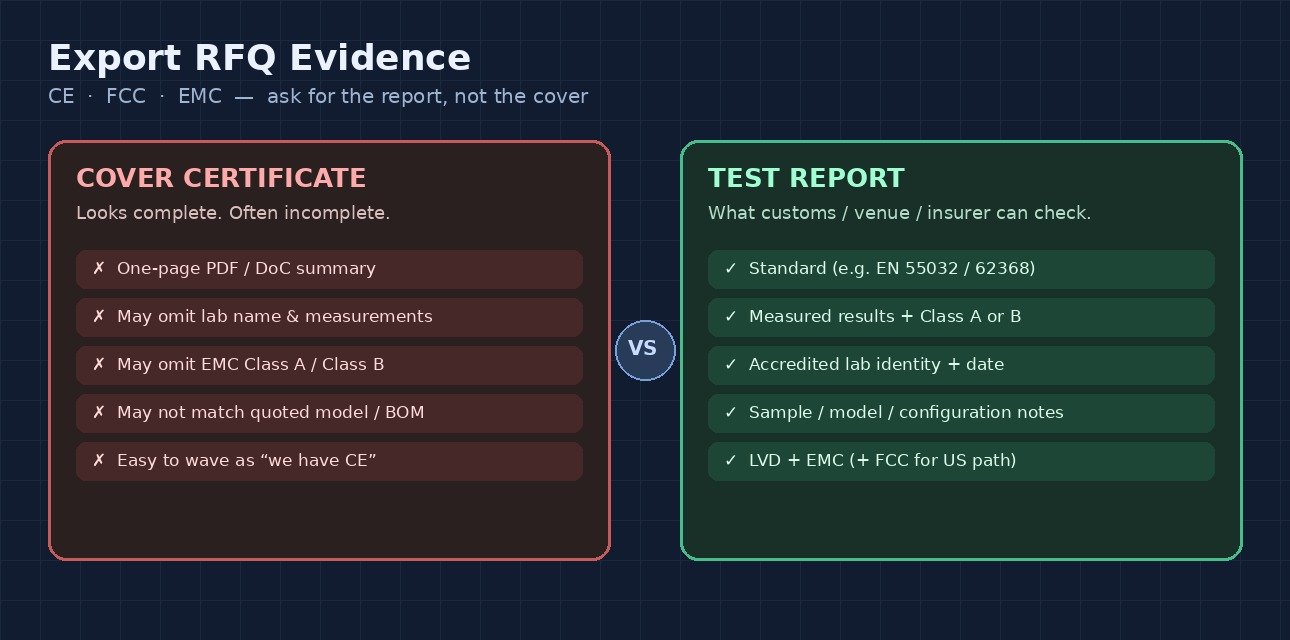
Two China-origin LED wall quotes can both say “CE / FCC ready” and still diverge at the worst moment – customs hold, venue EMC ask, or insurer document review. The gap is rarely the pixel pitch. It is evidence quality: a one-page certificate versus a model-matched test report that names the lab, the standard, the Class A or Class B result, and the exact configuration you are buying.
Our live IP54 vs IP65 post owns weather ingress. This post owns only one thing: how to ask for market-access evidence so “CE / FCC” is measurable before the deposit clears.
Quick definitions (clear the name collision)
| Term | What it means | What it is not |
|---|---|---|
| CE mark (honest) | Manufacturer’s EU conformity claim covering the applicable directives for that product | Not proof by itself that a third-party lab tested your model |
| LVD | Low Voltage Directive path – electrical safety evidence (commonly EN IEC 62368-1 class language for AV/ICT) | Not the same as EMC emissions Class |
| EMC | Electromagnetic compatibility – the screen should not create avoidable interference, and should tolerate normal interference | Not “we have CE” without an EMC report |
| EMC Class A | Industrial / dedicated environments – looser emission limits | Not automatically OK for offices, retail, hospitals, or broadcast rooms |
| EMC Class B | Residential / commercial mixed-use – stricter emission limits | Not free; often the report buyers actually need for lobbies and conference rooms |
| FCC (US) | US electromagnetic emissions path (commonly Part 15 for unintentional radiators; SDoC for many non-wireless LED walls) | Not included inside a CE file |
| Test report | Lab document with standard, measured results, Class, sample description, lab identity | Not a one-page “Certificate of Compliance” cover |
| Certificate / DoC cover | Summary declaration | Not a substitute for the report when a venue or customs officer asks hard questions |
| RoHS | Hazardous-substance restrictions for applicable markets / client specs | Not a replacement for CE or FCC |
| UL / ETL (typical LED practice) | Often power-supply / cord / component recognition | Not automatically a full-display UL listing |
| IP54 / IP65 | Dust/water ingress rating | Not a market-access certification and not an EMC Class |
Industry language is blunt: a countable evidence package beats a cheaper “we have all certs” email.
Why this question stays hot for buyers
2026 export and rental buyer guides keep repeating the same correction: the RFQ line that says “CE, FCC, RoHS” is meaningless until someone checks which reports, which Class, and which model revision. OEM education posts now teach buyers to ask for the EMC test report – EN 55032 language, Class A or Class B, accredited lab name – because two factories can both show a CE PDF and only one spent money on a real test. CN 2026 lab explainers make the same point in different words: CE is a directive package (EMC + LVD + RoHS where applicable), FCC is a separate US path, and IP65 is a protection test, not a CE/FCC substitute.
Start with destination market and site type
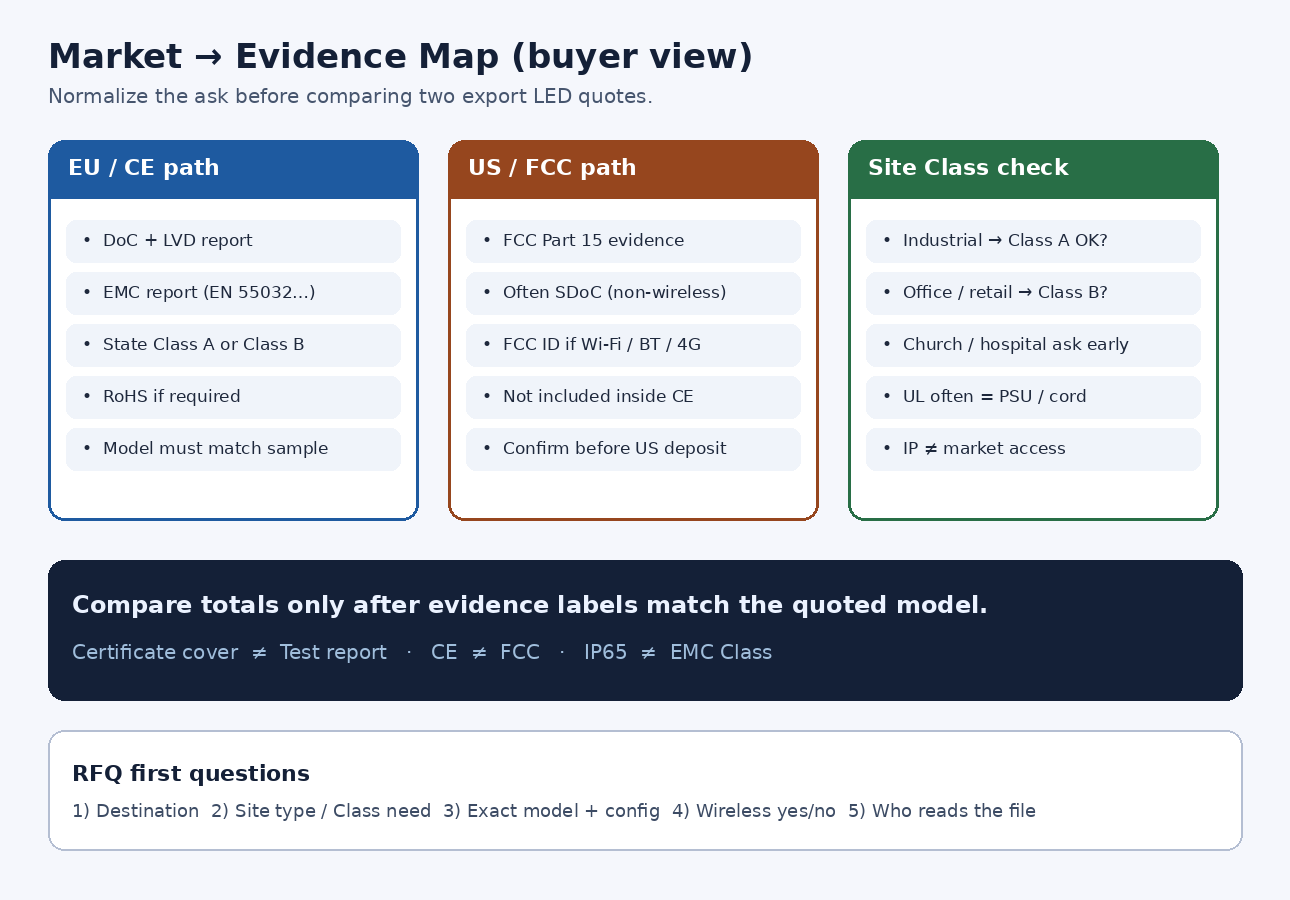
Before you accept “certs included,” the first page of a serious export RFQ should state:
- Destination country / customs path – EU, US, or another regime
- Site type – industrial warehouse vs office / retail / church / hospital / broadcast
- Whether EMC Class B is a hard ask (sensitive rooms) or Class A is acceptable
- Exact product family, pitch, cabinet, power architecture, and control configuration being quoted
- Wireless modules or not (Wi-Fi / BT / 4G can change the US path toward FCC ID territory)
- Who needs the file – customs, venue technical rider, insurer, end-client procurement
- Whether UL means power-component recognition or a claimed full-display listing
- Whether RoHS is a hard EU/client requirement or copy-paste from an old spec
Without those assumptions, a “CE / FCC ready” line is only a provisional marketing claim.
Label every evidence line – the comparison table that matters
Ask every supplier to tag each document with one of these labels. Then compare packages only after the labels match.
| Evidence block | What must be named | Common trap if unlabeled |
|---|---|---|
| CE / DoC | Directives covered; linked LVD + EMC reports; model/family in scope | “We have CE” with no report |
| LVD / safety report | Standard (e.g. EN IEC 62368-1 class language), lab, sample description | Safety assumed because EMC exists |
| EMC report | EN 55032 / EN 55035 (or stated equivalents), Class A or Class B, lab, date | Class A sold into a Class B site |
| FCC evidence | Part 15 path; SDoC vs ID if wireless; model match | Assume CE covers the US |
| RoHS pack | Component scope; whether whole screen or selected parts | RoHS used as a substitute for CE |
| UL / ETL notes | Power supply / cord recognition vs full-display listing | “UL” without saying what is listed |
| IP report (if outdoor) | IEC 60529 class for the enclosure you buy | IP65 treated as CE/FCC |
| Configuration control | Revision, BOM notes, which cabinets/PSUs/controllers were in the sample | Family brochure used for a different build |
| Commercial | Who pays for retest if configuration changes; lead time for missing reports | Deposit paid before the file exists |
Critical honesty: we do not publish an SFxDisplay “every SKU holds every market mark” sheet in this post. Use this table to normalize the ask, then request the model-specific package for your destination.
Traps that look like “certified”
| Trap | What goes wrong | What to ask |
|---|---|---|
| Cover-page only | Nice PDF, no measurements, no Class, no lab trail | Full EMC + LVD reports for the quoted model |
| Wrong Class | Class A industrial report used for office / retail / church lobby | Explicit Class B if the site needs it |
| CE sold as FCC | US shipment held or delayed | Separate FCC Part 15 evidence |
| Family ≠ configuration | Report for a different pitch / PSU / controller layout | Model + configuration + revision match |
| UL confusion | Buyer wanted full-display listing; seller meant power-supply recognition | “Component UL or full-display listing?” |
| IP as market access | Outdoor rain rating waved as EU/US compliance | Keep IP on the IP54 vs IP65 path; keep CE/FCC here |
| Wireless surprise | Wi-Fi / BT module added late; FCC ID path ignored | Declare wireless modules before deposit |
| Copy-paste RoHS | Spec asks RoHS though the site never needed it – cost and lead time inflate | Confirm hard requirement vs optional |
| Comparing unequal bids | Cheap quote wins, then “cert add-on” appears | Normalize evidence labels before comparing totals |
Sisters – keep them short
| Sister line | Why it sits next to this compliance post | Honest RFQ ask |
|---|---|---|
| IP54 vs IP65 | Weather ingress for outdoor cabinets | Named IP on the enclosure you buy – IP54 vs IP65 |
| Outdoor festival checklist | Weather, nits, wind, generator, crew tech | Night nits + rain/wind ownership – festival checklist |
| Power & signal redundancy | Failover design once the wall is accepted | Dual power / dual data ownership – redundancy |
| How to choose | Broad selection framing after market path is clear | Destination market before pitch debate – how to choose |
Receiving-card / per-port pixel load (Gigabit Ethernet ~650k-class @ 8-bit/60Hz, derates at higher bit depth, headroom) is a valid technical sister for controller sizing – we are not expanding that into a named-controller catalog here.
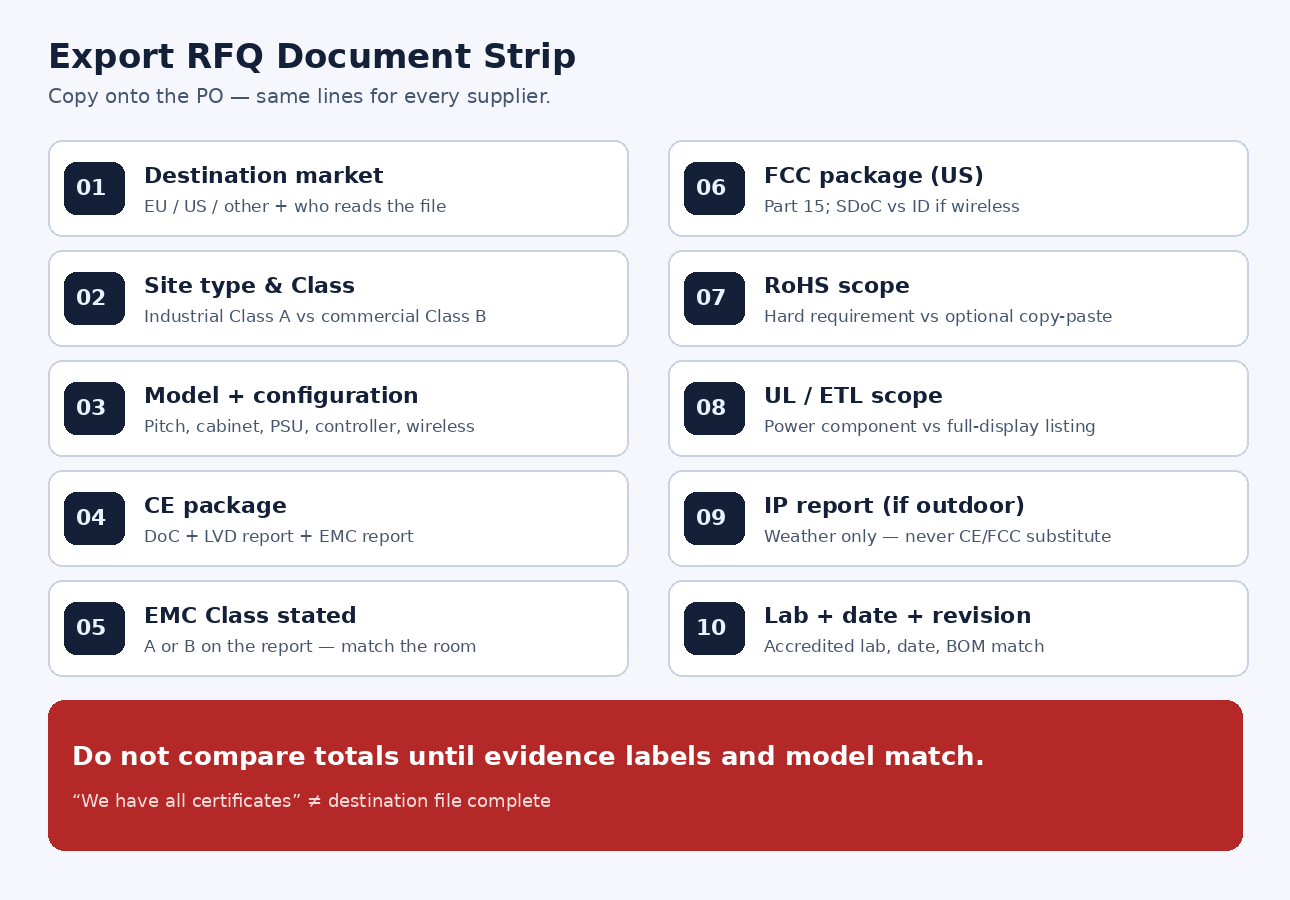
RFQ checklist (copy onto the PO)
Ask every supplier the same lines so export packages are comparable:
- Destination market – EU, US, or other; customs vs venue vs insurer as the reader of the file.
- Site type – industrial vs commercial/residential-adjacent; Class A vs Class B need.
- Exact model & configuration – pitch, cabinet, PSU brand/class, controller ecosystem, wireless yes/no.
- CE package – DoC + LVD test report + EMC test report (not cover only).
- EMC Class – A or B stated on the report; match the room.
- FCC package – Part 15 evidence for US; confirm SDoC vs ID if wireless.
- RoHS – hard requirement or optional; component scope.
- UL / ETL – power-component recognition vs full-display listing.
- IP report – only if outdoor/weather applies; never as a CE/FCC substitute.
- Lab identity & date – accredited lab name, standard numbers, report date.
- Revision control – reports match the shipped BOM / revision.
- Lead time & cost ownership – who pays if a missing Class B or FCC file must be created.
- Do not compare totals until evidence labels and model match.
- Do not treat “we have all certificates” as a synonym for “your destination file is complete.”
Related reading (live SFxDisplay)
| Post | What it owns vs this article |
|---|---|
| IP54 vs IP65 | Weather ingress – not EMC Class or market-access reports |
| Outdoor festival checklist | Weather, nits, IP, wind, power, crew tech |
| LED video wall cost 2026 | Panel vs turnkey CapEx framing |
| Power & signal redundancy | Failover paths |
| Peak vs average power | Electrical sizing numbers |
| How to choose | Broad selection framing |
| Rental series | Product starting point after market path is clear |
| Contact | Quote with destination market + evidence ask |
SFxDisplay honest boundary
We build and quote rental and fixed LED systems for buyers who need clear compliance language, not a folder of unexplained cover pages. We will help you list destination market, site type, Class A/B need, model/configuration, and which reports must appear before deposit when you ask. We will not invent a public claim in this post that every SFxDisplay SKU already holds every market mark. We will not treat IP65 as CE or FCC. We will not pretend Class A equals Class B. We will not push named competitor panel brands. If your project is US-bound, EU commercial indoor, hospital-adjacent, or insurer-reviewed, say so early – that changes the evidence package more than it changes the pitch number on the brochure.
Browse rental series and how to choose an LED display, then paste the checklist onto the PO. Or contact SFxDisplay.
Bottom line
“CE / FCC ready” only means something when the reports match the model and the market. Cover certificates are not enough for hard customs, venue, or insurer questions. Start with destination and site type. Ask for LVD + EMC reports with an explicit Class A or Class B result. Keep FCC as a separate US ask. Keep UL scope honest (often power components). Keep IP on the weather path. Compare bids only after the evidence labels match. Keep weather ratings on IP54 vs IP65; keep market-access honesty here – so the wall you buy is the wall that can actually clear the file review.