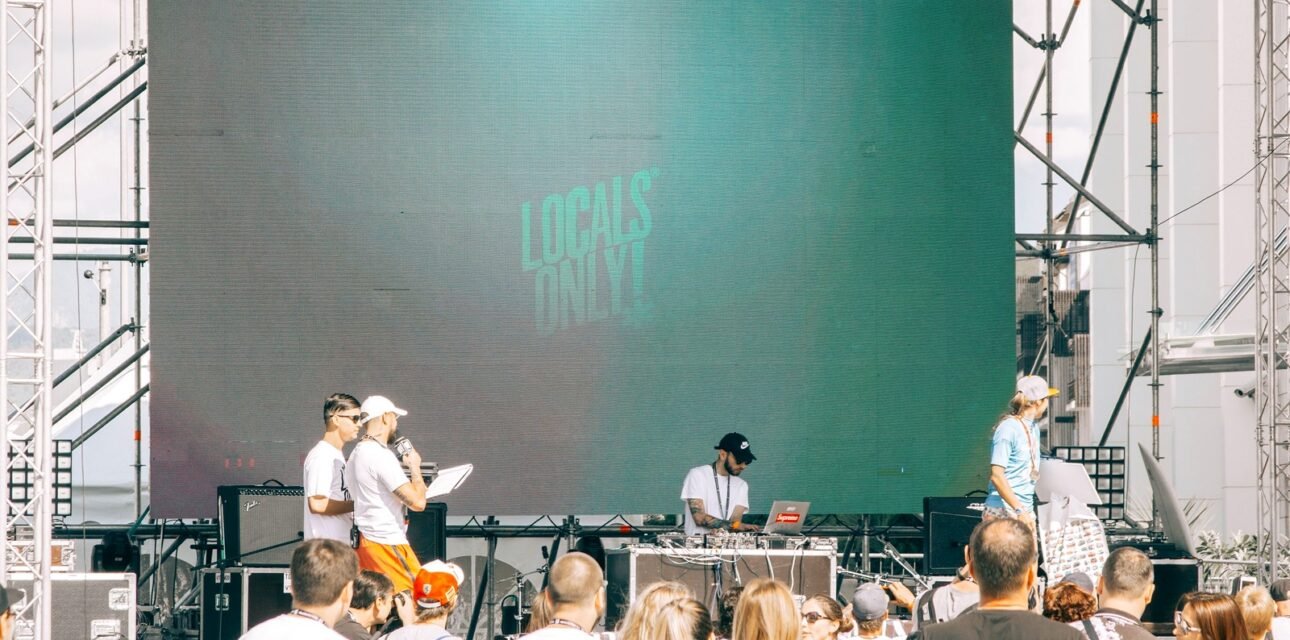
This week’s outdoor rental conversation is not only about another festival main stage. A 2 November 2026 outdoor rental P3 vendor page framed the product against two demand stories buyers already recognize: experiential events and public watch parties — fan zones, city activations, and sports screenings where the wall is part of the attraction, not a side monitor. A 1 November market brief circulating the same week put events and sporting matches at about 21% of the global LED screen rental market (about $126.7 million this year in that brief’s framing, with a long-range projection toward roughly $233 million by 2035), while noting that tournament seasonality can cut fleet operating efficiency by about 14% — which is why rental houses chase exhibition and modular / lighter inventory in the off-peak. We are deliberately not naming the OEM, the finance shops, or the local hire brands here. The RFQ question underneath the heat is simpler: what should an “outdoor P3 for a watch party / fan zone” quote include so two “bright enough” emails are actually comparable?
What the dated public signal actually published
Treat these as dated trade / market / literacy examples under stated conditions, not an SFxDisplay price list and not a substitute for your project datasheet, structural review, or site survey:
| Item | Public example (1–2 Nov 2026 cluster + outdoor literacy) | Buyer read |
|---|---|---|
| Outdoor P3 story angle | Vendor framing of outdoor rental P3 against experiential events + public watch parties (festivals, fan zones, city activations) | Ask for job type + farthest viewer + ambient light, not “P3 outdoor” alone |
| Sports / events share | Third-party brief: events + sporting matches ≈ 21% of global LED rental; seasonality ≈ −14% operating efficiency; response = off-peak exhibition hire + modular / lighter systems | Fleet ROI is about booked days across seasons, not one tournament weekend |
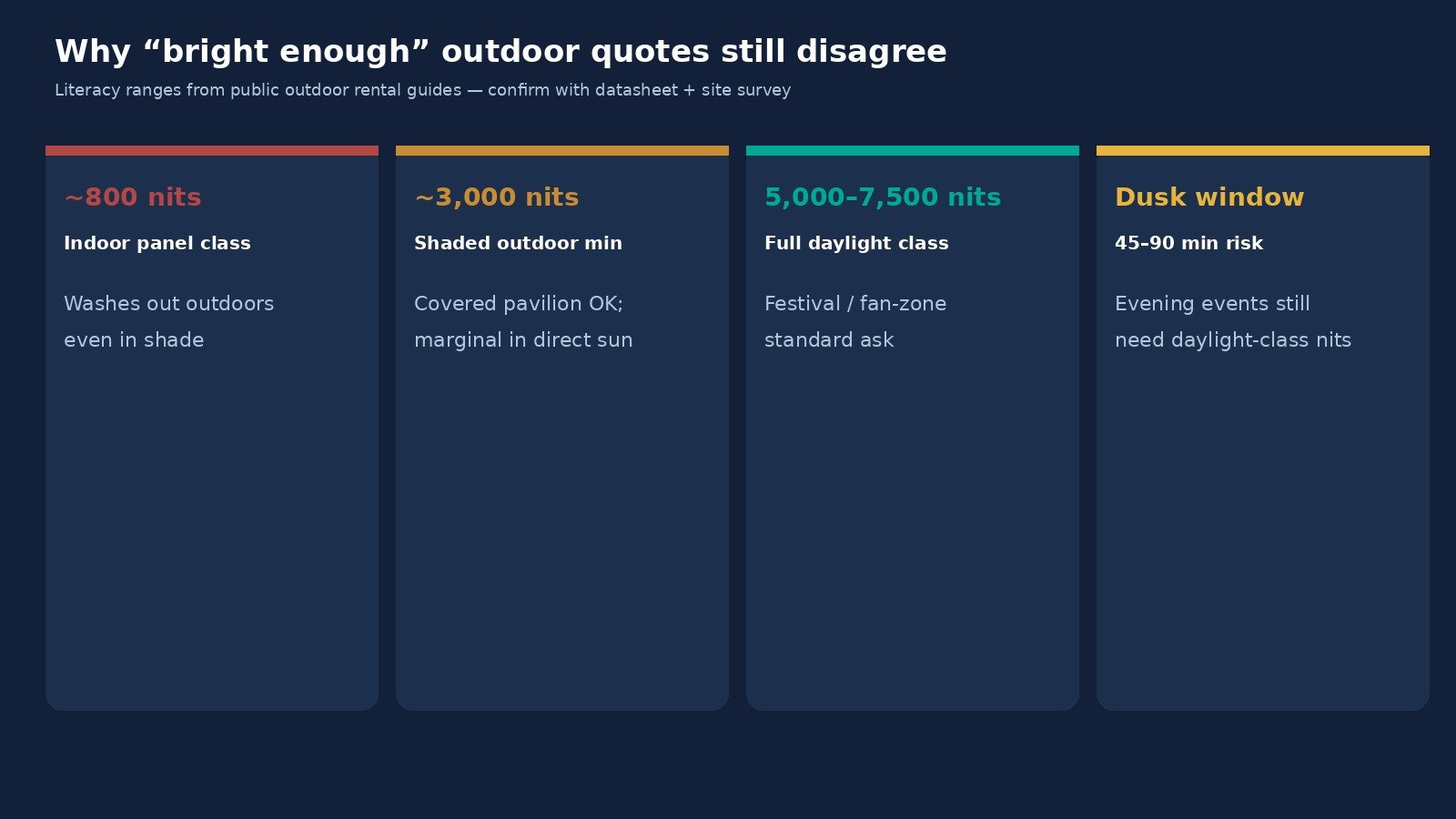
| Daylight brightness class | Public outdoor rental guides commonly put full-daylight walls in a ~5,000–7,500 nit conversation; indoor ~800 nit class washes out outdoors; shaded outdoor often cited near ~3,000 nit as a minimum | Write nits at the viewing condition, including the dusk window |
| Weather | Outdoor rental literacy repeatedly cites IP65 dust/jet protection + a cover / power-down plan for severe weather | IP rating without a weather protocol is incomplete |
| Pitch by distance | Common outdoor bands in public guides: roughly P3.9 for many festival / fan-zone depths, P4.8–P6 for very deep crowds — always tied to farthest viewer, not brochure romance | Measure the back of the lawn / lot first |
| Same-day adjacent (not today’s hero) | 4 Nov 2026 dry-hire investment of 250 m² outdoor transparent rental panels with frame-distributed power (no central PSU column) for touring / film-TV | Different SKU lane — see live transparent LED rental without a PSU column |
Chinese rental-buying guides and English outdoor hire pages soft-support the same pain: buyers confuse pitch with “looks sharp on a phone photo,” treat nits as a single brochure number without saying noon vs dusk, and omit generator kW, ground support, and audio. Social trade wires on ProAV watch-party LED were honestly thin in the 72 hours around this cluster — we are not inventing a viral spike.
Why two “outdoor P3, bright enough” quotes can mean different things
On a fan-zone or civic watch-party RFQ, “outdoor P3” describes almost nothing about whether the picture survives kickoff at 4 p.m. on an open plaza.
- Nits without a viewing condition are not a specification.
Public outdoor literacy separates indoor-class panels (~800 nits — not outdoor), shaded outdoor minimums (~3,000 nits), and full-daylight classes (~5,000–7,500 nits). An evening-only event still faces a dusk window of roughly 45–90 minutes of residual daylight that washes out under-specified walls. Ask for brightness at the ambient condition you will actually run, not a peak lab number alone. Deeper reading: live LED nits vs lumens and LED energy-efficiency RFQ 2026. - P3 / P3.9 / P4.8 are distance tools, not status symbols.
A watch party fails when the people 80–150 ft back cannot read a score bug. Public outdoor tables often map P3.9 to mid-depth festival / fan-zone crowds and coarser pitches to stadium-scale depths. Measure farthest viewer first, then pick pitch — the same hygiene we use when buyers over-buy fine pitch indoors. - IP65 is a cabinet claim, not a weather plan.
Dust-tight / water-jet language matters for plazas and parking lots. Still ask what happens in steady rain vs severe weather, who covers the wall, and who owns the call to power down. Pair with live IP54 vs IP65. - Trailer vs modular wall changes the RFQ, not just the photo.
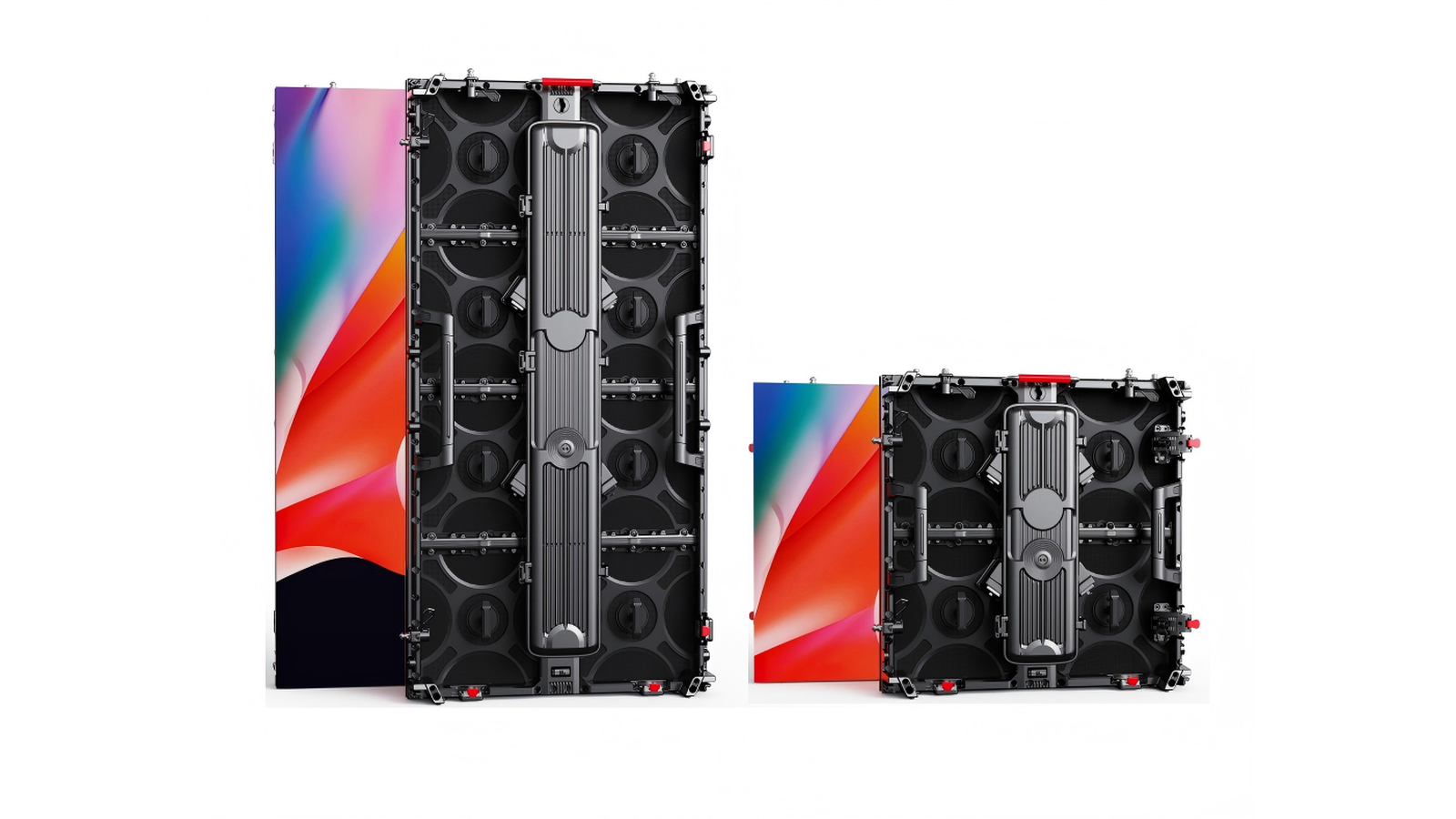
Mobile LED trailers optimize tow-in speed and a fixed footprint. Modular cabinets optimize custom width/height, multi-zone layouts, and sponsor villages. A quote that hides which architecture you are buying will disagree on labor, access roads, and scale. - Picture without power, structure, feed, and audio is not a watch party.
High-nit outdoor arrays draw real generator kW; ground support needs wind / ballast language appropriate to the site (one RFQ line here is enough for deep wind-load encyclopedia topics); the game feed needs a tested signal path and a backup; outdoor crowds need intelligible audio. Projectors fighting noon sun are a different failure mode — see live LED wall vs projector for events.
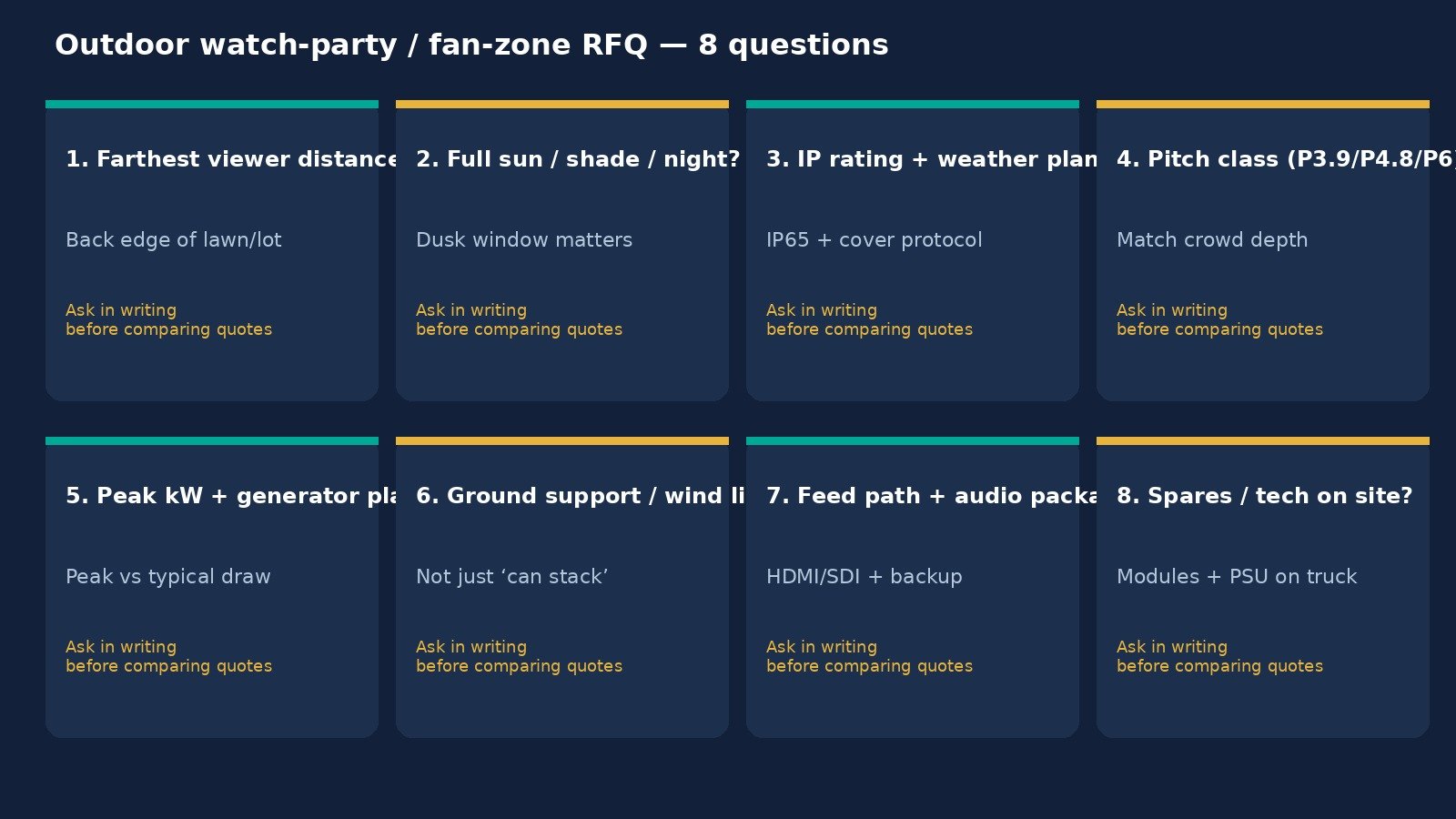
Eight RFQ checks before you hire or stock outdoor watch-party LED
- Farthest viewer distance in writing.
Back edge of the lawn, lot, or plaza — not “about 500 people.” - Ambient light plan: full sun / shade / night + dusk window.
State kickoff or program start time. Ask for a nit class that survives the brightest hour you will actually run. - IP rating + weather protocol.
IP65 (or the exact rating offered) plus cover / power-down ownership in rain. - Pitch class tied to that farthest viewer.
P3.9 vs P4.8 vs P6 (or the vendor’s nearest outdoor family) — justify with distance, not brochure ranking. - Peak power and generator / venue power plan.
Ask peak vs typical draw for the proposed wall size; outdoor daylight walls are not indoor conference loads. Soft-link live peak vs average power. - Ground support / hang method + wind/ballast line.
“Can stack” is not a site engineering answer. Require a method statement appropriate to open plazas; keep detailed ballast tables for a separate wind-load discussion. - Program feed path + audio package.
HDMI/SDI (or the broadcast path you will actually use), backup source, and whether audio is in the LED quote or a separate line. - Spares, tech on site, and utilization honesty.
Spare modules / PSUs on the truck; who watches signal integrity during the match; and — if you are stocking outdoor P3 for a fleet — which non-tournament jobs (exhibition, corporate outdoor, civic) keep the cabinets earning when sports seasonality dips.
For a general outdoor festival hire list (load-in windows, flight cases, crew counts), use the live outdoor festival rental LED checklist — that post remains the broad festival lane. This post is the watch-party / fan-zone RFQ hygiene layer on top: daylight, dusk, farthest viewer, and sports-season utilization.
How to run a fan-zone RFQ without drowning in brochure pitch
- Freeze the site map first. Farthest viewer, sun path, generator pad, emergency lanes, and whether the wall is trailer-fixed or modular.
- Require a one-page outdoor sheet: nit class at stated ambient, IP rating + weather protocol, pitch vs distance, wall size, peak kW, ground-support method, feed inputs, audio yes/no, spare %, and tech coverage hours.
- Separate transparent scenic mesh from opaque outdoor P3. If a quote mixes both because of this week’s European transparent fleet headlines, split the line items and send transparent questions to the live no-PSU-column checklist.
- Do not use someone else’s sports-share percentage as your day rate. The 21% / seasonality figures are market context, not a license to skip utilization math.
- Project cost still has many non-LED lines — see LED video wall cost 2026. Modular resize lessons for touring outdoor canvases also live on amphitheater modular resize.
Honest boundaries
- This is not a product review of any OEM cabinet, local hire house, trailer brand, or named processor. Names are left out on purpose.
- Market percentages, dollar figures, nit bands, and pitch-distance tables are dated public / third-party literacy illustrations, not SFxDisplay specifications, certifications, or published day rates.
- Confirm datasheet brightness test conditions, IP certificates, structural method statements, and a real site survey. Literacy ranges are for RFQ conversation — they are not a substitute for engineering.
- This post is outdoor watch-party / fan-zone RFQ hygiene. It is not a rewrite of live outdoor festival rental LED checklist, not a rewrite of live transparent LED rental without a PSU column (even though a 4 Nov 2026 transparent fleet PR landed the same week), not a rewrite of live energy-efficiency RFQ / nits vs lumens / IP54 vs IP65, and not a curved convex/concave fleet RFQ or trade-show booth RFQ piece.
- Cheapest “outdoor P3” line is not automatically a daylight fan-zone wall — undocumented nits, dusk behavior, IP protocol, generator kW, and farthest-viewer pitch are how washed-out kickoffs happen.
- SEMA week and the approaching rental & staging / IAAPA / World Cup 2026 calendar are context only; booth RFQ hygiene is a separate lane.
Related reading (already live)
- Outdoor Festival Rental LED Checklist
- Transparent LED Rental Without a PSU Column
- LED Energy Efficiency RFQ 2026
- LED Display IP54 vs IP65
- LED Nits vs Lumens
- LED Wall Peak vs Average Power
- LED Wall vs Projector for Events 2026
- Amphitheater Touring LED Modular Resize 2026
- 3840Hz vs 7680Hz LED Refresh Rate
- LED Video Wall Cost 2026
FAQ
Is this only about one OEM blog post?
No. The 2 Nov 2026 outdoor P3 watch-party framing is the news lede because it is dated this week. The RFQ hygiene applies wherever buyers hire daylight outdoor walls for fan zones, civic screenings, and experiential plazas.
What is the single most useful RFQ line?
“Give nit class at our ambient (including dusk), IP rating + weather protocol, pitch justified by farthest viewer distance, wall size, peak kW / generator plan, ground-support method, feed inputs + backup, audio yes/no, spare modules on truck, and tech coverage for the full program.”
Does this replace the outdoor festival checklist?
No. That live post is the broad festival hire list. This post is watch-party / fan-zone RFQ — daylight, sports-season utilization, and quote comparability.
Does this replace the transparent no-PSU post?
No. The same-week 4 Nov 2026 transparent touring fleet wire belongs to that live product lane. Soft-link only.
Does this cover curved fleets or trade-show booth RFQs?
No. Curved lock / concave-convex fleet RFQ and booth / show-floor RFQ hygiene are separate topics.
Should we stock outdoor P3 because sports is ~21% of rental?
Not from a blog sentence. Run your own utilization across tournament peaks and off-peak exhibition / corporate outdoor days.
Will X / social prove this topic is “viral” today?
No honest ProAV watch-party spike showed up in our search window. We are writing from dated outdoor/sports rental heat + RFQ literacy, not from invented engagement.
Planning a sports watch party, civic fan zone, or experiential outdoor activation — and the quotes only say “outdoor P3, bright enough” without nits at your ambient, IP protocol, farthest-viewer pitch, generator kW, or feed/audio lines? Share your site map, farthest viewer distance, program start time, sun/shade condition, target wall size, and whether you need trailer speed or modular scale — we will help you turn brochure pitch into a same-assumption outdoor RFQ checklist before you cut a deposit.
WhatsApp +86 150 1911 0341 · molly@sfxdisplay.com · Get a quote
SFxDisplay — LED factory for rental & fixed cabinets. Industry commentary from dated public outdoor / sports rental heat and outdoor hire literacy; not an SFx day-rate list. Two “bright enough outdoor P3” quotes can mean different nits, IP protocols, and farthest-viewer pitches — lock assumptions before you compare.