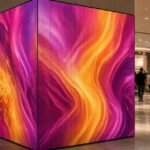

Between 9 and 13 October 2026, trade press across Installation International, Essential Install, invidis, and Digital Signage Magazine reported that the University of Bristol’s Digital Futures Institute had switched on its Reality Emulator — a room-scale immersive environment built from about 31 million pixels across 1,562 flexible LED modules in a continuous, egg-shaped 360° display (Installation International; Essential Install; invidis; Digital Signage Magazine).
That is the news. The buyer question underneath it is sharper: when is a flexible-module continuous curve the honest tool — and when is a rigid rental cabinet wall still the right PO?
What the press actually says (facts only)
| Fact | Dated source | Notes |
|---|---|---|
| ~31 million pixels; 1,562 flexible modules; egg-shaped / 360° continuous display | Installation International 9 Oct 2026 (updated 12 Oct); invidis 12–13 Oct; Essential Install 9 Oct; DSM 13 Oct | Venue: University of Bristol Digital Futures Institute (BDFI) Reality Emulator |
| ~1.2 mm pixel pitch (Ribbon Series Indoor class) | Same outlets | Some secondary writeups say 1.25 — primary trade copy we fetched uses 1.2 mm |
| 7,680 Hz PWM; 120 Hz stereoscopic (60 Hz/eye with shutter glasses) | Essential Install; invidis | Stereo + sync glasses called out for depth in virtual scenes |
| Eye tracking, motion tracking, real-time game-engine rendering | Essential Install; invidis | Content responds to user position / gaze |
| System architecture; assembled & factory-tested in Iowa, then shipped to Bristol | Essential Install; invidis | Project sources named once in press: ClearLED modules + Mechdyne system architecture |
| Use cases: emergency response training, urban planning, architecture, AI, digital twins, game-engine research | Essential Install; invidis; Installation | Dr Richard Cole (BDFI) quoted on putting people into risky scenarios without real-world exposure |
| GOB + flip-chip | Essential Install; invidis | Press / vendor claims — durability, thermal, efficiency language. Not SFx verification |
| Cost, timeline, packaged “productized” cave kit | DSM explicitly notes omission | We do not invent these |
Same-week weak category noise (not a hero): Planar announced a Tile Series with rigid and flexible creative modules around 6–8 October 2026 (Commercial Integrator). Treat it as evidence that creative/flexible modules remain a live product lane — not a review and not the center of this article.
CN SERPs this week still surface flexible / curved rental cabinets (500×500, concave/convex angles). That is category interest, not a claim about any social-platform engagement score.
Why this is not “another retail curve”
Retail and experiential curves already taught buyers that LED can bend. Bristol’s coverage emphasizes something different: a continuous room envelope that mixes curved immersion zones (peripheral wrap) with flatter zones for engineering data and models that must stay undistorted (Installation International; Essential Install).
That combination is the kind of geometry job standard rigid cabinets struggle to do without visible seams or heavy structural workarounds. The news is less “flexible LED exists” and more “flexible modules are winning research / simulation / immersive training canvases where the room shape is the brief.”
Stereo at 120 Hz with shutter glasses, plus tracking and game-engine pipelines, also raises the bar above a static digital-signage loop. Those are system requirements (display + sync + compute), not a pitch number alone.
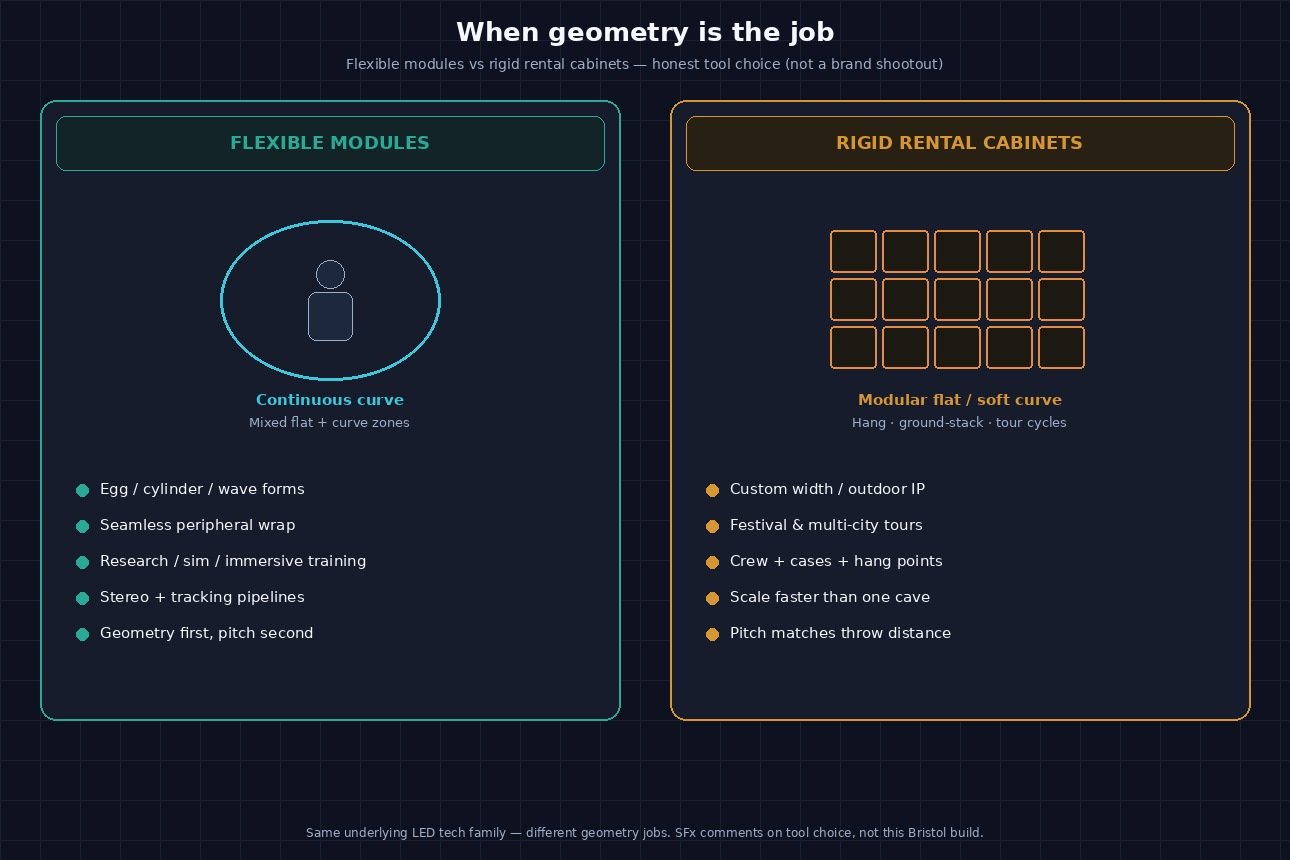
Honest lanes: flexible modules vs rigid rental cabinets
| If the brief is… | Honest tool | Common mistake |
|---|---|---|
| Egg / cylinder / continuous wrap with near-zero seam budget | Flexible modules (or a purpose-built creative system) | Quoting a flat rental wall and “soft-curve” hope |
| Mixed curve for immersion + flat zones for undistorted CAD / data | Flexible continuous surface engineered as one canvas | Treating every zone like a festival center-hang |
| Custom outdoor width, multi-city tour, hang/ground-stack crew cycle | Rigid (or soft-curve) rental cabinets | Buying one research-cave geometry for a festival PO |
| Stereo + tracking + digital-twin / game-engine pipe | Immersive system design (display is one layer) | Pasting a retail-curve RFQ and adding “3D” as a checkbox |
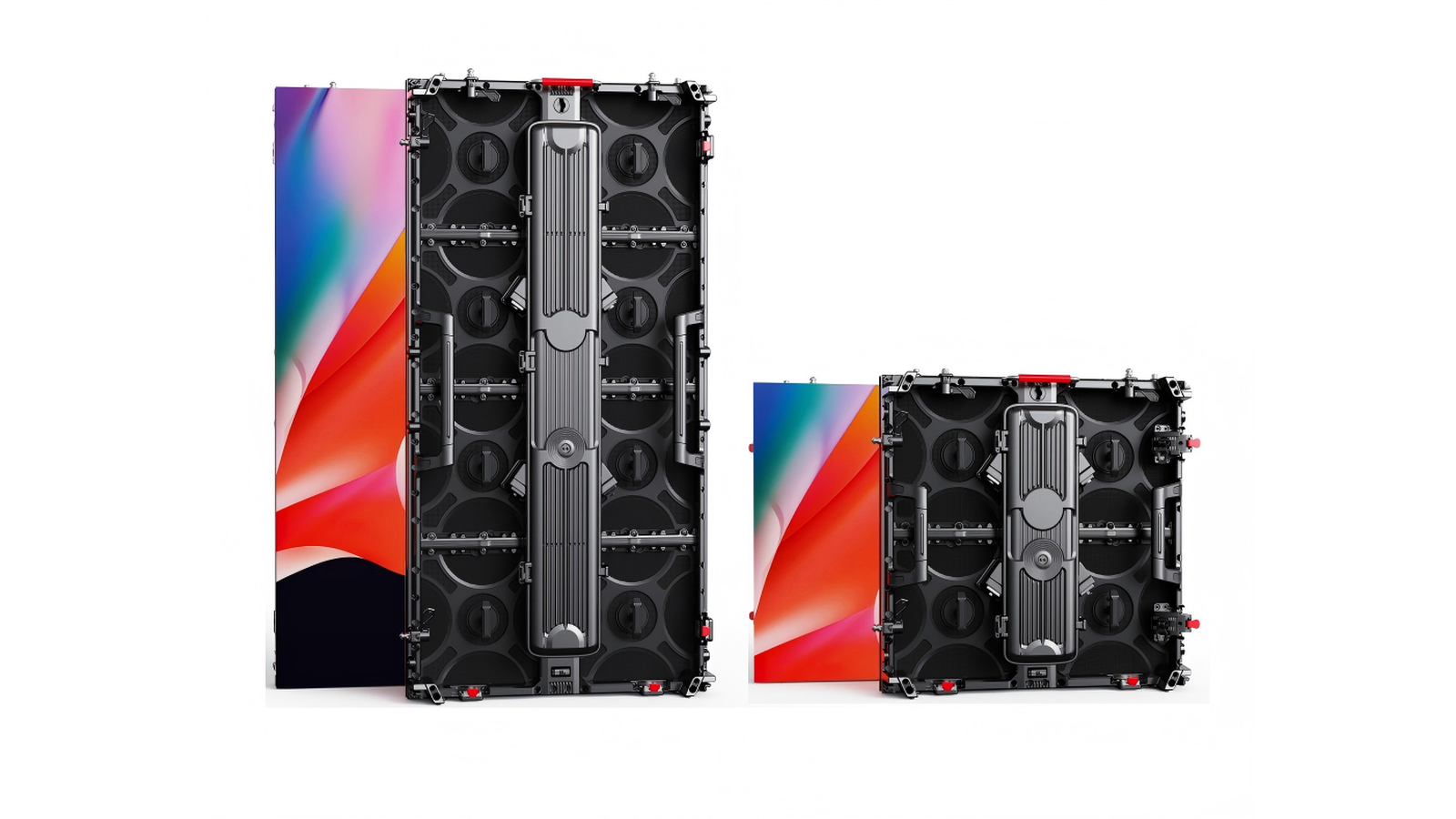
Flexible modules and rigid rental cabinets are related LED families, not the same PO. Modules optimize for form. Rental cabinets optimize for modular scale, weather, and crew workflows. If a buyer pastes an October research-cave headline into a festival outdoor RFQ, the first reply should be a geometry / lane question, not a pitch discount.
For touring lock and cabinet connection literacy you already own on-site, see soft vs hard connection for rental cabinets — that post is about how cabinets lock, not about continuous research caves. Different question.
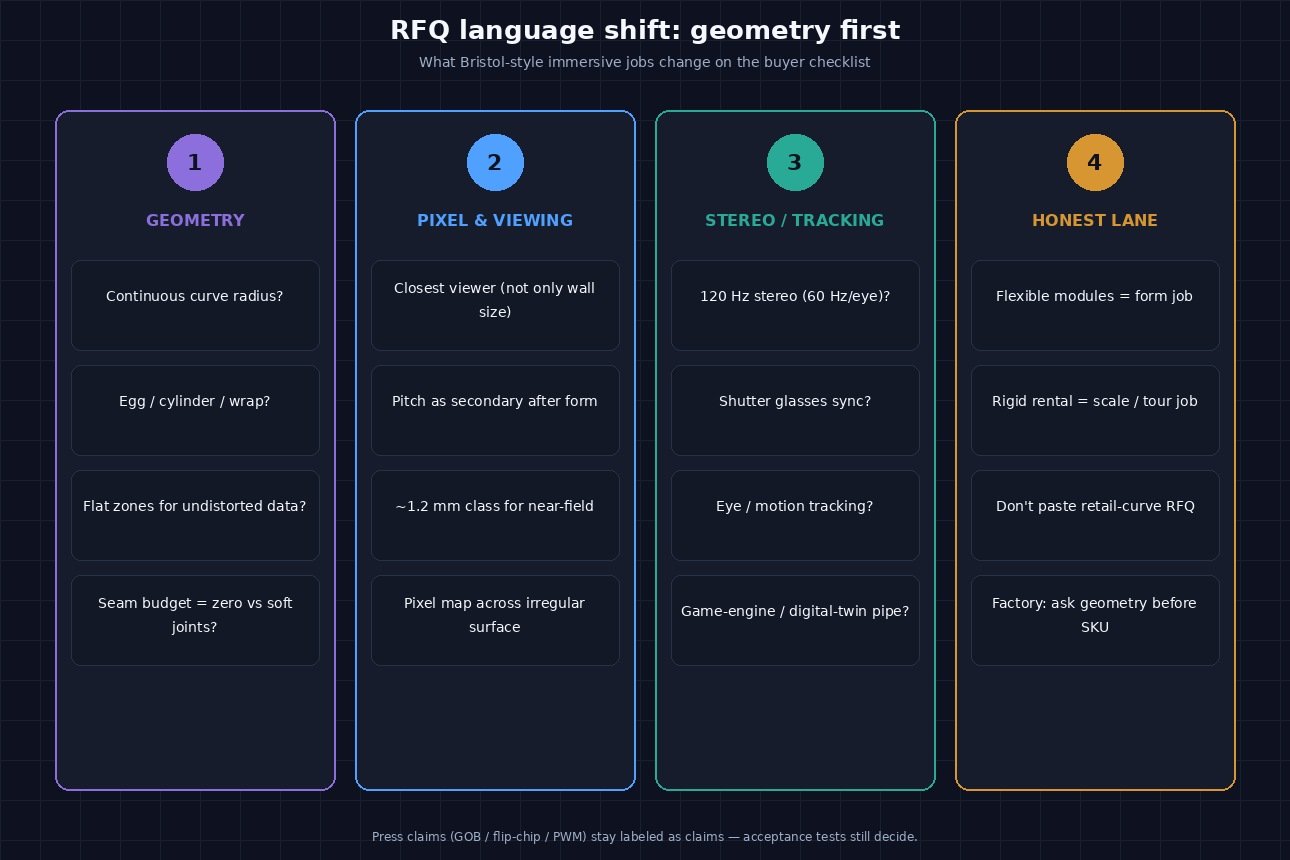
RFQ language shift: geometry first
Bristol-style jobs change what belongs on page one of the RFQ.
- Geometry — continuous curve radius? egg / cylinder / wrap? flat zones for undistorted data? seam budget zero vs soft joints?
- Pixel & viewing — closest viewer (not only wall size); pitch as secondary after form; near-field often lands in fine-pitch class (~1.2 mm in this press); pixel map across an irregular surface (resolution / pixel map).
- Stereo / tracking — 120 Hz stereo (60 Hz/eye)? shutter sync? eye / motion tracking? game-engine / digital-twin pipeline?
- Honest lane — flexible modules = form job; rigid rental = scale / tour job; do not paste a retail-curve RFQ into a research cave — or a cave RFQ into a festival hang.
Press lines about GOB protection and flip-chip LEDs appear in the October coverage as supplier positioning for durability, thermal behavior, and efficiency. Treat them as press claims. Acceptance tests and your own RFQ language still decide — the same discipline we used when foldable AIO shipping stories listed IP/GOB brochure lines (mobile foldable AIO shipping).
Honest SFxDisplay boundary
SFxDisplay is an LED factory for rental and fixed cabinets. We can help buyers ask geometry-first questions so RFQs stay honest. We are not claiming we built Bristol’s Reality Emulator, we do not invent cost or timeline figures the announcement omitted, and we will not write a vendor hero post about this install.
If your project needs continuous curve, mixed flat zones, or a modular tour wall, send the room geometry, closest viewer, and whether stereo/tracking is in scope — and we will answer in the lane that actually fits.
FAQ (light)
Is this the same story as “curved rental cabinets for stage”?
No. Stage soft-curve cabinets solve creative stage shapes with modular tiles. Bristol’s coverage is a continuous research envelope with stereo/tracking — overlapping technology family, different job.
Does fine pitch alone make a research cave?
No. Press specs put pitch around 1.2 mm, but the harder requirement is geometry + system pipeline (stereo, tracking, compute). Pitch without form is the wrong first question.
Should we treat GOB / flip-chip / 7,680 Hz PWM as verified for every flexible wall?
No. Those lines are press claims in the October stories. Useful as category advertising language; not factory verification for every SKU.
Did SFxDisplay supply this install?
No. This article is industry-news commentary on a public university project.
Is soft vs hard connection the same topic?
No. Soft vs hard connection is about rental cabinet locks on tour. This post is about when flexible modules win seamless immersive geometry.
Related reading (live only)
- Cinema LED Screens Are Scaling in 2026
- Mobile Foldable LED Walls Hit Shipping
- LED Wall Resolution: Pixel Map
- LED Wall Setup Time: Load-In
- Soft vs Hard Connection LED Rental Cabinets
Need a straight answer on flexible-geometry vs rental-cabinet lanes? WhatsApp +86 150 1911 0341 · molly@sfxdisplay.com — send room geometry, closest viewer, and whether stereo/tracking is in scope. We will not sell a research-cave headline as a festival wall RFQ.
SFxDisplay — LED factory for rental & fixed cabinets. Industry commentary only; not a claim that we built Bristol’s Reality Emulator.