The quote says "walkable LED floor" or "wall-to-floor 2-in-1." Procurement hears immersive visitor paths and one cabinet language from ground to wall. The venue hears liability. The crew chief hears: will heels, carts, and a show car actually clear the rated load – or did we buy a brochure number that only rates the glass?
A floor LED is not a wall cabinet tipped on its side. Our live 4K hang weight post owns vertical wall kilograms and truss/building math. Our IP54 vs IP65 post owns ingress. This post owns only the floor load path – what kg/m² means, when a cheap club lighting tile is not a video floor, when public venues plan around ≥1,500 kg/m², when auto-show paths push ≥2,000 kg/m², and how wall-to-floor 2-in-1 cabinets should appear on the RFQ without pretending the wall mode inherits the floor rating.
Quick definitions (clear the name collision)
| Term | What it means | What it is not |
|---|---|---|
| LED floor / dance floor / floor tile | Modular LED cabinets engineered for horizontal pedestrian (and sometimes equipment) load | Not a wall rental cabinet laid flat |
| Wall-to-floor 2-in-1 | Same cabinet language used as floor, 90° transition, and wall in one content continuum | Not automatic proof that one datasheet kg/m² covers every orientation |
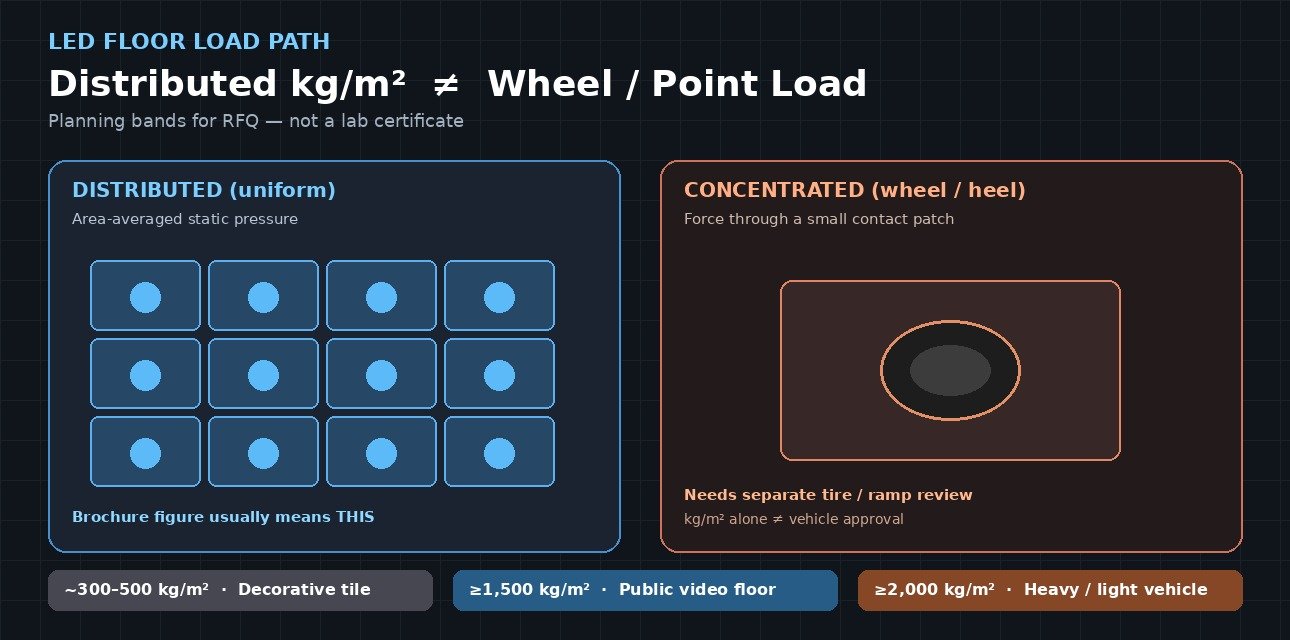
| Distributed / uniform load (kg/m²) | Area-averaged static pressure the assembled floor + subframe is rated for | Not approval for a single heel, cart wheel, or vehicle tire |
| Concentrated / point / wheel load | Force through a small contact patch (heel, caster, tire) | Not interchangeable with the brochure kg/m² figure |
| Decorative lighting tile | RGB club / dance lighting panels – often low CapEx, modest load bands | Not a camera-grade video LED floor by default |
| Video LED floor | Higher-density display architecture with engineered load path, protective surface, and service plan | Not "strong because the glass is thick" |
| System load rating | Cabinet + surface + support/subframe tested together | Not a surface-material-only marketing number |
Industry language is blunt: pitch sells the picture; the load path sells the lawsuit.
Why this question stays hot for buyers
2026 floor-LED buying guides still put load capacity next to pitch and IP, because immersive malls, museums, rental stages, and auto shows keep asking the same procurement line: can people walk on it – and can anything heavier? Dance-floor and interactive-floor OEM pages keep publishing mid-band planning numbers in the 1,500-2,000 kg/m² class for professional walkable video floors, while decorative lighting tiles often sit in a much lower band. Wall-to-floor platforms advertise one cabinet that continues content through a 90° turn – which is useful creative language and a different RFQ problem.
Load-test explainers keep repeating two points: a static pass is not dance-ready, and support spacing is not portable across venues.
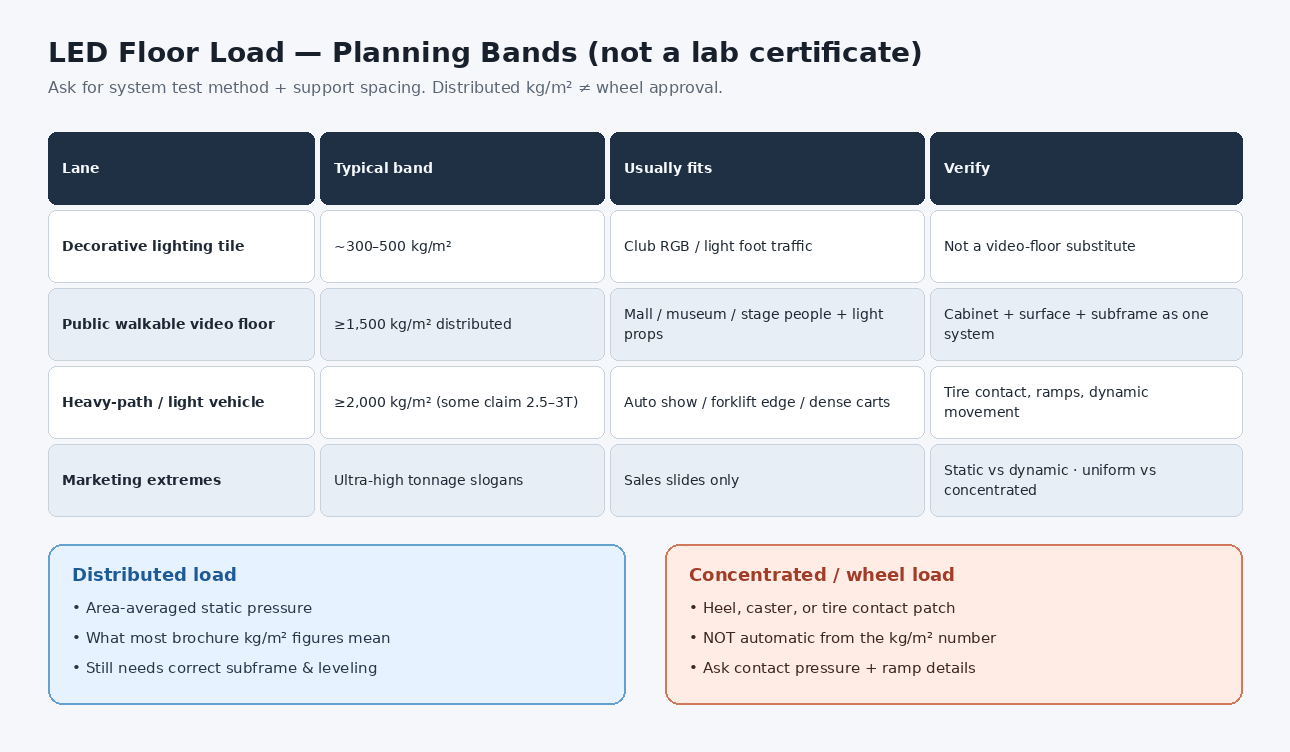
Honest planning bands (not a lab certificate)
Treat every kilogram-per-square-meter as a starting band. Ask for the test method, then confirm the installed subframe, leveling, and edge conditions before the venue opens.
| Planning lane | Typical brochure / guide band | What it usually fits | What to verify |
|---|---|---|---|
| Decorative lighting tile | Often ~300-500 kg/m² | Club RGB effects, light foot traffic, non-video lighting floors | Not a substitute for a camera-grade video floor |
| Public walkable video floor | Often ≥1,500 kg/m² static distributed | Malls, museums, exhibitions, stages with people + light props | System rating (cabinet + surface + support), not glass-only |
| Heavy-path / light vehicle planning | Often ≥2,000 kg/m² (some brochures claim 2,500-3,000) | Auto shows, forklift edges, dense equipment paths | Tire contact pressure, ramps, dynamic movement – kg/m² alone is not a wheel approval |
| Marketing extremes | Ultra-high tonnage slogans without method | Sales slides | Demand the report: static vs dynamic, uniform vs concentrated, sample size, support spacing |
Critical honesty from 2026 floor FAQs: a published 1,500 kg/m² distributed figure is not automatic approval for every vehicle or every wheel. Review vehicle weight, tire contact patch, access ramps, dynamic movement, subframe spacing, and floor flatness. CN test explainers add the sister line: static qualification ≠ "safe to dance" until dynamic / repeated impact is considered for the use case.
When a wall cabinet is not a floor
Do not buy "strong" as a synonym for "walkable."
| Trap | What goes wrong | What to ask |
|---|---|---|
| Wall cabinet tipped flat | No engineered load path; modules take the audience | Written floor series + load test, not a wall datasheet |
| Surface-only rating | Thick glass / PC marketed as "2T" while the cabinet ribs fail | Complete system load cert (cabinet + surface + support) |
| kg/m² without method | No static/dynamic, no uniform/concentrated, no support spacing | Test method + support pitch on the quote |
| Decorative tile as video floor | Low load band, weak camera behavior, different service story | Confirm whether the quote is lighting tile or video floor |
| Ignoring joints and edges | Failures start at seams, locks, and ramp transitions | Edge protection, leveling tolerance, ramp detail |
| Skipping anti-slip / wear | Wet heels and carts polish the surface into a hazard | Anti-slip / wear language + cleaning SOP |
Pair this with front vs rear service so the RFQ covers access after the crowd walks on it, not only a tonnage slogan. Magnetic / tool-free module access matters more on floors than on most walls because downtime is visible under every visitor’s feet.
Wall-to-floor 2-in-1: when the continuum earns CapEx
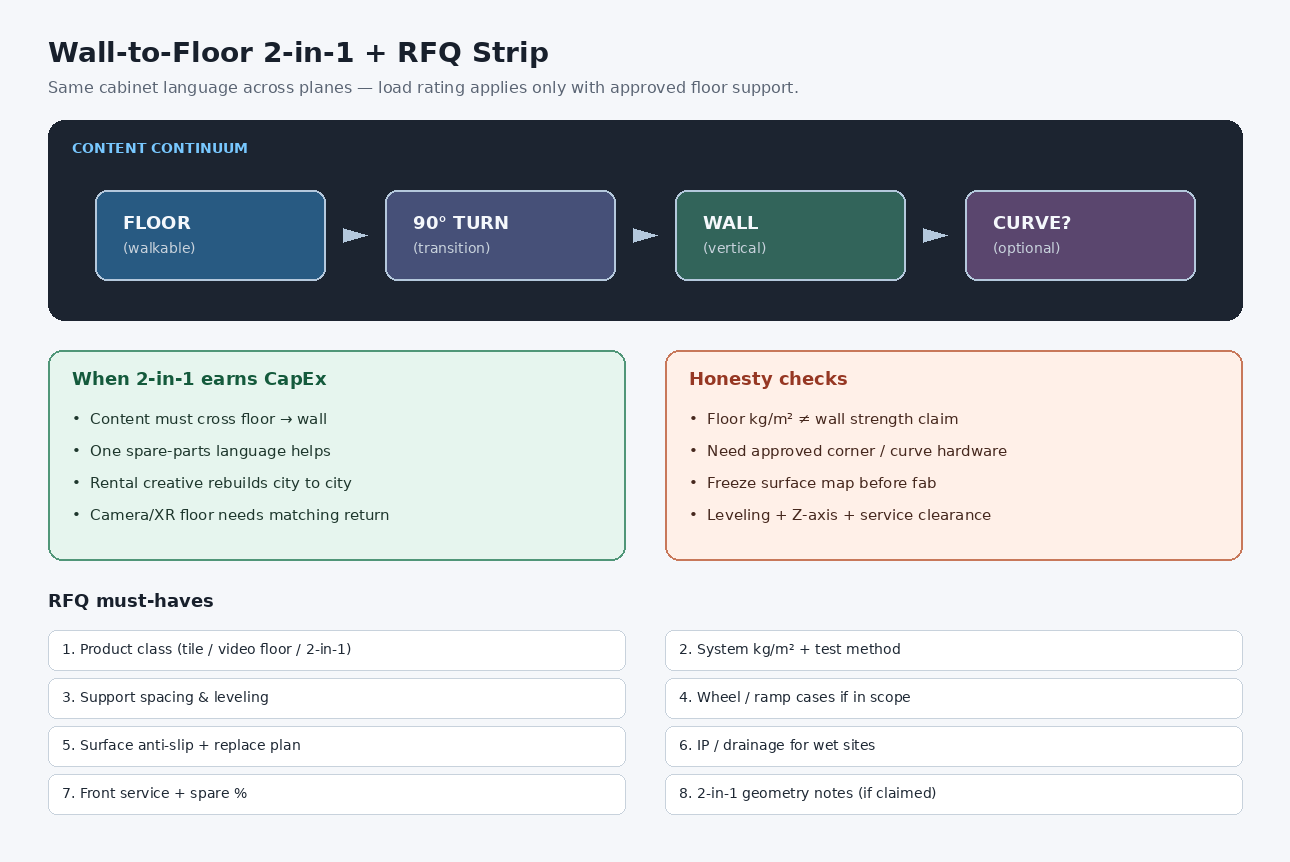
A 2-in-1 (or floor-to-wall) cabinet language is useful when the creative brief needs one surface continuum: walkable floor -> 90° transition -> vertical wall, sometimes into a soft curve. That is a real product lane in 2026 immersive / rental creative work.
It earns the upcharge when:
- Content must cross planes – visitor path imagery continues onto the wall without a hard media break.
- One spare-parts language – same module family for floor and wall reduces SKU chaos (still keep a spare plan).
- Rental creative packages – stages and brand moments that rebuild the same continuum city to city.
- Camera / XR floors that also need a matching vertical return – still test refresh and shutter with the production camera; do not invent camera compatibility from a blog.
Honesty for the RFQ: the floor load rating applies in floor orientation with the approved support. Wall mode does not "inherit" kg/m² as a vertical strength claim, and a pretty 90° render does not replace approved corner hardware, leveling, Z-axis alignment, cable routes, and service clearance. Freeze the surface map (active dimensions, corner detail, curve radius) before fabrication – the same discipline as locking hang drawings in the hang weight post, but for the ground plane.
Surface, IP, interaction, and pitch (sisters – keep them short)
| Sister line | Why it sits next to load | Honest RFQ ask |
|---|---|---|
| Protective surface | Takes heels, carts, and cleaning abuse | Material + thickness + anti-slip + replacement procedure |
| IP / drainage | Spills and outdoor plazas kill unprotected floors | Front/rear IP; drainage plan for outdoor – see IP54 vs IP65 |
| Interaction (optional) | Pressure / IR / other sensors change content under feet | Response expectation, sensing density, who commissions the software |
| Pixel pitch | Standing viewers look down from ~1.5-1.8 m | Match pitch to viewing height/distance – many commercial floors land around P2.5-P4.8 class; do not overbuy fine pitch for a distant stage floor |
| Refresh / camera | Concert and livestream floors appear on camera | State camera use on the RFQ; test with the production shutter |
Relative CapEx: interactive and heavy-duty floors typically cost more than display-only walkable floors; decorative lighting tiles often cost less and deliver less. We publish no invented unit prices here.
RFQ checklist (copy onto the PO)
Ask every supplier the same lines so quotes are comparable:
- Product class: decorative lighting tile vs video LED floor vs wall-to-floor 2-in-1 – written, not "walkable."
- Rated load: kg/m² as distributed static for the assembled system (cabinet + surface + support).
- Test method: static vs dynamic; uniform vs concentrated; sample size; support spacing.
- Concentrated / wheel cases: if carts, heels, or vehicles are in scope – contact patch assumptions and ramp details.
- Subframe & leveling: approved support pitch, flatness tolerance, edge / ramp detail.
- Surface: material, anti-slip, wear, replacement procedure.
- IP / environment: indoor vs outdoor model; drainage for wet sites.
- Service: front magnetic / tool-free module access; spare-module %.
- 2-in-1 extras (if claimed): approved 90° / curve hardware; surface map; wall-mode does not reuse floor kg/m² as a vertical claim.
- Do not accept brochure tonnage without a report and an installed support plan.
Related reading (live SFxDisplay)
| Post | What it owns vs this article |
|---|---|
| 4K hang weight | Vertical wall kg + building/truss load math – not floor load path |
| IP54 vs IP65 | Ingress language – pairs with outdoor floor drainage |
| Outdoor festival checklist | Weather, nits, wind, power, crew list |
| Front vs rear service | Access route after the crowd walks the surface |
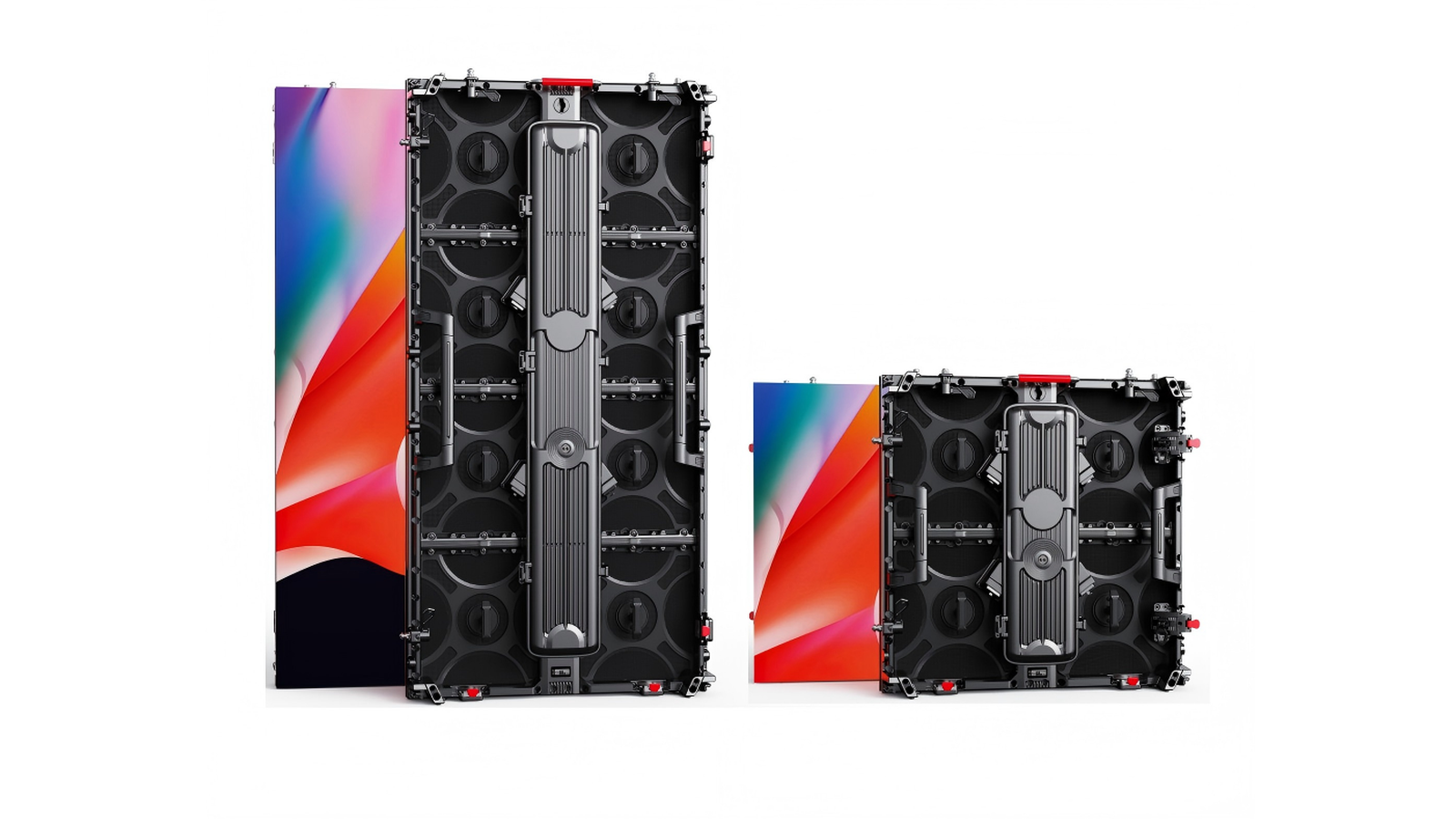
| 500×500 vs 500×1000 | Cabinet geometry / stock shape |
| LED rental spare parts / hot-swap | Inventory % once floor SKU is locked |
| Soft vs hard connection | Lock style for touring rebuilds |
| How to choose | Broad selection framing |
| Rental series | Product starting point after load + footprint are clear |
SFxDisplay honest boundary
We build and quote rental and creative LED systems for buyers who need clear load language and real installation conditions, not brochure poetry. We will put product class, system kg/m², test method, support pitch, surface/IP, and 2-in-1 geometry notes on the quote when you ask. We will not invent an SFxDisplay lab percentage that "every floor is 2 tons." We will not call a wall cabinet a floor. We will not treat distributed kg/m² as a vehicle tire certificate. We will not push named competitor panel brands. If people, carts, or cars will stand on the picture, say so early – that changes the series more than it changes the pitch number.
Browse rental series and how to choose an LED display, then paste the checklist onto the PO.
Bottom line
A walkable LED floor is a load path first and a pixel pitch second. Decorative lighting tiles often live in the ~300-500 kg/m² class and are not a video-floor substitute. Professional public walkable floors commonly plan around ≥1,500 kg/m² static distributed system ratings; heavy exhibition paths often plan ≥2,000 kg/m² – still verify tire contact, ramps, and dynamic use. Wall-to-floor 2-in-1 earns CapEx when content must cross planes with one cabinet language, but wall mode does not inherit floor kg/m². Demand system test reports, support spacing, anti-slip surface, IP/drainage, and service access. Write those lines into the RFQ next to hang weight and IP – so the floor you open matches the load you paid for.