The quote says "weatherproof." The datasheet says IP54. The stage is open to the sky. That mismatch is how outdoor and rental buyers inherit wet receiving cards and a season of board swaps.
IP54 and IP65 are not marketing synonyms. They are two different IEC 60529 test outcomes – and many cabinets list two ratings: one for the front (pixel face) and one for the rear (service side). Rental fleets often ship as Front IP65 / Rear IP54. That split is an engineering trade-off, not a typo.
This post owns the IP decision tree. Our live outdoor festival rental checklist still covers the full tour list (power, hang, weather, crew). Our indoor vs outdoor LED wall post frames the environment class. Here we answer only: which IP digits belong on this job – front and rear – and what "IP" still does not buy you.
Quick definitions (clear the name collision)
| Term | What it means | What it is not |
|---|---|---|
| IP (Ingress Protection) | IEC 60529 two-digit code for how well an enclosure resists solids and liquids | Not a synonym for "outdoor-ready forever" |
| First digit | Solids / dust (0-6). 5 = dust-protected; 6 = dust-tight | Not UV, temperature, or salt fog |
| Second digit | Liquids (0-8+). 4 = splash; 5 = low-pressure jet; 7 = short immersion | Not surge / lightning protection |
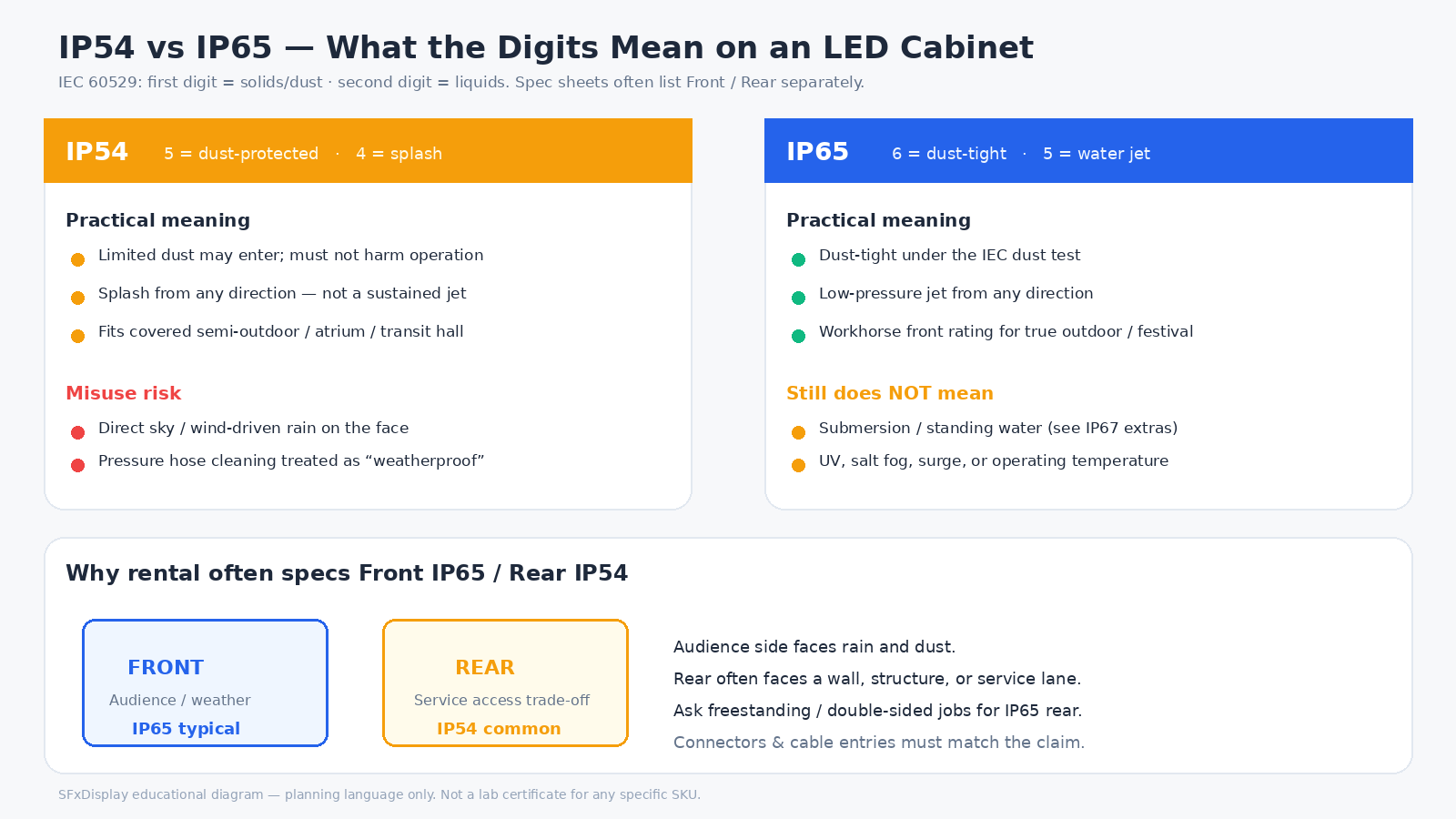
| IP54 | Dust-protected + splash from any direction | Not jet-proof; not a safe default for open sky |
| IP65 | Dust-tight + low-pressure water jet from any direction | Not immersion; not coastal corrosion by itself |
| Front / Rear IP | Separate ratings for pixel face vs service side | Not "pick the higher number and ignore the slash" |
| Front IP65 / Rear IP54 | Common rental outdoor compromise: weather on the face, faster rear access | Not enough when the rear also sees open weather |
Industry language is blunt: IP is risk reduction against dust and water ingress. If gaskets age, connectors are under-rated, or the rear faces a monsoon with no shelter, the printed number will not save the show.
Why this question stays hot for buyers
Buyer guides keep correcting the same mistake: hearing "weatherproof" and accepting IP54 for a facade, rooftop, or open festival wall that needs a jet-class front face. Festival and outdoor RFQs already whisper IP65 front / IP54 rear – but many POs still arrive with a single vague IP line and no connector language.
We are not inventing engagement scores. Indexed 2026 IP explainers, IEC 60529 framing, and durable CN rental选型 language (前IP65后IP54) are enough heat for an honest OEM answer. Live Google PAA and social spike counts were not scraped this pass – so we do not invent them.
What the two digits mean (IEC 60529)
Every real IP code is two digits:
- First digit – solids / dust
– 5 (dust-protected): limited dust may enter; it must not interfere with operation. – 6 (dust-tight): no dust ingress under the IEC dust test.
- Second digit – liquids
– 4 (splash): water splashing from any direction. – 5 (jet): low-pressure water jet from any direction – the practical bar for wind-driven rain and hose-style cleaning on many outdoor faces. – 7 (immersion): short immersion (typical ask for some stage-floor / puddle-risk products) – a different test family from jets.
So IP65 reads as dust-tight + jet. IP54 reads as dust-protected + splash. The gap is not "one number nicer." It is splash versus jet, and protected versus tight on dust.
IP54 vs IP65 in practice
| Question | IP54 | IP65 |
|---|---|---|
| Dust | Limited ingress allowed if harmless | Dust-tight under the IEC dust test |
| Water | Splash from any direction | Low-pressure jet from any direction |
| Typical good fit | Covered semi-outdoor, atrium, transit hall with no direct sky on the face | True outdoor facade, roadside, open festival / stage face |
| Typical misuse | Sold as "outdoor weatherproof" for open-sky installs | Treated as flood / immersion proof (it is not) |
| Cost / complexity | Often lighter sealing; faster rear service when used on the rear | Heavier sealing on the protected face; connectors must match |
Rule of thumb: If rain can hit the pixel face with wind behind it – even under a short overhang – treat IP65 front as the minimum conversation. Wind-driven rain is horizontal. A partial roof is not an automatic IP54 license.
Why rental often specs Front IP65 / Rear IP54
A complete outdoor or touring cabinet frequently lists two numbers. That is deliberate.
- The front faces the audience and the weather. It needs the higher liquid rating.
- The rear often faces a building wall, a structure, a service lane, or a briefly sheltered tech side. Full IP65 rear sealing on every touring cabinet adds cost and can slow field PSU / card swaps – the same access story we cover in front vs rear service.
So Front IP65 / Rear IP54 is a common rental outdoor compromise: protect the face the sky sees; keep the service side practical. It is not a free pass for freestanding totems, double-sided walls, or any job where the rear is as weather-exposed as the front.
When you see a single "IP65" with no front/rear split: ask which surface was tested, and whether connectors and cable entries were in the same configuration.
When IP54 is OK vs when IP65 front is mandatory
IP54 (or similar) can be honest when…
- The face sits under a real cover with no direct sky and no wind-driven rain path.
- The job is atrium / arcade / covered transit / HVAC-adjacent indoor-outdoor edge – still ask about condensation and drip.
- You are comparing indoor-adjacent products and refusing to pay for jet sealing you will never use.
IP65 front is the mandatory conversation when…
- Any part of the face can see open sky, roadside spray, or festival weather.
- Crews may hose-clean or the site sees monsoon-class wind rain.
- The wall is a rental outdoor / touring face that must survive load-in in bad weather – the same world as the festival checklist.
Brightness still matters outdoors – see nits vs lumens – but more nits do not seal a cabinet. Power sizing and backup are separate layers (peak vs average power, power & signal redundancy).
Freestanding, double-sided, stage floor, coastal (brief extras)
Keep these short and honest – no overclaim:
| Situation | What to ask beyond "IP65" |
|---|---|
| Freestanding / open-back / double-sided | IP65 rear (or equal) – IP54 rear is for sheltered rear geometry, not both faces in the weather |
| Stage floor / dance / puddle risk | Immersion-class language (IP67 class) on the product that sits in standing water – IP65 alone is not a puddle certificate |
| Coastal / salt air | Salt-fog / conformal coating / hardware corrosion language – separate from IP |
| Pressure-wash sites | Confirm whether jet class on the datasheet matches how the face will actually be cleaned |
Do not invent a universal "always buy IP67" rule for every outdoor wall. Match the failure you refuse.
What IP does not cover
IP testing answers dust and water ingress on the enclosure under defined lab conditions. It does not replace:
- UV resistance of masks, gaskets, and jackets
- Salt fog / marine corrosion
- Surge / lightning protection on power and signal
- Operating temperature range and thermal design
- Long-term gasket life – seals compress and age; field rating can drift without inspection (maintenance guide)
A wall can be correctly IP-rated and still fail from UV-cracked gaskets, salt, a surge, or a generator sag. Buy the IP layer for ingress – then name the other owners on the RFQ.
RFQ checklist (copy into the PO)
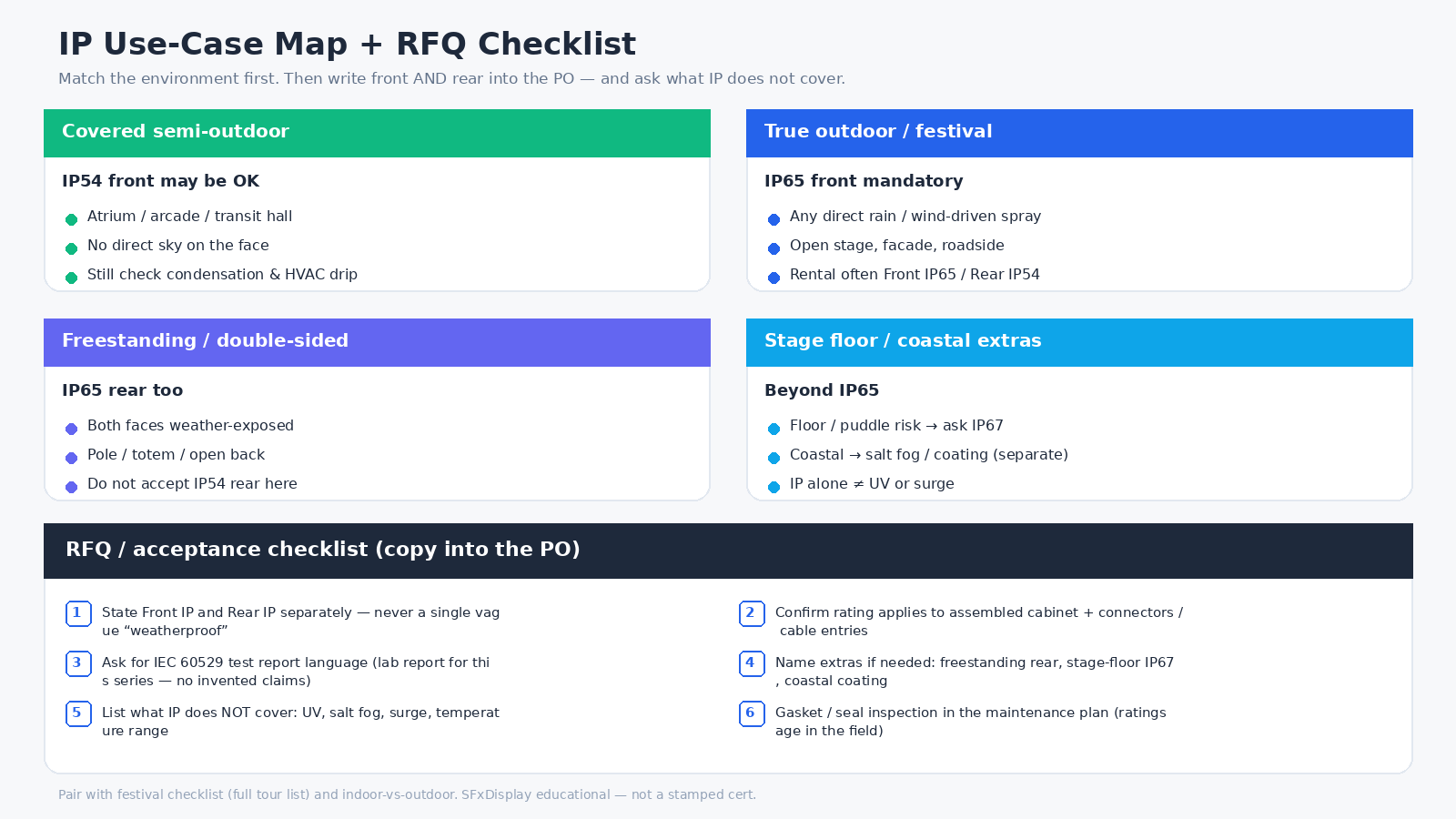
Ask for written answers, not brochure slogans:
- Front IP and Rear IP separately for this exact series – never one vague "weatherproof."
- Scope of the claim: assembled cabinet, or module only? Do connectors / cable entries / power box match the printed digits?
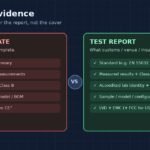
- IEC 60529 test report language: ask whether a lab report exists for this series/configuration. Do not invent SFxDisplay lab claims here – require whatever documentation the factory can actually attach.
- Geometry: wall-mount sheltered rear vs freestanding / double-sided / open back.
- Extras if needed: stage-floor immersion class, coastal coating, cleaning method.
- What IP does not cover: UV, salt fog, surge, temperature – name owners.
- Gasket / seal maintenance: inspection interval and spare seals in the kit.
- Service access that matches how you will swap PSUs and cards in weather – front vs rear.
Browse rental series and how to choose an LED display as starting points, then paste the checklist onto the PO.
How this sits next to the festival checklist
| Post | Owns |
|---|---|
| This article | IP digits, Front/Rear split, when IP54 vs IP65, extras, RFQ for ingress |
| Outdoor festival checklist | Full tour list: weather + power + hang + crew + more |
| Indoor vs outdoor | Environment class and product family framing |
| Peak vs average power / redundancy | Keeping pixels powered and lit when a path fails |
| Nits vs lumens | Daylight visibility – not sealing |
What SFxDisplay can help with (honest scope)
We build rental and outdoor LED cabinets and can help you specify Front/Rear IP language, connector expectations, and spare-seal / maintenance habits that match the job. We can walk covered semi-outdoor vs open festival vs freestanding geometry before you freeze the PO.
We cannot turn a datasheet line into a climate certificate for your venue, invent a third-party lab report that does not exist, or promise that IP alone covers UV, salt, surge, or temperature. Bring the weather you refuse, ask for front and rear in writing, and keep gasket checks on the maintenance calendar.
Bottom line
"Weatherproof" is not a specification. IP54 is splash + dust-protected. IP65 is jet + dust-tight. Rental outdoor often lands on Front IP65 / Rear IP54 because the audience face sees the sky and the rear needs service access – until the rear is freestanding and weather-exposed, in which case ask for IP65 rear too.
Write both digits into the PO, confirm connectors, ask for real test documentation for that series, and name the extras IP does not buy. That is how an IP line item earns its place next to brightness, power, and hang.
—