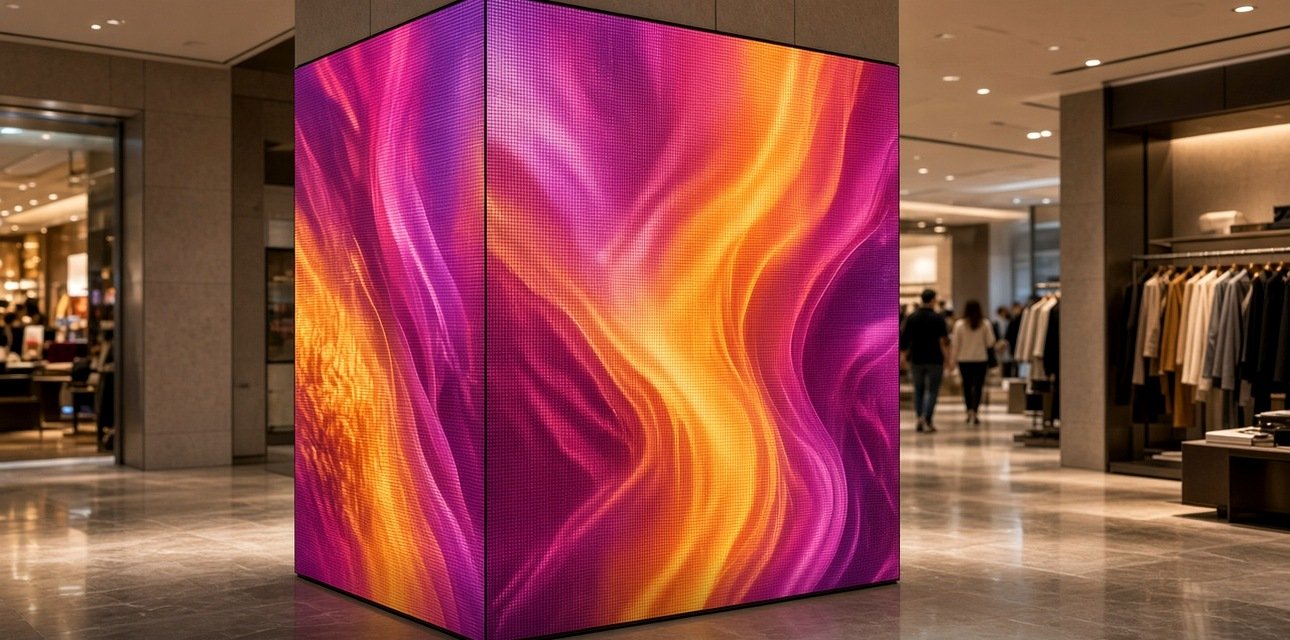
On 7 October 2026, a dated North American trade report put a quiet but sharp buyer question back into trade-show, retail, and stage RFQs: if the content needs to wrap a column or a booth corner, why are we still butting two flat walls and hoping the joint disappears? An indoor fine-pitch COB / MiniLED line expanded to support 90° corner configurations — continuous LED around corners, columns, and architectural features that go beyond a flat wall or a faceted approximate curve (AVNation, 7 Oct 2026 — OEM name kept out of this article on purpose). A day earlier, a creative Tile series reminded the market that non-flat form factors (rigid aspect options plus flex modules with a published minimum curve diameter) are still being stocked for the same buyer pool (dated OEM packaging, 6 Oct 2026 — de-branded). And rental catalogs already list dedicated 90° / perfect-corner cabinets as rentable SKUs — which is the market telling you that hard corners are specified in writing, not only drawn on moodboards. The interesting engineering detail for buyers is not a magic product name: a true 90° corner tile is a different mechanic from a soft flex curve, and both are different from a flat wall plus a scenic return. That is the news. The buyer question underneath it is simpler: before you ask for a “corner LED,” have you decided whether content must actually wrap the corner — and which mechanic matches that need?
What the packaging actually published (facts only)
Treat the following as category facts from dated public packaging, not as an SFxDisplay SKU sheet and not as an endorsement of any cabinet OEM or rental house:
| Item | What public packaging says (de-branded) |
|---|---|
| Hero news date | 7 Oct 2026 — indoor fine-pitch COB / MiniLED line adds 90° corner configs |
| What 90° enables | Continuous LED around corners, columns, architectural features — beyond flat or faceted curved walls |
| Indoor pitch (published) | As fine as 0.7 mm on that line; COB coating called out to minimise reflections |
| Already supported | Faceted curves on the same platform (approximate curve ≠ hard 90°) |
| Supporting news | 6 Oct 2026 creative Tile series: rigid 2:1 / 16:9 + Flex (min curve Ø ~1 m), 1.2–2.5 mm |
| Market signal | Active 90° / perfect-corner rental SKUs in public catalogs (de-branded) — buyers already rent hard corners |
| Outdoor note (light only) | Same 7 Oct package also expands outdoor fine-pitch / high-brightness / high IP — not this article’s hero; leave outdoor close-view to its own lane |
None of that replaces your content map, your seam QA, or your viewing-distance pitch choice. It only tells you what October packaging is training booth, retail, and stage buyers to demand in writing.
Hard 90° ≠ soft flex ≠ flat + scenic
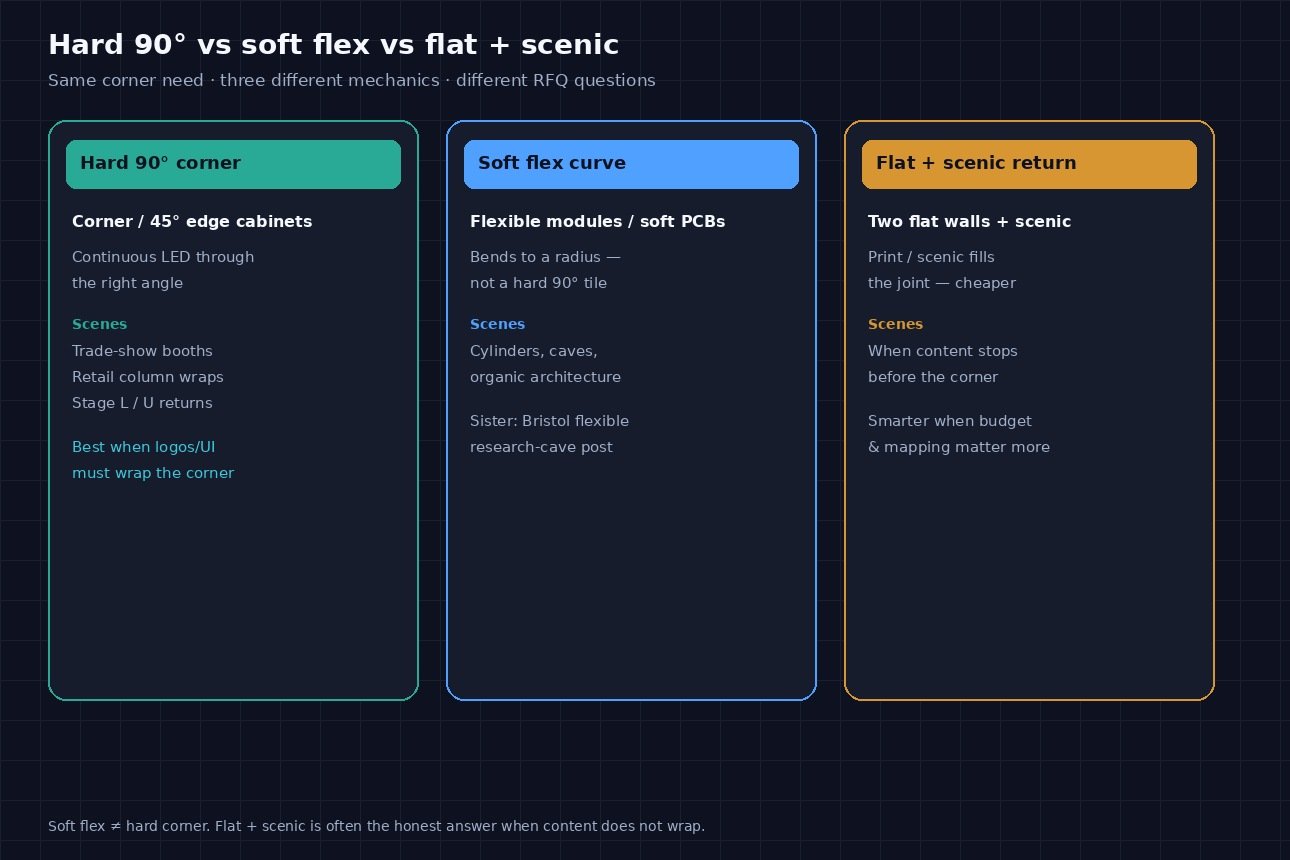
A surprising number of RFQs still treat “corner LED” as if it were one catalogue part. For modular LED, how you turn the corner is a mechanic choice:
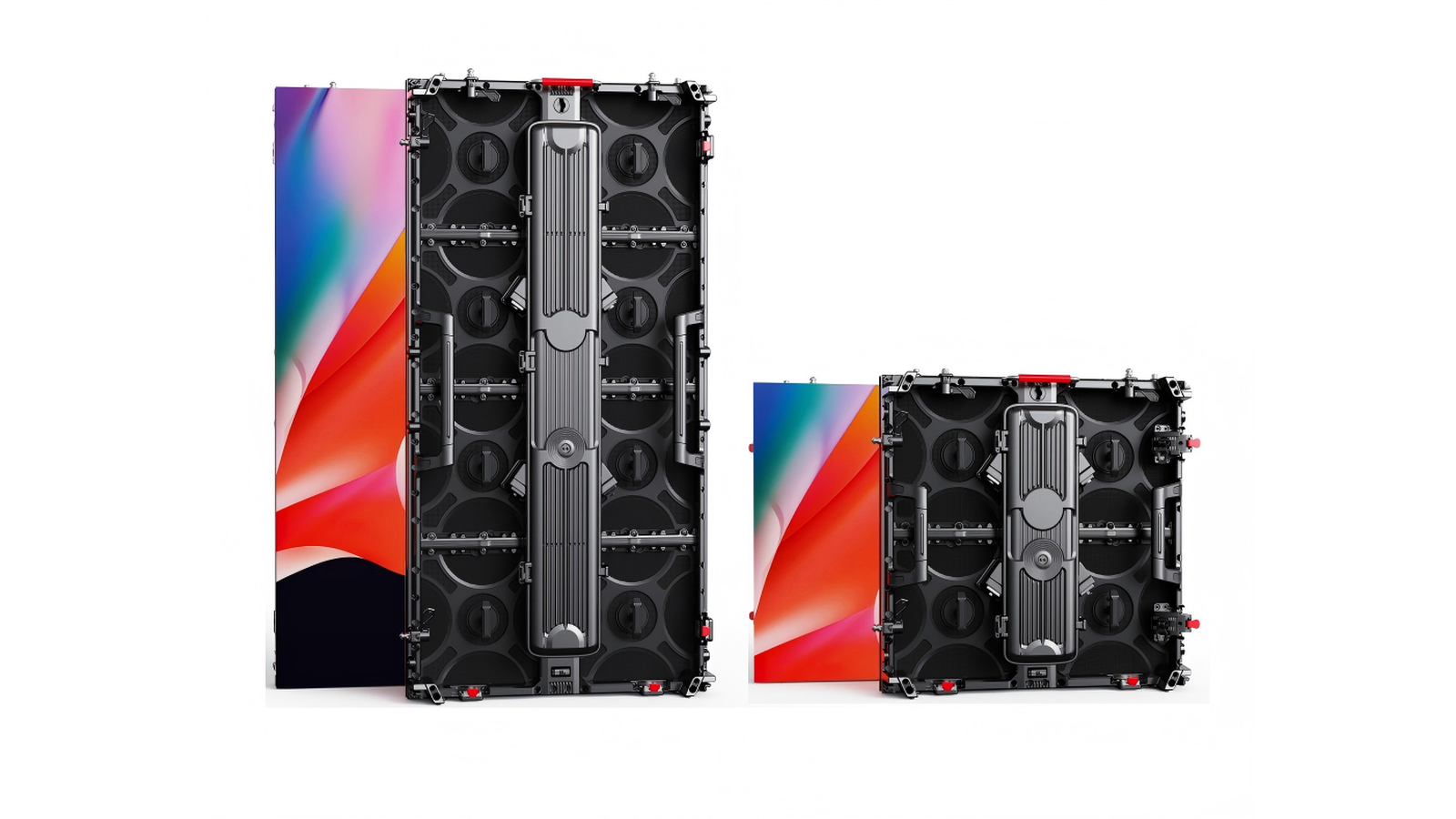
- Hard 90° corner cabinets / 45° edge-cuts — purpose-built tiles (or paired 45° edges) that keep pixels continuous through a right angle. This is what the 7 Oct packaging is selling when it says content can wrap corners and columns on the same indoor platform.
- Soft flex curve — flexible modules / soft PCBs that bend to a published radius. Great for cylinders, caves, and organic architecture. Not a hard right-angle tile. Our live Bristol flexible LED research-cave post covers that mechanic — link it; do not confuse it with a 90° corner SKU.
- Flat wall + scenic return — two flat walls meet; print, scenic, or a non-LED return fills the joint. Often cheaper and lower mapping risk when logos and UI stop before the corner.
Creative flat + flex modules (6 Oct supporting news) prove non-flat demand is real — but flex minimum diameter and hard 90° are still different RFQ lines. Faceted “approximate curves” (already common on fine-pitch indoor) are a fourth cousin: they look curved from far away and still leave a segmented joint up close.
Where 90° corners earn their keep — and the gotchas
Scenes that justify a true corner tile
- Trade-show booths — brand walls that wrap an L or U so the logo never “falls off” the edge when visitors walk the aisle.
- Retail / column wraps — architectural columns and shop corners where continuous product film matters more than a scenic filler.
- Stage L / U returns — side returns that keep IMAG or scenic content continuous as the eye leaves the main wall.
Gotchas that belong in the RFQ before the PO
- Content mapping across the corner — UI, logos, and video must be authored for the wrap; a 16:9 slide stretched around 90° looks worse than a flat wall. Pair with LED wall resolution / pixel map literacy.
- Seam / gap risk — corner joints are where mechanical tolerance shows; write acceptable gap mm and who owns seam QA.
- Pitch at close viewing — booth and retail viewers often stand under 2–3 m; fine pitch that looks fine on a flat 6 m wall can look coarse on a wrapped column.
- Service / locking — front service and locking hardware still matter when the corner sits flush to architecture; see magnetic vs screw vs front-locking modules.
- When flat + scenic is smarter — if content stops before the corner, if mapping budget is thin, or if the wrap is cosmetic only, two flat walls + scenic often win on cost and risk.
This article is not a rewrite of our live Bristol flexible post (soft curve / research cave), not a redo of transparent LED rental without a PSU column, and not a morph of amphitheater modular resize or LED wall vs projector for events. Those pages answer different questions. This one answers how you turn a hard corner.
Buyer meaning: pick the mechanic before the SKU
If you are specifying a trade-show booth, retail wrap, or stage return in late 2026, put these lines above “who has a corner product?”:
- Does content actually wrap the corner — or are we buying a corner SKU for a moodboard that stays flat in real life?
- Is the right mechanic hard 90°, soft flex radius, or flat + scenic?
- Can the vendor show cabinet geometry (45° edge / corner SKU), pixel map across the joint, and seam tolerance in one table?
- What is the closest viewing distance on the wrapped face — and does pitch match it?
- Who owns content authoring for the wrap (brand agency, in-house, or “we will figure it out on site”)?
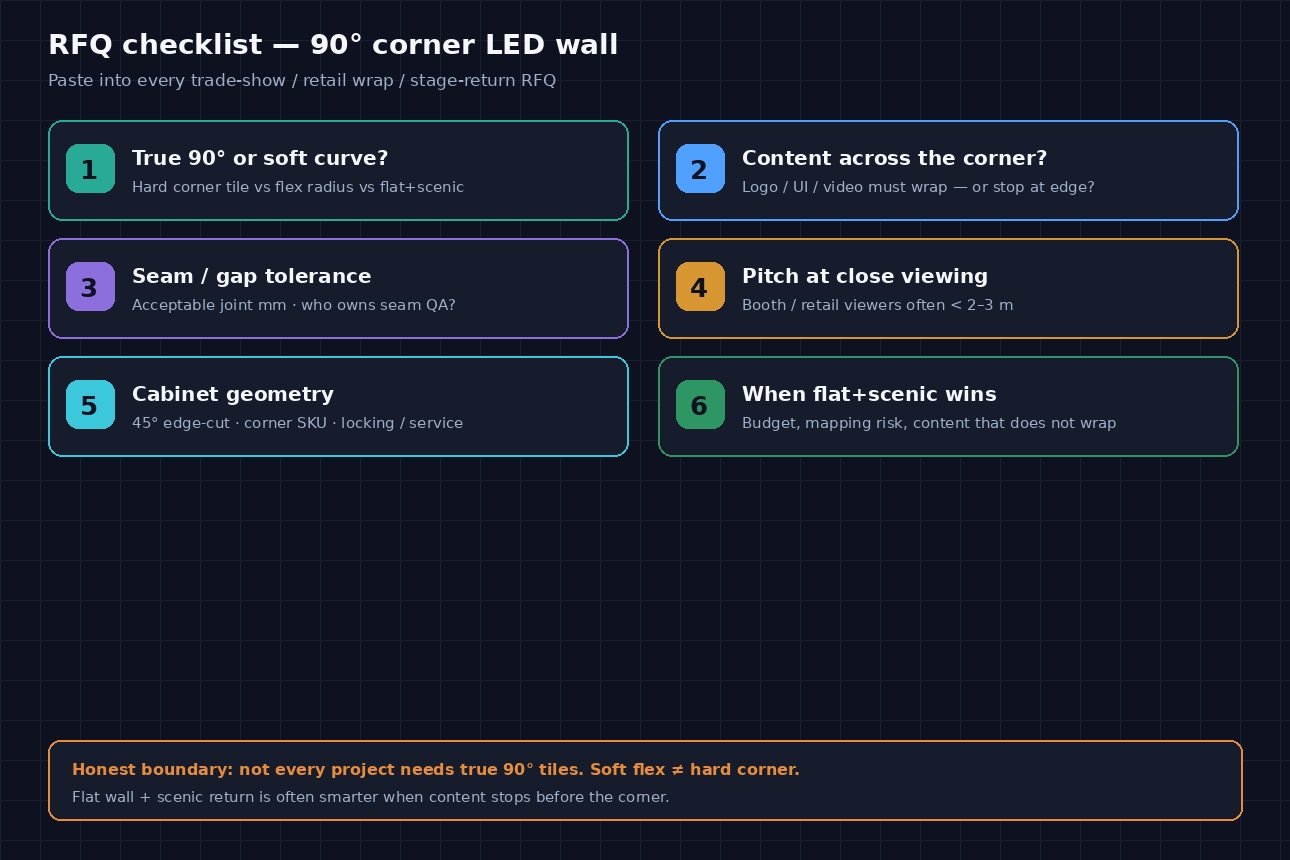
RFQ checklist — six written questions
| # | Ask in writing |
|---|---|
| 1 | Do we need a true 90° corner tile, a soft flex radius, or flat walls + scenic return? |
| 2 | Must logo / UI / video wrap the corner continuously — or does content stop at the edge? |
| 3 | What seam / gap tolerance (mm) is acceptable, and who owns seam QA on site? |
| 4 | What is the closest viewing distance on the wrapped face, and which pitch matches it? |
| 5 | Exact cabinet geometry (45° edge-cut / corner SKU), locking, and front/rear service plan. |
| 6 | When would flat + scenic be the smarter answer (budget, mapping risk, content that does not wrap)? |
Honest boundary
SFxDisplay designs and supplies LED walls from real drawings and RFQs. This article comments on dated public product packaging (7 Oct corner capability + 6 Oct creative flat/flex) and on the existence of hard-corner rental SKUs — it is not an SFxDisplay SKU card, and it is not a claim that every booth or lobby should buy true 90° tiles. Soft flex is not a hard corner. Faceted curves are not a hard corner. Flat + scenic is often the honest answer when content does not wrap. If your quote cannot show mechanic → geometry → pixel map across the joint in one table, you are not ready to buy “corner LED.”
Related reading (live only)
- Bristol Flexible LED Research Cave 2026 (soft flex curve — distinct mechanic from hard 90°)
- Amphitheater Touring LED Modular Resize 2026
- LED Wall Resolution / Pixel Map
- Magnetic vs Screw vs Front-Locking LED Modules
- Transparent LED Rental — No PSU Column 2026
- LED Wall vs Projector for Events in 2026
FAQ
Do I always need a true 90° corner tile?
No. Specify hard 90° when logos/UI must wrap continuously. Soft flex fits radius work. Flat + scenic often wins when content stops before the corner.
Is soft flex the same as a hard corner?
No. Soft flex bends to a radius; a hard corner is a right-angle cabinet (or paired 45° edges). See our Bristol flexible post for the soft-curve mechanic — different RFQ.
Why are rental houses stocking corner SKUs?
Public catalogs already list 90° / perfect-corner rentals, which means buyers ask for them in writing. Stocking is a demand signal — not proof that every job needs one.
What breaks first on a bad corner install?
Usually content mapping (logo stretched around the joint) and seam appearance up close. Write pixel map + gap mm into the RFQ before cabinetry is locked.
Does this replace outdoor fine-pitch / high-nit shopping?
No. The same October package also talked outdoor fine-pitch and high brightness — that lane stays separate (and near our outdoor close-view / MIP lane). This article is about indoor / booth / retail / stage corner mechanics.
Specifying a trade-show booth, retail column wrap, or stage L/U return? Send booth/room photos, whether content must wrap the corner, closest viewing distance, and pitch target — we will reply with a corner-mechanic checklist you can paste into every RFQ (hard 90° vs soft flex vs flat+scenic, not a magic SKU name).
WhatsApp +86 150 1911 0341 · molly@sfxdisplay.com · Get a quote
SFxDisplay — LED factory for rental & fixed cabinets. Industry commentary from dated public product packaging; not an SFx SKU card. Soft flex ≠ hard corner; not every project needs true 90° tiles.