
In late October 2026, dated public event-AV guides put the same planner question back into corporate inboxes: LED wall, or will a projector still do? One selection guide (updated 22 Oct) framed the split plainly — LED for bright venues, large audiences, and product launches; projectors for smaller indoor meetings with controlled light — and published viewing-distance pitch bands around 1.9–2.6 / 2.9–3.9 / 4.8–6 mm, plus a warning that content aspect ratio and hybrid stage-LED + breakout-projector layouts matter as much as the headline technology. Two days earlier, another business-event framework (updated 20 Oct) boiled the choice down to ambient light, viewing distance, space above and behind the stage, content type, cameras, build window, and venue power / rigging rules — seven written questions before anyone crowns a winner. A published U.S. house comparison (23 Sep 2026) put numbers under the brightness argument: indoor LED often about 800–1,500 nits, outdoor 5,000+, versus a few hundred nits of usable screen brightness from even a high-lumen projector on a large surface once house light lands. Supporting cost-structure literacy from another public comparison puts a comparable ~16 × 9 ft LED day rate roughly 2–3× a projector-and-screen package in that market — useful as structure, not as an SFx price. And a 10 Sep 2026 daylit-atrium pattern keeps showing up in buyer stories: when skylights wash the room and IMAG is in scope, houses keep picking a ~16 × 10 ft P2.9 indoor LED over projection rather than fighting daylight. That is the news. The buyer question underneath it is simpler: before you compare a “P2.9” line to a “12k lumen” line, have you aligned light, cameras, shape, setup window, and budget — or are you comparing two different shows?
What the guides actually say (facts only)
Treat the following as category facts from dated public packaging, not as an SFxDisplay price list and not as an endorsement of any rental house, client, or cabinet OEM:
| Item | What public packaging says (de-branded) |
|---|---|
| When LED is favoured | Bright / daylit rooms, large audiences, product launches, brand-heavy stages, outdoor daylight |
| When projector is favoured | Smaller indoor meetings, training, seminars; rooms that can go properly dark; tight budgets; mapping onto non-screen surfaces |
| Indoor LED brightness (one published U.S. range) | About 800–1,500 nits indoors; outdoor panels often 5,000+ nits |
| Pitch bands by viewing distance (one Oct 2026 guide) | About 1.9–2.6 mm (close / VIP); 2.9–3.9 mm (most indoor stages); 4.8–6 mm (large halls / outdoor evening) |
| Decision questions (one Oct 2026 framework) | Ambient light control; nearest / farthest row; ceiling / rigging / windows; content type; filmed or streamed?; build + rehearsal window; venue power / floor / hang rules |
| Cost-structure literacy (dated public examples) | Comparable ~16 × 9 ft LED day packages often about 2–3× a projector-and-screen package in published house examples — gap can narrow on multi-day jobs |
| Bright-atrium pattern (Sep 2026) | Daylit / skylit venue with 200+ guests and IMAG → ~16 × 10 ft P2.9 ground-supported LED chosen over projector |
| Hybrid layout FAQ | Main-stage LED + projector (or smaller screens) in breakouts is a normal budget split, not a failure |
None of that replaces your city’s market, your hang plot, or your camera rider. It only tells you what October packaging is training buyers to demand in writing.
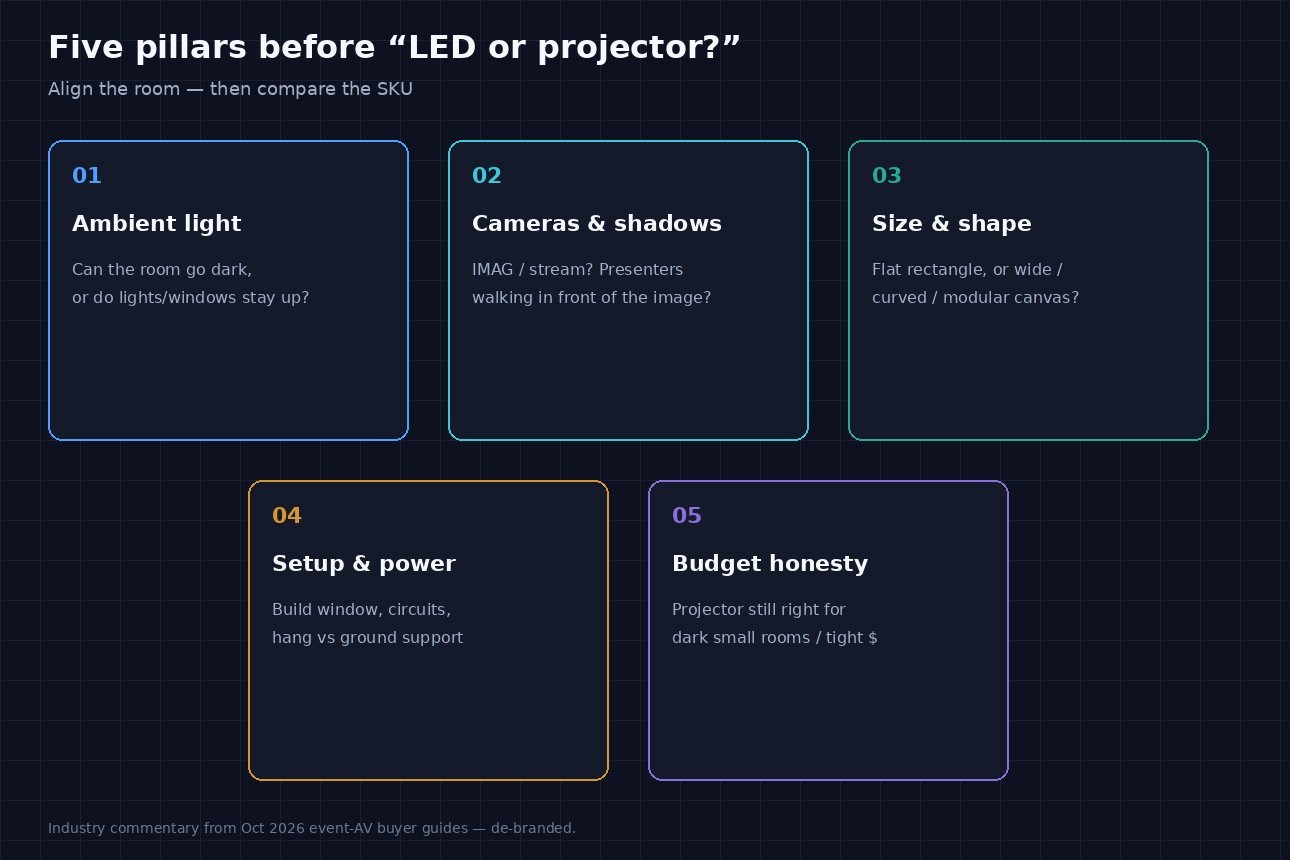
Five pillars that matter more than “LED or projector?”
1) Ambient light decides first
If house lights stay up for note-taking, windows cannot black out, or the room is a skylit atrium, projection is fighting physics. LED emits its own light; a projected image only looks as bright as the leftover contrast after ambient light hits the screen. Sister literacy on LED nits vs lumens belongs in the same email as the technology choice — nits and lumens are not interchangeable shopping labels.
2) Cameras and shadows change the same room
Front projection puts a beam in the air: presenters walking downstage cast shadows; IMAG and livestream often read the projected image as flat once stage light is up. LED removes the throw path and usually photographs punchier when pitch and camera settings are matched (watch moiré). If photos, IMAG, or a stream are in scope, put that in the RFQ before you crown the cheaper option. Pair with our 3840 vs 7680 Hz page when the wall will be filmed.
3) Size and shape are not the same product
LED builds in panel increments — wide canvases, curves, columns, asymmetric stage sets. Projection is limited by throw distance, screen size, and how fast brightness falls as the image grows. Content aspect ratio matters too: many LED stages are wider than default 16:9 slides. Ask for the exact wall resolution early, or you will letterbox a keynote on the most expensive screen in the building.
4) Setup window and power are ops, not footnotes
A small projector-and-screen package can often be up in under an hour; a mid-size LED wall usually wants structure or ground support, dedicated circuits, processing, and a rehearsal on the actual canvas. Sister pages on setup time / load-in and venue power circuits vs outlets should travel with the display decision. A bright atrium that “needs LED” still fails if the building cannot feed the wall or the load-in window is a ninety-minute turn.
5) Budget honesty — projector is not “obsolete”
Published house examples in 2026 still show LED day packages often roughly 2–3× a comparable projector-and-screen line. That gap can be the right spend for a lit product launch; it can also be the wrong spend for a dark breakout or a nonprofit gala that only needs readable slides. Multi-day curves, outdoor IP-rated walls, and flown rigs move the number again. Chinese-language 2026 rental guides keep making the adjacent point that panels-only ≠ all-in (hang, labour, transport) — useful as literacy, but a different checklist from technology choice.
Buyer meaning: align the room before the SKU
If you are choosing between an LED wall and a projector for an event in late 2026, put these lines above “who is cheaper?”:
- Can this room go properly dark — or will lights / windows stay up?
- Will the session be filmed, streamed, or IMAG’d?
- Do presenters need to walk in front of the image?
- Is the canvas a flat rectangle, or a wide / curved / shaped set?
- What is the build + rehearsal window, and who owns power / hang approval?
- Same inclusion list on both quotes (processor, labour, technician, calibration, freight).
- Is a hybrid split smarter — LED on the main stage, projection or smaller screens in breakouts?
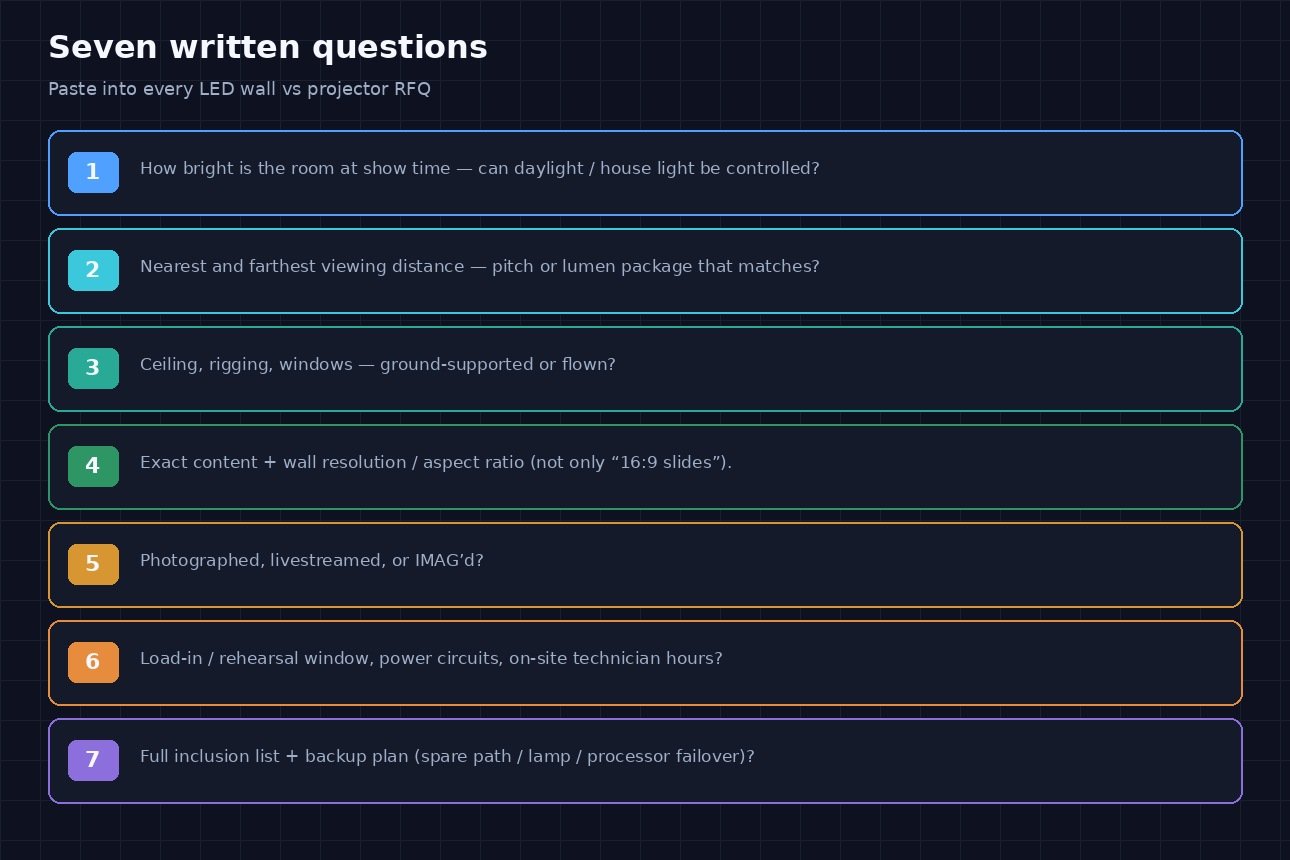
RFQ checklist — seven written questions
| # | Ask in writing |
|---|---|
| 1 | How bright is the room at show time, and can daylight / house light be controlled? |
| 2 | Nearest and farthest viewing distance — and the pitch or lumen package that matches. |
| 3 | Ceiling height, rigging points, windows, and whether the wall is ground-supported or flown. |
| 4 | Exact content: slides, motion, live camera, data — and the wall resolution / aspect ratio. |
| 5 | Will the event be photographed, livestreamed, or IMAG’d? |
| 6 | Load-in / rehearsal window, power circuits, and on-site technician hours. |
| 7 | Full inclusion list + backup plan (spare path, spare projector/lamp, or panel/processor failover). |
Honest boundary
SFxDisplay designs and supplies LED walls from real drawings and RFQs. This article comments on dated public event-AV selection guides — it is not an SFxDisplay city day-rate card, and it is not a claim that projectors are obsolete. Dark small rooms, tight budgets, and non-screen mapping surfaces still favour projection. Bright rooms, cameras, large seamless canvases, and daylight outdoor work usually favour LED. If your quote cannot name light assumptions, camera needs, and the inclusion list, you are not ready to pick a technology.
Related reading (live only)
- LED Nits vs Lumens
- LED Wall Setup Time / Load-in
- LED Wall Venue Power: Circuits vs Outlets
- 3840 Hz vs 7680 Hz LED Refresh Rate
- Transparent LED Rental: When Power Boxes Kill the Scenic Look (Oct 22 sister — different topic)
FAQ
Is an LED wall always better than a projector for corporate events?
No. For bright venues, large audiences, product launches, and camera-critical stages, LED usually wins. For small indoor meetings with controlled lighting and a tight budget, a projector is often the smarter call.
Why do October 2026 guides keep comparing them again?
Because planners still get one quote that assumes a dark room and another that assumes a lit ballroom — both labelled “stage screen.” Dated guides are training buyers to align light, cameras, shape, and setup before comparing price.
How bright is indoor LED vs a large projected image?
One published U.S. house range (Sep 2026) cites about 800–1,500 nits for indoor LED and 5,000+ outdoors. A high-lumen projector on a large screen often lands at only a few hundred nits of usable peak white once ambient light hits the surface. Confirm for your room — do not shop nits against lumens as if they were the same unit.
Can I mix LED and projectors at one event?
Yes. Many conferences put LED on the main stage (and on camera) and use projectors or smaller screens in breakouts. That is a budget and ops split, not a compromise of quality.
Are published LA or other city $ bands my price?
No. They are dated public examples that show structure (including a rough 2–3× LED-vs-projector gap in some markets). Your city, hang plot, outdoor exposure, and crew window will move the number.
Choosing LED wall vs projector for a corporate event, product launch, or conference? Send venue photos, guest count, indoor/outdoor, camera needs, and city — we will reply with an honest checklist you can paste into every RFQ (so quotes cannot hide behind “P2.9” or “12k lumens”).
WhatsApp +86 150 1911 0341 · molly@sfxdisplay.com · Get a quote
SFxDisplay — LED factory for rental & fixed cabinets. Industry commentary from dated public event-AV guides; not an SFx city day-rate card. Projector is not obsolete.