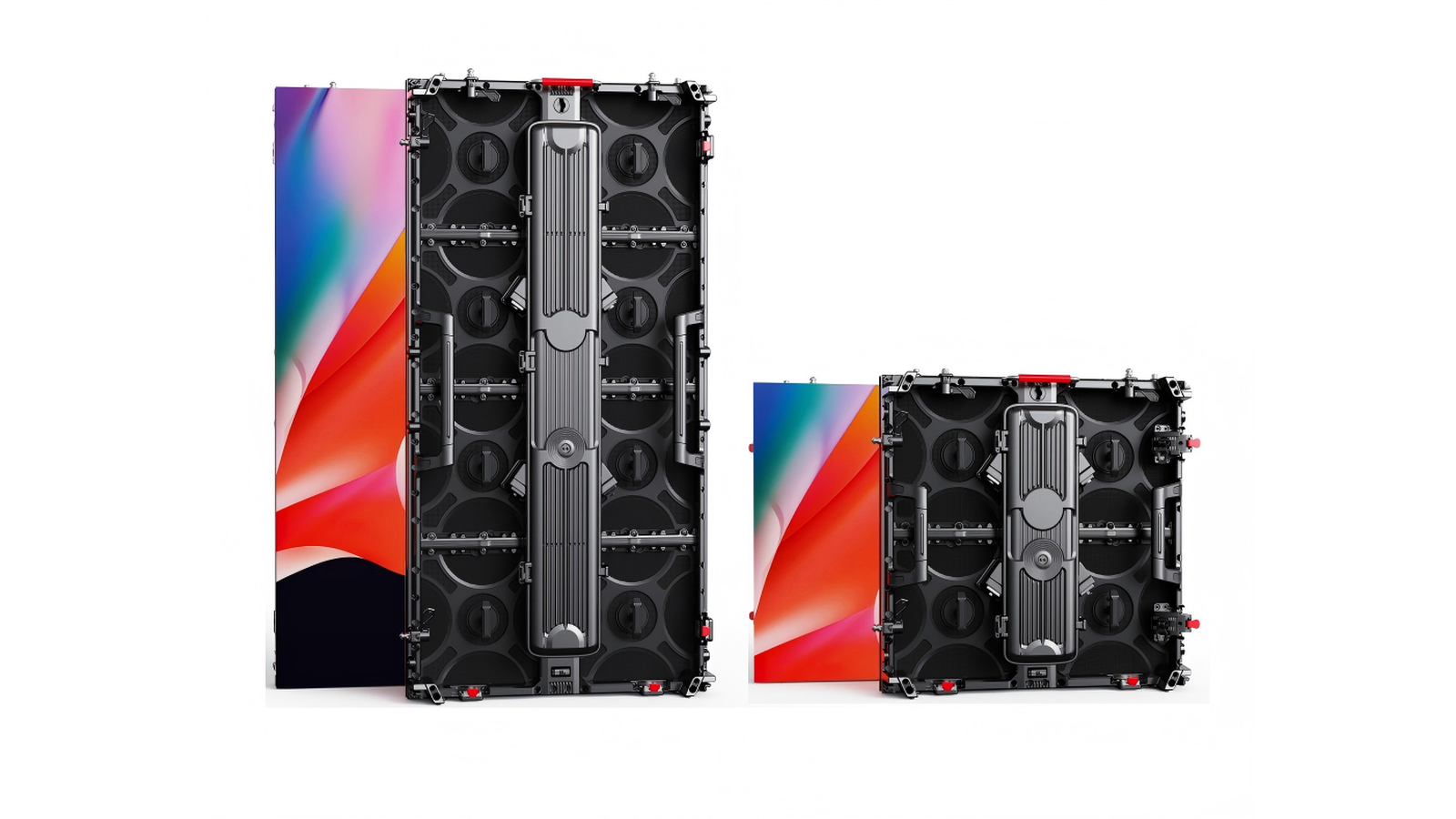

In late October 2026, trade coverage of a European rental house expanding its transparent / scenic LED inventory put a blunt production question back on RFQ desks: what actually ruins a see-through wall once the creative team has already paid for “transparency”? One dated case (trade outlet 20 Oct) paraphrased the buyer pain in plain language — the biggest obstacles with transparent screens have long been power boxes that ruin visual impact — and pointed to a panel architecture that distributes power through the frame, eliminates the conventional central PSU column, and aims for a structure that is nearly invisible from about five to eight metres (Digital AV Magazine, 20 Oct 2026). Category product documentation in the same lane (launch language plus brochure specs) describes a 1000 × 1000 mm rental platform, a slim ~18 mm frame, roughly 92% visual transparency against roughly 44–47% physical open area, outdoor peaks around 4,000 nits, outdoor IP65 / indoor IP40 class, panel weights on the order of ~8.5–11.8 kg, 7,680 Hz / 16-bit grayscale language, optional rear blanking plates that turn transparent into solid, and small curve windows around ±5°.
That is the news. The buyer question underneath it is sharper: when does a “transparent” rental wall fail even though the brochure percentage looks fine?
What the press actually says (facts only)
We cite the dated stories once, then speak in PSU / transparency / scenic language. OEM and rental-house names stay out of the reader body on purpose.
| Fact | Dated source | Notes |
|---|---|---|
| European rental fleet adds transparent rental LED for concerts / broadcast / corporate | Digital AV 20 Oct 2026 | Project / fleet signal — not an SFx inventory claim |
| Buyer pain: power boxes ruin visual impact; want real transparency without structural grille distraction | Same | Scenic look, not pitch millimetres |
| Power through panel frame; no central PSU column; nearly invisible at ~5–8 m | Same + OEM category docs | Architecture question for every transparent RFQ |
| ~1000×1000 mm; ~18 mm frame; ~92% visual / ~44–47% physical transparency | OEM category brochure / launch | Quote both percentages; walk samples at show distance |
| Up to ~4,000 nits outdoor; IP65 outdoor / IP40 indoor class; ~8.5–11.8 kg; 7,680 Hz + 16-bit; blanking plate dual-use; ±5° curve | Same | Category envelope — verify on the SKU you buy |
| CN transparent rental literacy still itemises panels + logistics + build + labour; fly vs ground-stack | Lianman FAQ (older RMB bands) | Literacy only — do not treat 2020 RMB/㎡ as 2026 global prices |
| EN rental SERP still stresses refresh, grayscale, hot-standby, and all-in vs panels-only quotes | PixelPro Oct 7; TriVision 2026; Vancouver all-in Oct 15 | Category support — backup literacy |
We do not invent which pitch every scenic should buy. We do not claim SFxDisplay supplied any named fleet in this week’s press. Venue weight / rider limits, mixed-format inventory, and always-on command are separate topics — amphitheater nightly resize is already live — this article is about transparent power architecture and scenic honesty.
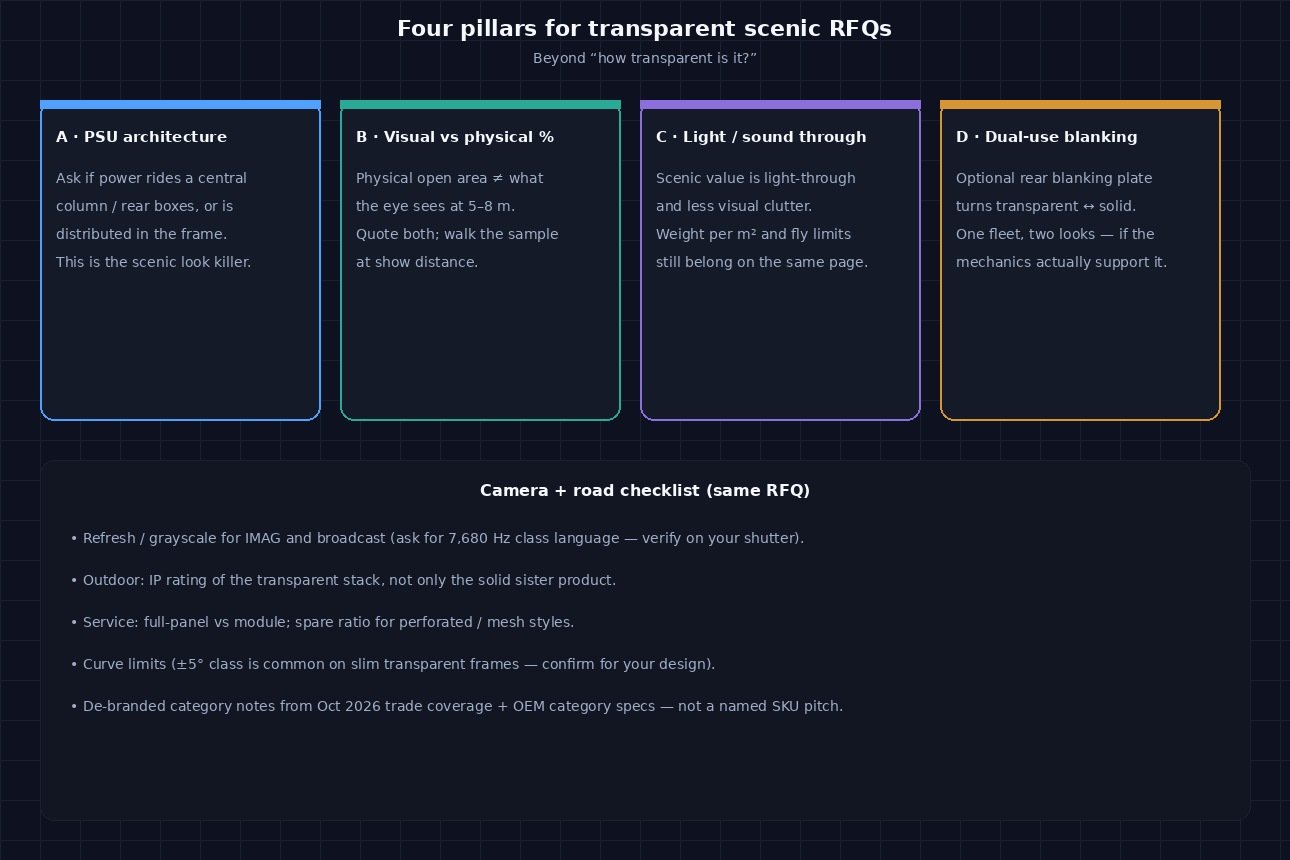
Four pillars one transparent scenic RFQ should cover
| Pillar | Why a “transparency %” quote fails | What the RFQ should force |
|---|---|---|
| PSU architecture | A beautiful open LED face with a fat central power spine still looks like a power spine on camera and to the balcony | Written answer: central column / rear PSU boxes / frame-distributed power + a rear photo of a lit sample wall |
| Visual vs physical % | Physical open area is not what the eye sees at show distance; perforated layouts can “disappear” at 5–8 m while still occupying mass | Quote both numbers; walk the sample at the distance your audience actually sits |
| Light / sound through + weight | Scenic value is light-through and less visual clutter — but fly points and kg/m² still decide the hang | Panel kg, kg/m², max hang rows, and outdoor wind / ballast if the transparent stack leaves the shed (setup time; floor / hang load where relevant) |
| Dual-use blanking | Many houses need transparent one night and solid the next; buying two fleets is expensive | Confirm optional rear blanking plate mechanics and how service / spares change when blanked |
Honest line: a higher transparency percentage that still parks power boxes in the sightline is still a compromised scenic. Transparent buyers pay for clean architecture + verified look at distance, not only for a brochure %.
What buyers should change in the RFQ
- Ask for the power path first — central column, rear boxes, or frame-distributed? Demand a rear photo.
- Split visual vs physical transparency — and schedule a walk at 5–8 m, not only a desk PDF.
- Put weight and hang on the same page as “see-through” — scenic openness does not cancel structural math.
- Decide dual-use up front — blanking plate yes/no, and how content / brightness change when blanked.
- Keep camera language honest but secondary — if IMAG / livestream sit on the scenic, use the live refresh guides; do not let Hertz replace PSU architecture (3840 vs 7680).
- Match IP to the transparent SKU — outdoor IP on a solid sister product is not automatic inheritance (IP54 vs IP65).
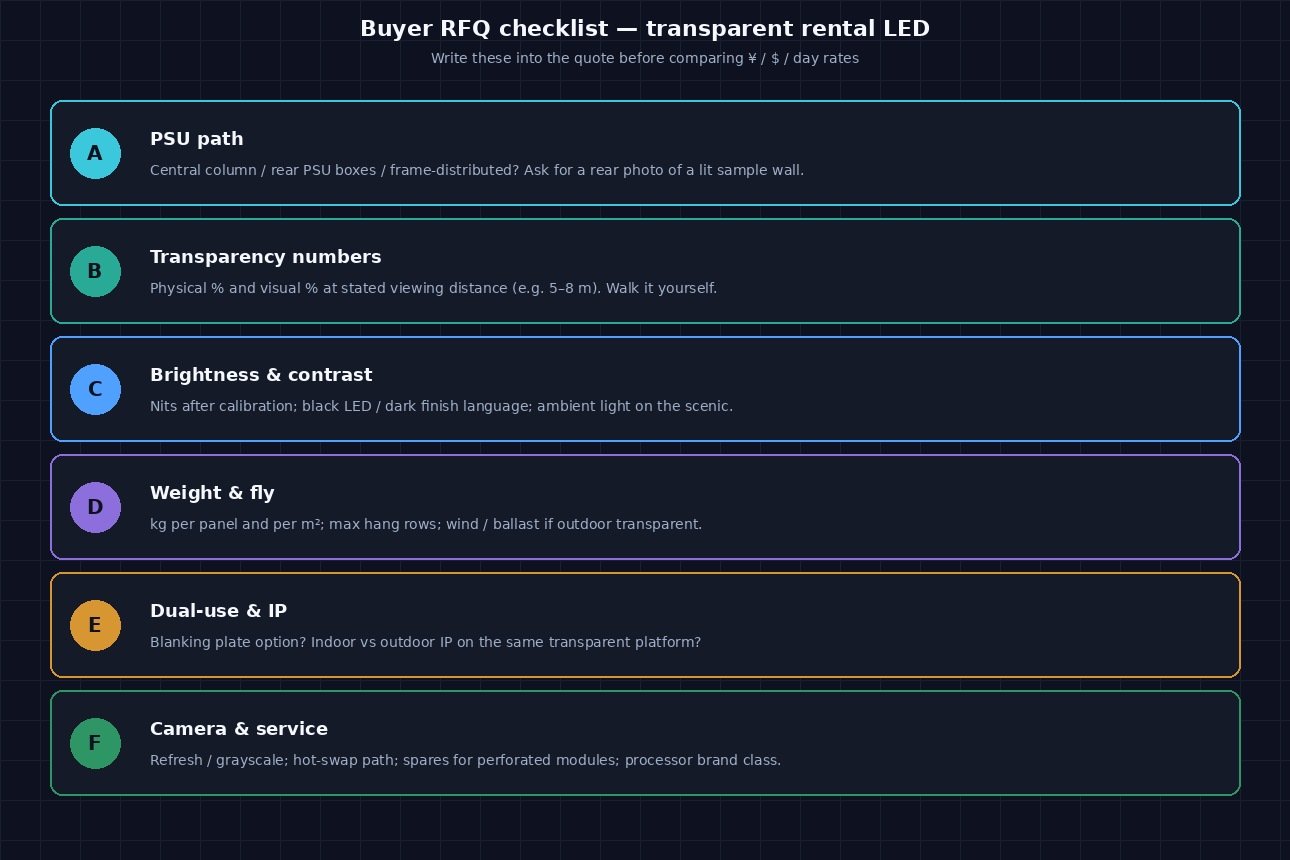
RFQ checklist (copy into your next PO)
| # | Ask | Pass signal |
|---|---|---|
| A | Where does power live — central column, rear boxes, or the frame? | Written architecture + rear photo of a lit sample |
| B | What are physical % and visual % at a stated viewing distance? | Both numbers + a walk at ~5–8 m |
| C | What calibrated nits and black-level finish survive your ambient scenic light? | Calibrated nits + dark-finish language, not peak-only demos |
| D | What is kg/panel and kg/m², and what is the max hang story? | Weight sheet next to the transparency claim |
| E | Is blanking dual-use real, and what IP does this transparent stack carry indoors vs outdoors? | Blanking yes/no + IP on the transparent SKU |
| F | Refresh / grayscale for cameras, spare ratio for perforated modules, service path? | Camera test language + spares kit (hot-swap) |
SFxDisplay lane: we help design rental walls for real scenic and touring jobs — including transparent / mesh-class conversations where power path and verified see-through matter as much as pitch — and we stay clear of claiming we stocked any fleet named in this week’s press.
Related reading (live only)
- LED Wall Setup Time: What Actually Drives Load-In Speed
- LED Rental Spare Parts & Hot-Swap
- 3840Hz vs 7680Hz LED Refresh | What Cameras See
- IP54 vs IP65 LED Display
- Soft vs Hard Connection LED Rental Cabinet
FAQ
Q: Is this the same topic as mixed-format rental inventory?
A: No. Mixed-format inventory is about 500×500 / 500×1000 / cubes on one opaque platform. This article is about transparent scenic power architecture.
Q: Do we always need “92% visual transparency”?
A: No. That number is a category example from public OEM docs. Your pass/fail is what the wall looks like at your audience distance with your lighting.
Q: Does frame power alone win a transparent bid?
A: No. Architecture removes the power-spine problem. Wins also need honest transparency numbers, weight/hang, IP, dual-use, and camera readiness.
Q: Did SFxDisplay supply the fleet in this week’s news?
A: No. This is industry commentary from public trade sources. We de-brand OEM and rental-house names on purpose.
Specifying a transparent / scenic rental LED wall? Send the viewing distance, whether the wall must fly, indoor vs outdoor, and whether you need blanking dual-use — we will help map power path, transparency honesty, weight, IP, and spares before a brochure percentage decides the quote.
WhatsApp +86 150 1911 0341 · molly@sfxdisplay.com · Get a quote
SFxDisplay — LED factory for rental & fixed cabinets. Industry commentary only; not a claim that we stocked any fleet named in this week’s press.