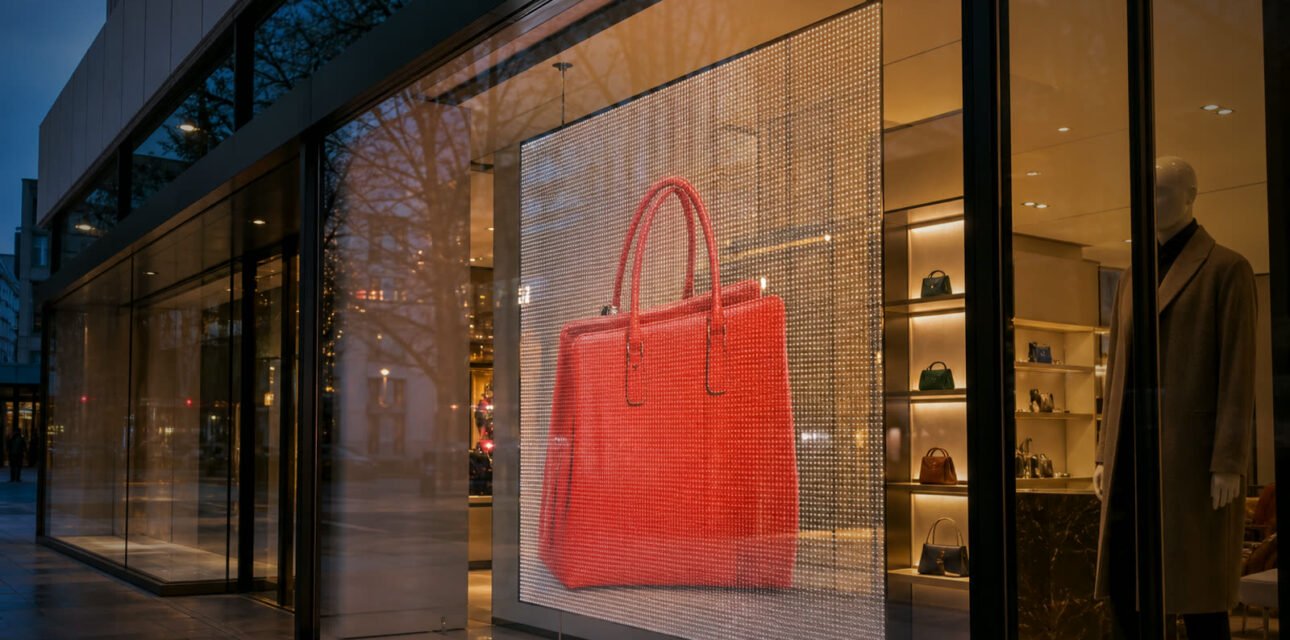
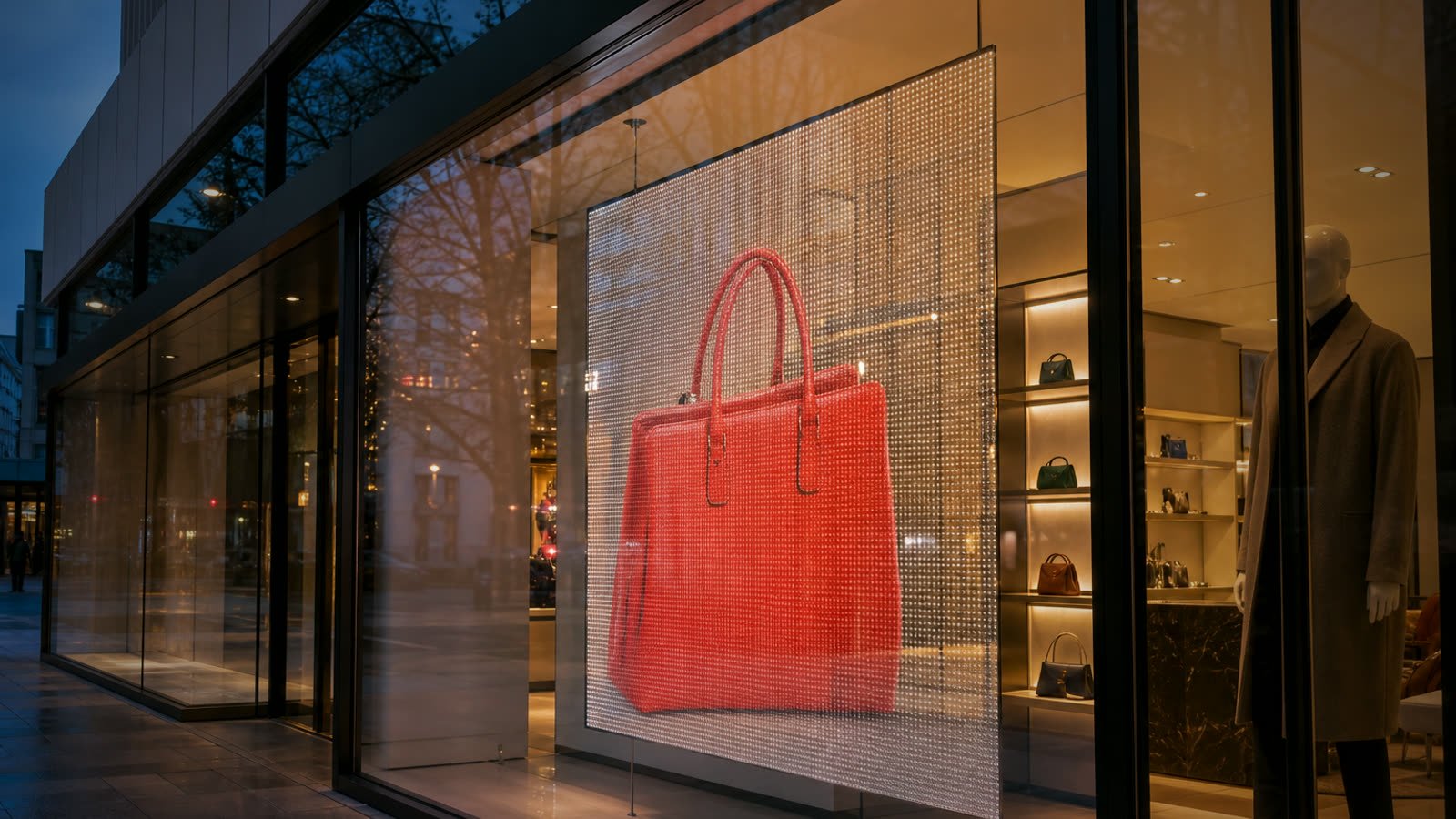
A transparent LED display is a video surface you can still see through. That is the whole product. It is not a hologram, not a Pepper’s Ghost, and not the anamorphic “3D billboard” look that uses a solid LED wall and forced perspective. For retail windows the job is: motion on the glass, product and interior still visible, daylight outside.
SFxDisplay builds transparent LED in indoor and outdoor pitches and brightness levels. There is not a separate product URL in the nav yet, so start from the homepage transparent section and send the window drawing to contact. This article is how to choose the hardware type before anyone talks pitch.
Three hardware types (and when each belongs)
Retail glass is not one problem. Film, cabinets, and structural glass-wall systems solve different windows.
LED film (adhesive / mesh-on-glass) A thin LED film or stick-on mesh bonds to existing storefront glass. Attractive when the landlord will not let you hang cabinets, when the glass is already the façade, and when you need a fast indoor install. Limits: brightness is often lower than a cabinet, service usually means replacing a strip or a section, heat and sunlight on the glass stack have to be checked, and the pixel structure is typically coarser than a close-view indoor wall. Good for large window graphics that will be read from the sidewalk, not for a 2 m viewing distance inside the door.
Transparent cabinets (the usual factory product) Open-structure cabinets with LEDs on a strip or grid, high see-through percent, hung or stacked like other LED boxes. This is what most “transparent LED display” RFQs actually mean. You get serviceable modules, a known IP option (indoor vs outdoor), and a brightness range you can spec for daylight. You also need a structure: a frame inside the glass, a hang from the slab, or a stand-off that does not block the fire exit. Cabinets add depth — often tens of millimeters plus service gap — so measure the reveal.
Glass-wall / media-façade systems Here the LED is designed as part of a curtain wall or a dedicated glass unit, sometimes spanning a whole elevation. This is an architectural product: wind load, cleaning, and the glazing contractor sit in the same meeting as the pixel pitch. It is the right conversation for a new façade. It is the wrong conversation for a two-bay shopfront that needs a screen next quarter.
A short filter: existing glass + landlord limits → film or a slim indoor cabinet behind the glass. Existing glass + daylight + service access → cabinet. New building skin → glass-wall system.
See-through percent vs image density
Transparency is quoted as a percentage of open area. Higher percent means more of the interior (or the sky) remains visible and less wind load on an outdoor mesh. It also means fewer LEDs, so the image is more “dots in air” up close.
Planning, not a datasheet:
- High transparency (often in the 60–80% conversation) keeps merchandising and daylight. Fine for large logos, simple motion, and night-time window graphics. Up close, you will see the grid.
- Lower transparency packs more pixels, looks more like a conventional wall from the sidewalk, and starts to hide the shop. If the brief is “we still want to see the dresses,” do not fill the glass with a dense pitch.
Pitch on transparent product is often coarser than indoor solid walls, and it can be asymmetric (tighter horizontally than vertically) because of how strips are laid out. Viewing distance is still the first number: a sidewalk 4–8 m away does not need P1.5. A mall corridor at 2 m might need a denser cabinet or a different product.
Ask for a sample cabinet or a film swatch on the actual glass. Photographs of other cities’ windows do not show your tint, your mullions, or your noon sun.
Daylight is the hard spec
A window faces the sky. Indoor-bright transparent product that looks vivid in a factory hall can disappear at noon on a west-facing street.
Treat nits like any outdoor-facing LED:
- Deep mall interior, no direct sun: indoor-class brightness may be enough.
- Street-facing glass with sun on the façade: you need a high-nit transparent cabinet (or you run the window as a night-time medium and accept daytime as branding-only).
- South- or west-facing glass in summer: budget the high end, and plan for glare on the glass itself. The LED cannot fix reflections on the pane in front of it.
Outdoor-rated transparent cabinets exist for façades that see weather. A film on the inside of insulated glass is an indoor product even if the street is outside. Do not mix those IP ratings.
Dimming at night is mandatory. A window left at daytime nits becomes a nuisance light. Specify a schedule and a driver that still looks even when dimmed.
What a window install actually involves
A transparent LED is not a TV on a floor stand.
- Mullions and doors. Content will be broken by frames unless you design around them. Doors that swing or slide need a gap; cabinets cannot block egress.
- Service. Front service may mean standing on the sidewalk. Rear service may mean a stockroom you do not have. Pick this before pitch.
- Cables. Power and data have to leave the glass line cleanly. Landlords notice surface raceways.
- Heat. Glass + sun + LED is a stack. Leave a gap, know the HVAC at the window, and do not seal cabinets in an unventilated reveal.
- Content. Small type fails. High-contrast, large motion, short loops win. If the merchandiser still needs to see through, keep fill and brightness in a range that does not turn the window into a solid billboard.
Cost sits in the same band as other LED equipment — often $600–$2,500 per m² depending on pitch, with transparent frequently mid-to-high because of structure and high-nit drivers. Cabinets are still about 55–65% of turnkey; film plus labor can flip that ratio. Planning estimates, not quotes.
It is not a hologram
If the brief says “hologram in the window,” stop and name the product.
- Transparent LED: real pixels on a see-through grid. You see the shop behind. This article.
- Anamorphic / “holographic” LED billboard: usually a solid LED wall shot from a specific camera angle. We build that as a different product. It does not make the wall disappear.
- True holography: not what a storefront LED RFQ delivers.
Selling a window as a hologram sets a visual expectation the hardware will not meet. Sell motion, see-through merchandising, and night-time presence.
FAQ
Can we apply film to existing storefront glass? Often yes, if the glass type, coating, and warranty allow it. Confirm with the glazing supplier. Film is still an indoor-side product on most shops.
What see-through percent should a fashion window use? Start high enough that product and lighting still read, then add density only if the sidewalk image looks too thin. A sample on one pane beats a number in an email.
Will it work in daylight? Only if nits and glass orientation were specified for noon, not for a night rendering. Ask for a daytime photo of the façade with the RFQ.
Do we need a dedicated product page to request a quote? Not yet. Use the homepage transparent section and contact with width, height, indoor vs outdoor, and a street photo.
Send the window, not a hologram brief
Measure the glass, photograph it at noon, and say whether people must still see merchandise through the picture. We will recommend film vs cabinet vs a façade approach and a nits package. Contact SFxDisplay.