
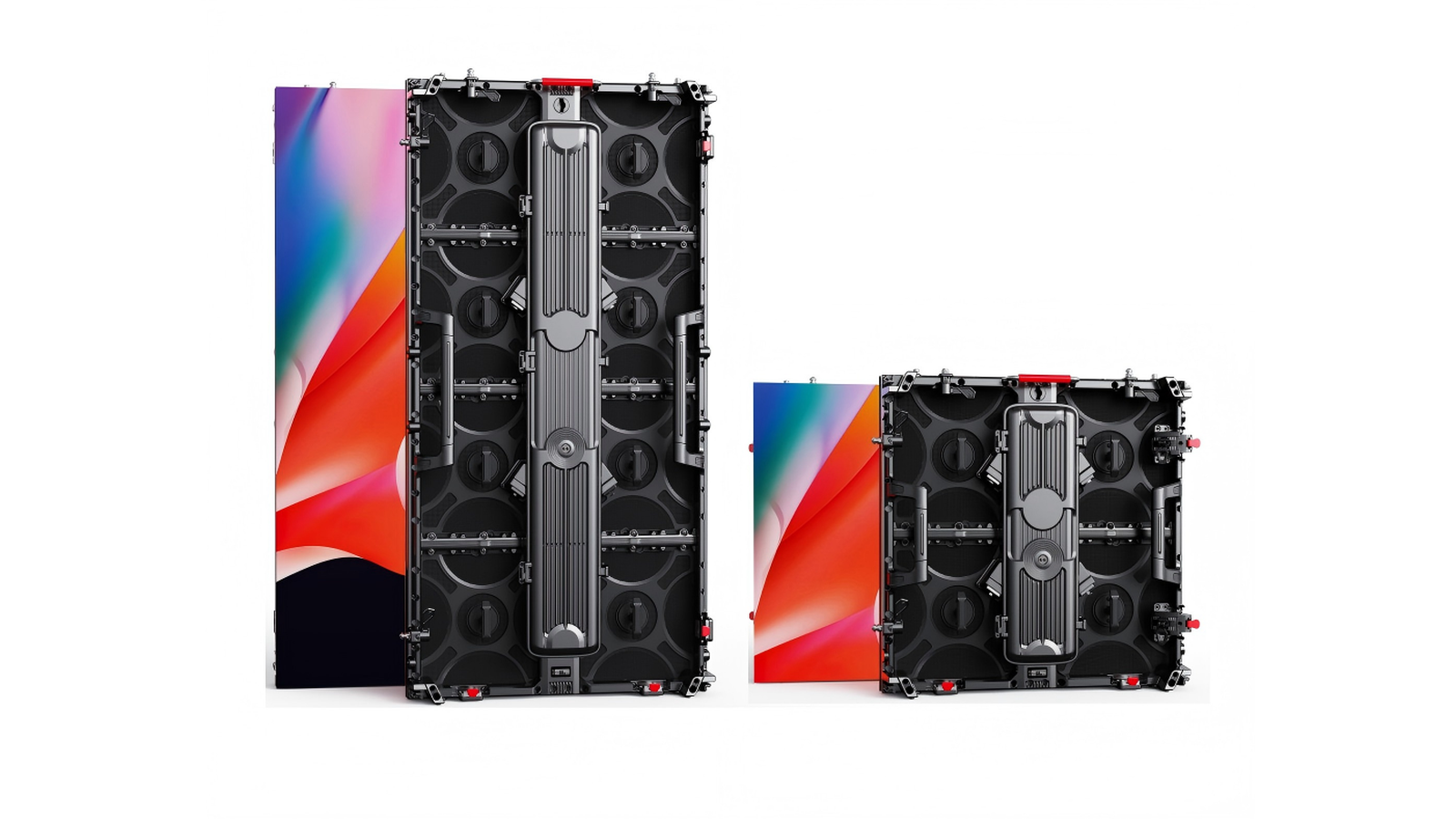
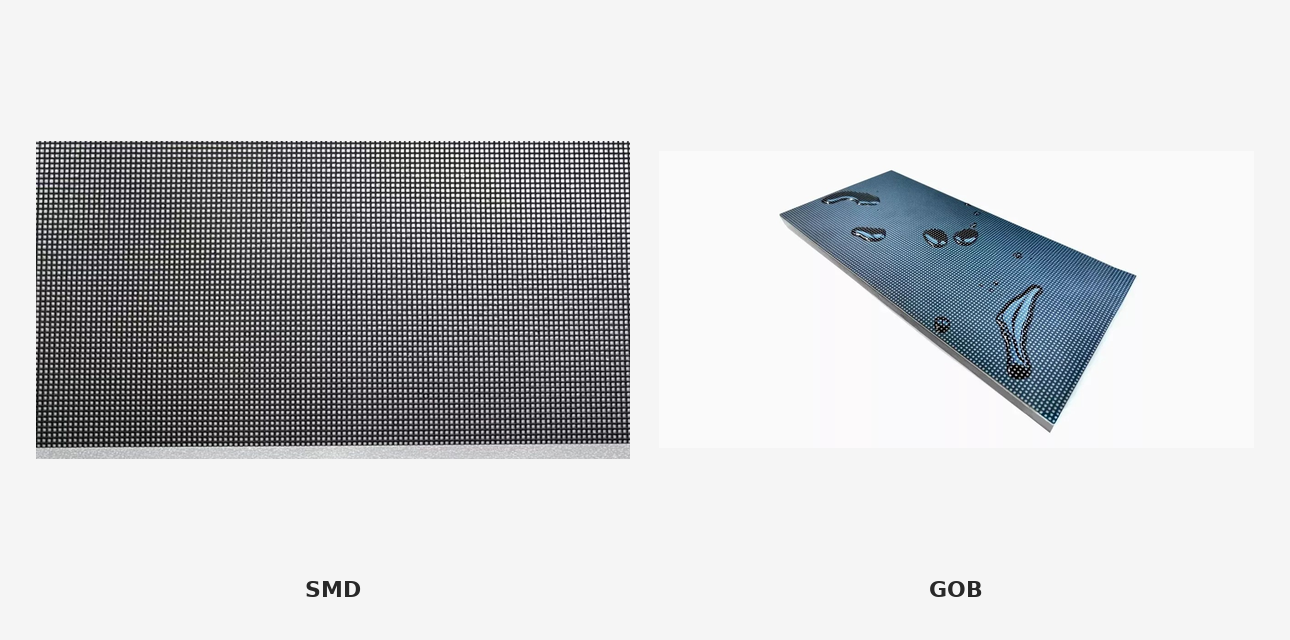
Glue on Board (GOB) adds a cured protective layer over the front of an assembled SMD LED module. It can make the face more resistant to bumps, dust, moisture and static. It does not automatically make every cabinet waterproof, does not create a smaller pixel pitch, and does not turn a difficult repair into an easy one.
This guide compares GOB with SMD and COB, briefly explains where MIP fits, and gives a practical way to choose based on viewing distance, touch risk, operating environment and maintenance. For the wider selection sequence–viewing distance, brightness, installation type and camera use–see our guide on how to choose an LED display.
What GOB LED actually is
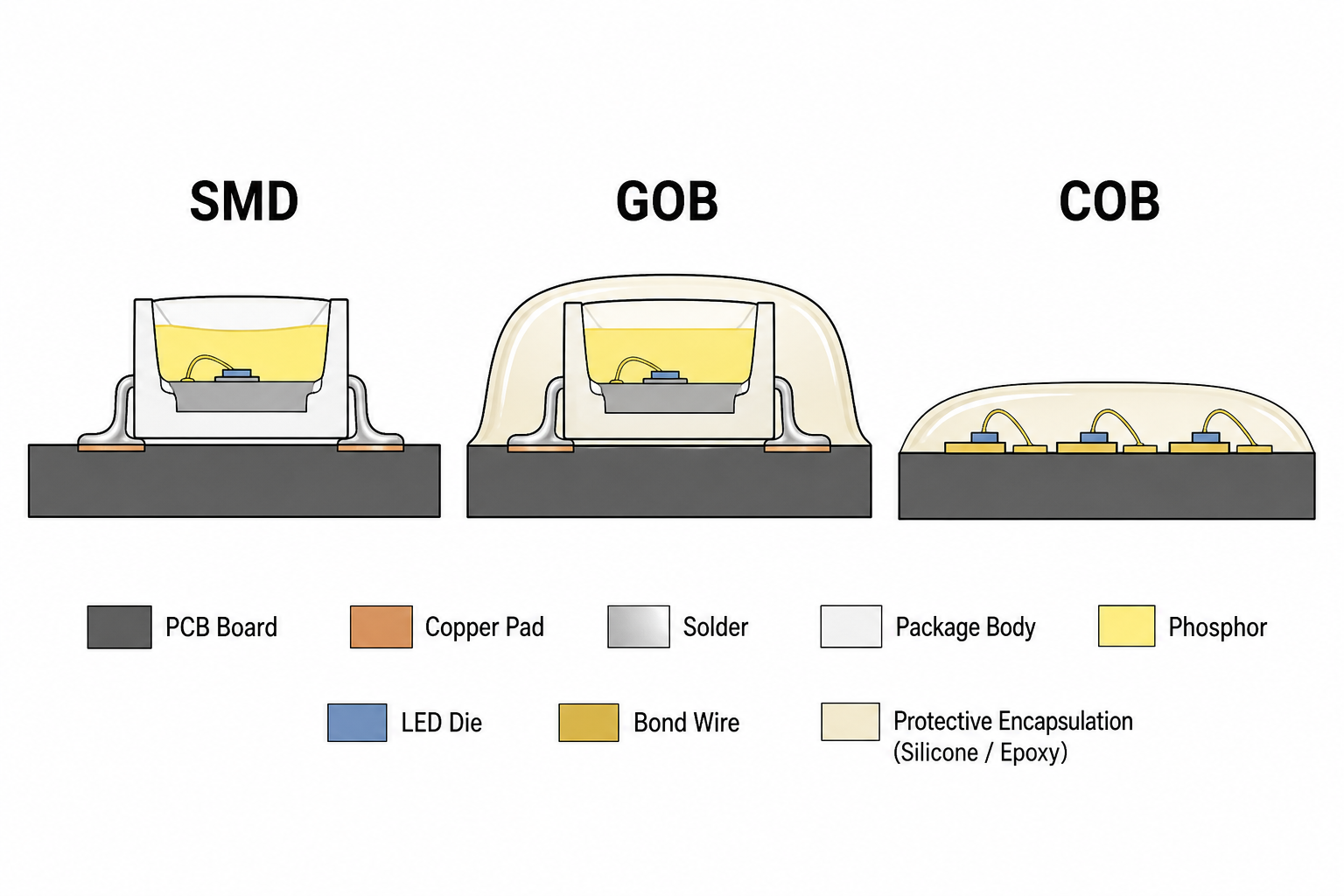
In a conventional SMD module, packaged red, green and blue LED devices are soldered onto a printed circuit board. The packages are visible on the face of the module. That mature construction is flexible and serviceable, but an exposed lamp package can be damaged by a hard impact, careless handling, dust, liquid or repeated transport.
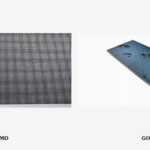
GOB keeps the SMD foundation and adds a transparent or optical protective material across the display face. The material fills the gaps around the lamp packages and cures into a continuous surface. The exact resin, thickness, finish, curing process and optical treatment vary by product; “GOB” by itself is not a complete performance specification.
That distinction is important. GOB is best understood as a protection and surface-treatment process applied to an SMD module. It is not the same construction as COB, where bare LED chips are mounted directly on the board and then encapsulated. A GOB quote should still identify the underlying SMD module, pixel pitch, cabinet design, ingress protection and service method.
GOB vs SMD vs COB vs MIP: the short version
| Technology | How the pixel is built | What it is usually good at | Main trade-off |
|---|---|---|---|
| SMD | Packaged LED devices are soldered to the PCB | Cost control, broad availability, lamp-level rework by a trained technician, many outdoor and rental formats | Exposed packages are more vulnerable to impact and contamination |
| GOB | An SMD module receives a cured protective face layer | Protecting a touch-prone or frequently handled SMD surface; a practical middle option | The cured layer complicates pixel repair and must be processed consistently |
| COB | Bare LED chips are mounted directly on the PCB and encapsulated | Fine-pitch indoor walls, a smooth close-view surface, high mechanical protection | Higher process complexity and normally module-level service when a chip fails |
| MIP | Very small LED chips are packaged into components before module assembly | Ultra-fine-pitch products where packaged micro-pixels, inspection and SMT-style assembly are useful | Availability, terminology, service model and maturity vary by product |
There is no universal “best” row. The same pixel pitch can be built with different processes, and pixel pitch–not the label alone–sets how much detail a viewer can resolve. At a distance, a well-made SMD, GOB or COB display of the same pitch may look more alike than a sales comparison suggests. Up close, the surface texture, black level, calibration and pitch become easier to see.
For a deeper look at the close-view and repair trade-off between SMD and COB, read COB vs SMD: Close View vs Field Fix.
What buyers notice: durability, cleaning and close viewing
Durability is GOB’s clearest reason to exist
A GOB face gives a bump or scrape more protection than an exposed SMD lamp package. That matters on rental load-ins, stage edges, retail displays, public information screens, school installations and any wall that people can reach. A smooth surface can also be easier to wipe than a face with many exposed lamp packages.
The protection has limits. A cured face can still be scratched or gouged. The module, connectors, power supplies, receiving cards, cabinet seams and rear side still need appropriate protection. A GOB front layer is not proof that the whole screen can be left in rain. For outdoor use, confirm the complete cabinet’s front and rear ingress rating, drainage, brightness, temperature range and installation method.
Close viewing is mainly a pixel-pitch question
GOB can make an SMD surface look more uniform and can reduce the visual prominence of individual lamp packages. Some surface finishes also reduce reflections or soften the apparent texture. That can improve comfort when a viewer is near the wall.
However, GOB does not add pixels. If the nearest viewer can resolve the pixel grid, the first question is still whether the pitch is appropriate. Measure the closest standing or seated position–not just the back row–and evaluate a real sample with the content and cameras you will use. The SFxDisplay indoor series is a useful example of why close-view indoor work is separated from touring and general-purpose cabinet decisions.
COB is usually the stronger candidate when the brief calls for a very fine indoor pitch, a highly uniform face, frequent close viewing or a premium touch-facing installation. GOB is often the more balanced choice when the pitch is already suitable but an exposed SMD face needs extra protection. SMD can be entirely adequate when the wall is far enough away that its texture is not distracting.
Do not use GOB as a promise of “no moire.” Moire depends on pixel pitch, camera distance, angle, lens, shutter and content as well as the surface. Test the exact module if a livestream, IMAG or studio camera will shoot the wall.
Maintenance: the part of the quote that matters later
SMD’s major practical advantage is access. A trained technician may be able to replace an individual failed lamp or repair a module without sending the whole tile through a specialized encapsulation process. Not every failure is a lamp failure–drivers, power, data and solder joints can also be involved–but SMD generally gives a service team more repair options.
GOB reduces the chance of damage to the lamp packages, but the same layer makes access harder after curing. A failed pixel may require careful local removal of the protective material, specialist rework and optical restoration. In many service plans, the realistic field action is to swap the module and return the failed one for factory-level assessment. Ask the supplier to state this plainly:
- Is pixel-level GOB repair supported in the field, or is module replacement the normal action?
- Who removes and reapplies the protective material?
- What tools, training and turnaround time are required?
- How is color and surface uniformity checked after repair?
- Are same-batch spare modules available, and how should they be stored?
COB normally makes the module-swap assumption even more important because there is no ordinary packaged lamp to desolder. That can be a good operational model for a permanent indoor wall if spares and access are planned. It is less attractive if your team’s core strength is fast lamp-level SMD rework.
Cleaning is simpler only when the manufacturer’s instructions allow it. Use a soft, lint-free method and the approved cleaning procedure. Do not assume that a smooth GOB face is safe for abrasive cloths, aggressive chemicals or high-pressure water.
Thermal and optical reality: ask for the exact module data
A protective layer changes the surface and the heat path, so the glue material and process matter. Poorly controlled thickness, bubbles, uneven curing or a mismatch between resin and module can affect appearance, reflectance, color consistency or long-term stress. A well-designed module may manage heat successfully; another design may need more careful thermal validation.
This is why broad claims such as “GOB always runs cooler,” “GOB always improves contrast,” or “GOB always lasts longer” are not safe buying rules. Ask for brightness and power data at the operating level you will use, thermal test information where relevant, a uniformity sample, and the actual front/rear IP rating of the cabinet. The goal is not to win a technology argument; it is to match the module to the room.
When GOB wins–and when it does not
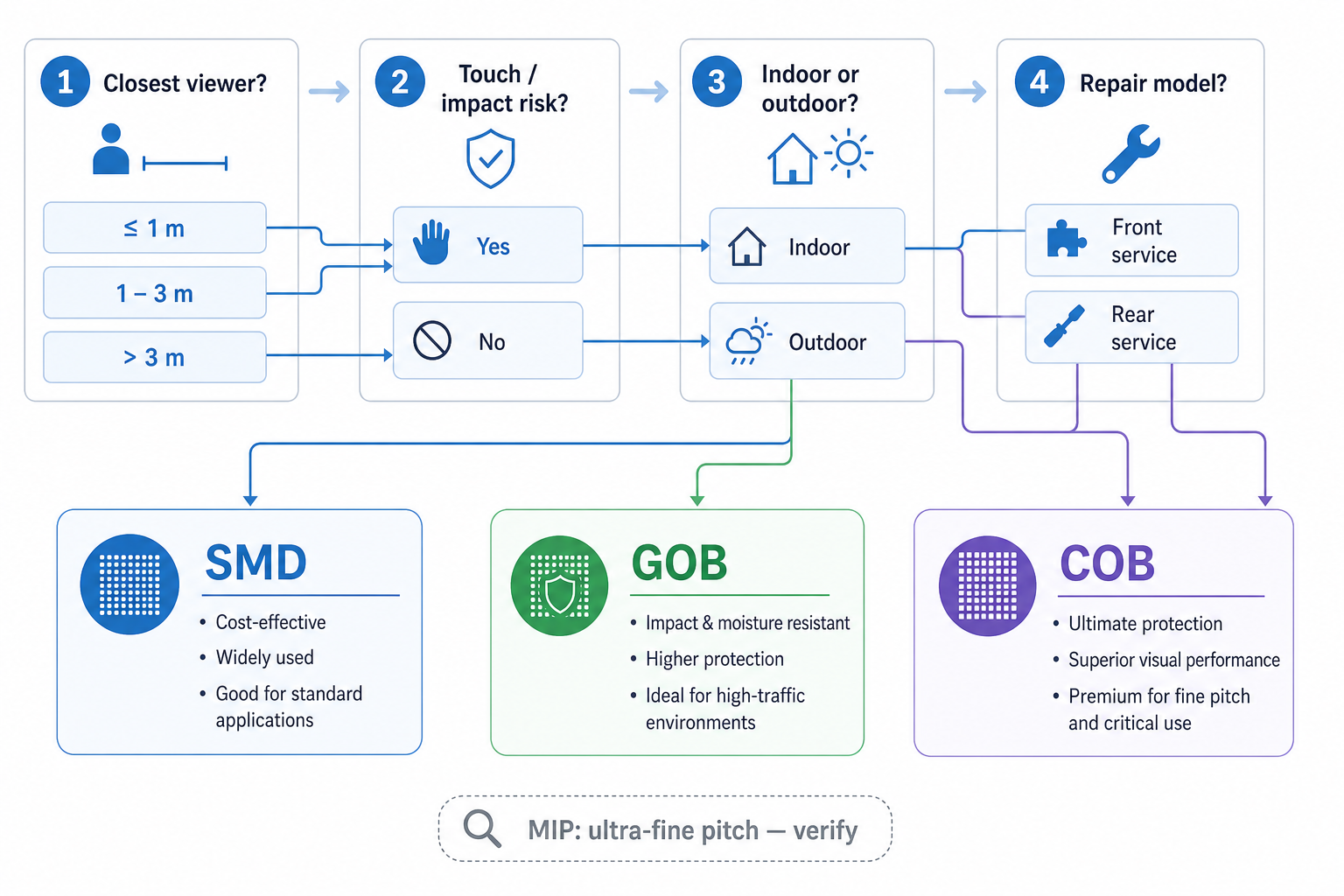
GOB is a strong fit when:
- The screen is within reach of visitors, students, shoppers or performers.
- Modules will be transported, installed and removed often, increasing impact risk.
- Dust, humidity or accidental splashes are realistic concerns, but the complete cabinet and site design still meet the required rating.
- The pitch is already right for the viewing distance, while the exposed SMD surface is the weak point.
- You want more face protection than standard SMD without automatically moving to a COB architecture.
- Your service plan accepts trained GOB rework or module-level replacement.
SMD is often the better buy when:
- The display is in a controlled space and out of reach.
- Viewers are far enough away that the exposed lamp texture is not a concern.
- A trained local team values individual lamp rework and short repair paths.
- The project needs a proven outdoor or touring cabinet with the required brightness and ingress protection.
- Budget is better spent on the correct pitch, cabinet, processor, spares or installation structure.
A church is a good example of why context matters. A main sanctuary with a first row several metres away may get little visible benefit from paying for a very fine close-view surface. A welcome area, children’s space or side wall within arm’s reach may justify extra protection. Our church LED wall vs projector guide explains why first-row distance, house lights and camera use should be written down before choosing a pitch.
COB is often the better buy when:
- Viewers are close enough to resolve surface texture and the image must remain comfortable and uniform.
- The project calls for a fine-pitch indoor wall, premium black appearance or frequent touch exposure.
- A permanent installation can hold same-batch spares and support module-level service.
- The project values the COB construction enough to accept its process and maintenance model.
See the COB LED screen overview for an example of an indoor, fine-pitch product category. Treat product-page values as model-specific, not as a definition of every COB screen.
Where MIP is relevant
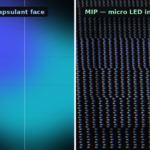
MIP–often expanded as Micro LED in Package–sits closer to the packaged-component side of the discussion than to GOB’s protective coating. Tiny chips are packaged into small components, then assembled into a module. That can support ultra-fine pitches and inspection before final assembly, while keeping some manufacturing and service practices closer to SMT.
MIP is worth asking about when a project is already evaluating sub-millimetre or very fine-pitch indoor products. It is not a reason to choose GOB for a normal P1.5-P2.9 decision, and it is not yet a uniform product category: verify the exact package, pitch, surface protection, repair method, spare availability and supplier support.
A factory POV: what a serious GOB quote should show
From a factory perspective, applying glue is not the whole product. Yield and consistency depend on module cleanliness, material handling, dispensing or coating control, curing, flatness, optical inspection, calibration and final aging. The factory should also be clear about what happens to a module that fails after shipping.
A useful request for quotation asks for:
- The underlying SMD package and pixel pitch, not only the word “GOB.”
- Front and rear ingress ratings for the complete cabinet, with the test basis stated.
- Brightness, refresh, power and operating-temperature data for the quoted model.
- A close-up sample or video under room lighting, plus a camera test if filming matters.
- The normal repair path, expected service turnaround and recommended spare strategy.
- A written warranty that explains treatment of coating defects, dead pixels, moisture and accidental impact.
- A module layout, access direction and maintenance plan for the installed wall.
This is also where honest total-cost thinking beats a simple “GOB costs more than SMD” comparison. A protected face may reduce impact-related service events, but a glued repair may cost more when a failure does occur. Compare likely damage, downtime, local skills, spare modules and access–not just the purchase line.
Bottom line
Choose GOB when the main risk is damage to an SMD face: contact, transport, dust, moisture or repeated handling. Choose SMD when field repairability, broad cabinet choice and cost control matter more than face protection. Choose COB when close indoor viewing, a smooth fine-pitch surface and premium protection justify module-level service. Consider MIP only when the project is already in the ultra-fine-pitch conversation and the exact product has a credible support plan.
The best first question is not “Which technology is newest?” It is: How close will people stand, what can hit the screen, and who will repair it?
FAQ
Is GOB the same as COB?
No. GOB normally adds a protective cured layer over an assembled SMD module. COB mounts bare LED chips directly on the board before encapsulation. Both can protect the face, but their construction, optical behavior and repair paths differ.
Is every GOB LED screen waterproof?
No. GOB improves protection at the module face, but the full cabinet’s ingress rating depends on the cabinet, seams, connectors, rear side, drainage and installation. Request the rating for the exact model and use case.
Can a GOB pixel be repaired?
Sometimes, with specialist equipment and a controlled process. In practice, many projects plan to replace the module and return the failed tile for factory assessment. Confirm the supplier’s normal service method before buying.
Is GOB better for close viewing than SMD?
It can make the surface look smoother and less exposed, but it does not change pixel pitch. Select pitch from the closest viewer, then compare samples with the actual content and camera setup.
Is GOB better than COB?
Neither is always better. GOB is often a practical protection upgrade for an SMD-based product. COB is often preferred for premium, fine-pitch indoor close viewing. The right answer depends on distance, impact risk, maintenance and budget.
Should I choose GOB for a rental screen?
It can make sense when repeated handling and impact are the main failure risks. Also confirm case packing, cabinet mechanics, access, spare modules and whether your team can service the coated modules between events.
Does GOB remove moire or camera flicker?
No. Surface finish can affect what a camera sees, but moire and flicker also depend on pitch, viewing geometry, lens, shutter, scan design, refresh and content. Test the actual module in the intended camera setup.



2 Comments
[…] guide sits next to our live COB vs SMD and GOB LED guide. SMD vs COB answers "packaged lamp or encapsulant face." GOB answers "do we coat an […]
[…] family (SMD / GOB / COB / MIP) only after access and pitch are honest-see COB vs SMD, GOB guide, MIP vs […]