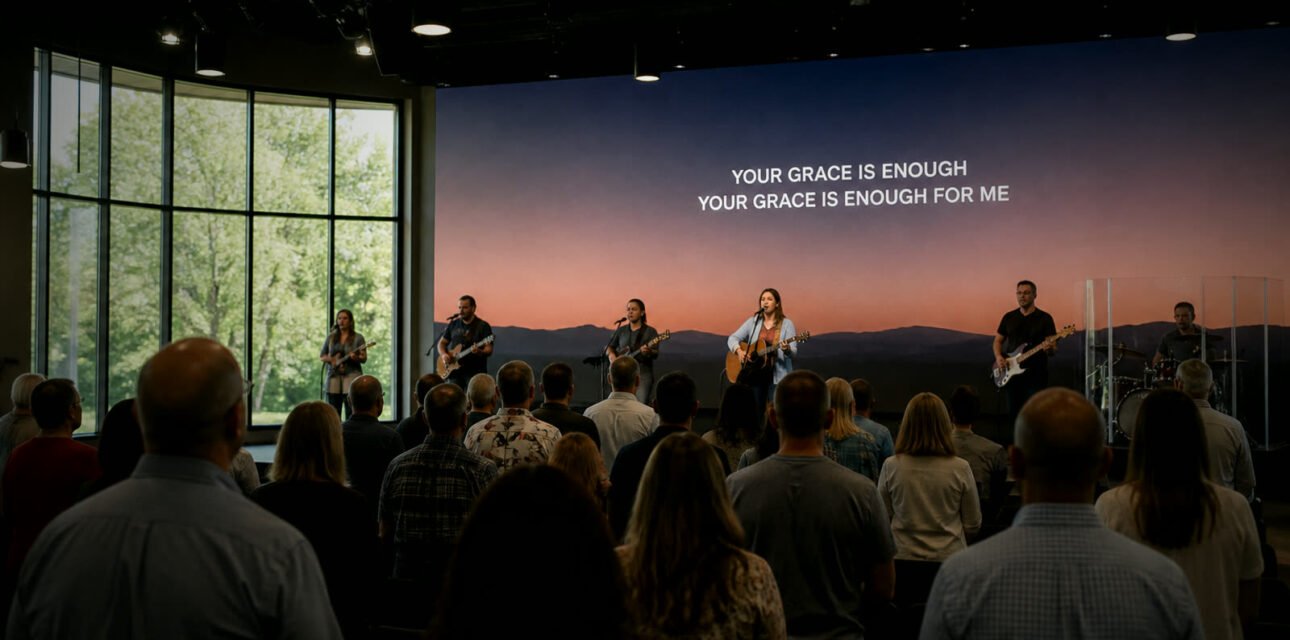
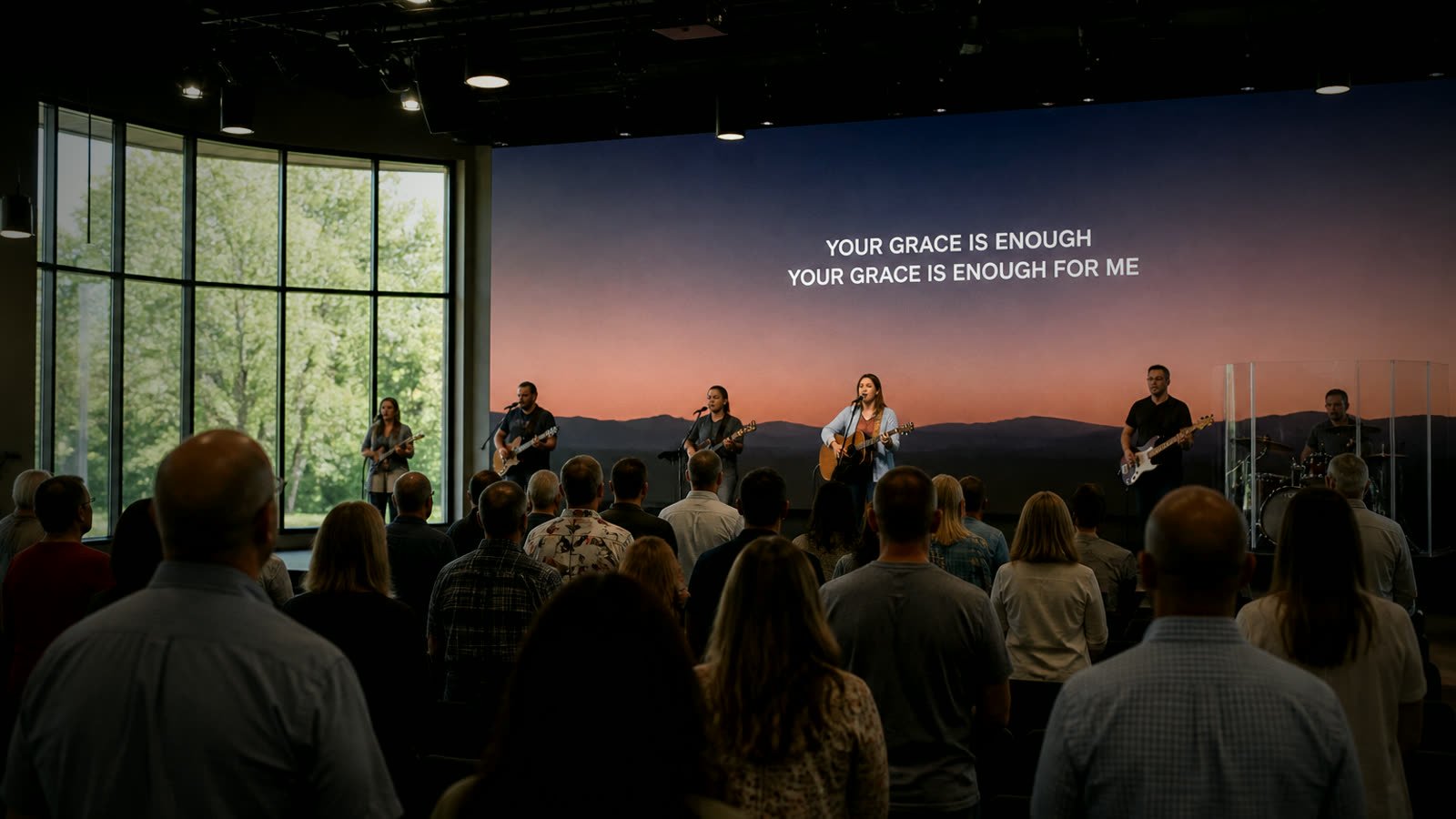
The church LED wall vs projector question is not “which image looks prettier in a dark demo.” It is whether the sanctuary still has windows, whether lyrics have to survive house lights, and whether cameras will take IMAG and a livestream off that same surface. For most rooms, the honest LED answer is a P2.6–P2.9 wall, not a P1.5 showcase. Projectors still win some rooms. The checklist below is how we sort the two when a church or its integrator sends a floor plan.
SFxDisplay builds fixed mounting and rental cabinets. We are not a house-of-worship integrator. Use this as a spec conversation with whoever will hang the steel.
Windows and house lights are the first test
A projector needs a dim field and a screen that does not also light the stage. Many sanctuaries cannot offer that. Side windows, clerestories, glass entry walls, and “we leave the house lights up so people can read and the cameras can work” are normal, not edge cases.
What that does in practice:
- Projector: ambient light raises black level. Lyrics go gray. IMAG looks milky. Closing blinds for every service is a policy, not a technical solution, and it fights the architecture.
- LED wall: the surface emits light. Window wash still matters — you may need more nits — but you are not depending on a reflective screen. House lights can stay at a level that is safe for walking and for faces.
If the room has uncontrolled daylight on the display wall, LED is usually the more predictable picture. If the room is already a black box with a working high-lumen projector and no IMAG complaints, replacing it “because LED is newer” is a weak reason.
Nits, not lumens, are the LED number. A sanctuary with modest windows often lands in the 1,000–1,500 nit indoor band. A glass-heavy room may need more. Do not specify an outdoor 5,000-nit cabinet as a shortcut; you will dim it, annoy the front row, and still pay outdoor mechanics.
Lyrics have to read at the back row
Worship lyrics and scripture are high-contrast text. They fail in two different ways:
- Too dim / too washed — the back row guesses the words. This is the classic projector-plus-windows failure.
- Too small or too close-pitch for the budget — the wall is expensive, but the font is still 80 px tall because the wall itself is small.
LED helps with (1) if nits and viewing angle are specified. It does not automatically fix (2). A 3 m-wide LED ribbon over the baptistry will not replace a 4.5 m image that people were already used to. Measure the current screen, sit in the last pew, and decide width before pitch.
If the wall will show both sparse white lyrics on black and full-color IMAG, check both looks. A wall tuned only for music video can clip lyric whites.
IMAG and livestream change the spec
If cameras put a close-up on the same wall (IMAG) or cut the stream from those cameras, the display is a camera subject, not only a pew display. That adds three requirements:
- Refresh rate. 3840 Hz is a reasonable church floor; 7680 Hz is what we put on rental cabinets when cameras are in the brief. A wall that looks stable to the eye can still show scan lines on a 1/60 or 1/120 shutter.
- Moiré. Fine pixel grids plus a tight lens equal a wavy pattern on the IMAG feed. Distance, angle, and pitch all contribute. Do not buy P1.5 “so the camera sees more resolution” if the IMAG camera is 12 m off-axis; you may make moiré worse.
- Brightness on camera. An LED wall that is comfortable in the pews can still clip on a camera pointed at it. You need a dimming range that stays clean at 20–40% output, not just a high nit number on the datasheet.
Projectors can be easier on cameras in a dark room. They lose that as soon as house lights come up for faces. In a bright room with a live image, LED is the more consistent IMAG surface if refresh and pitch are specified for cameras.
Pitch: P2.6–P2.9 for most sanctuaries, not P1.5
Typical sanctuary first rows are 6–12 m from a center wall, with balconies sometimes closer. In that geometry:
- P2.6–P2.9 is usually enough for lyrics, lower-thirds, and IMAG. The pixel grid is not the thing people notice from the pews.
- P1.9 can make sense if a balcony or a thrust stage puts people inside ~4 m, or if the wall is also a close-view lobby piece.
- P1.5 is a close-view indoor product. On a 8–12 m wide worship wall it multiplies cabinets and power without a matching gain in readability. Put that money into width, nits, processing, or a second side screen.
If the first pew is at 8 m, P2.6 already has margin. A 6 m-wide P2.6 surface is about 2,300 pixels across — enough for HD IMAG and large-type lyrics. Side IMAG screens can use a different pitch if distances differ; keep lamp bins in one family so color matches.
For a wall that never leaves the building, use fixed mounting LED screens. For a portable setup that moves between a gym and a sanctuary, use rental cabinets in P2.6 or P2.9. Very close indoor viewing (welcome desk, kids-wing) is where COB indoor is worth a look — not as a default for the main auditorium.
Power draw and HVAC at the wall
Projectors concentrate heat in a booth or a ceiling pod and dump lamp or laser heat into that zone. LED spreads heat across the wall and into the room air at the face.
Honest planning notes, not a sales comparison:
- Power. Indoor P2.6–P2.9 often draws a few hundred watts per square meter at full white; lyrics-plus-IMAG average is lower. A 15–25 m² wall still needs a dedicated circuit, not the old projector outlet. Ask for max and average watts and size breakers with headroom.
- HVAC. The wall adds heat at the platform. It is not automatically worse than a large projector in a booth, and it is not free. Put the LED wattage into the load calc, and leave airflow behind cabinets.
- Dimming is your friend. Running at the nits the room actually needs cuts both power and heat. Specify a driver that still looks even at low gray.
If the electrical service cannot support the wall you want, shrink the wall or the nits before you shrink pitch. Pitch does not light the room; current does.
When a projector is still the better buy
LED is not the default for every congregation.
Keep or replace a projector when:
- The room is already dark, the current image is large enough, and nobody is fighting windows.
- The budget is a lamp/laser cycle, not a structural hang and a new electrical feed.
- The “screen” is a 20 m-wide painted wall you cannot cover with cabinets this year.
- You need occasional big image for a conference and will otherwise leave the surface dark — rental LED for those dates may beat a purchase.
Move to LED when windows or house lights are non-negotiable, when IMAG and stream quality are part of the ministry, or when the projector cannot get bright enough without destroying contrast. Many churches land on LED for the main wall and keep a small projector in a chapel or overflow that is already dark.
| Factor | Projector tends to win | LED wall tends to win |
|---|---|---|
| Daylight / windows | Only if you can black out | Indoor nits sized to the glass |
| Lyrics with house lights on | Weak blacks | Strong if nits and size are right |
| IMAG + livestream | Fine in a dark room | Better in a lit room if refresh is spec’d |
| Closest pew 6–12 m | Either | P2.6–P2.9 is usually enough |
| Closest viewer < 4 m | Watch pixels on LED | P1.9 or COB, not automatic P1.5 on a huge wall |
| Electrical / HVAC | Existing booth circuit | New wall load; plan it |
| First-cost for a large image | Often lower | Higher; fewer lamp cycles, different maintenance |
FAQ
Can we keep the projector for overflow and add LED on the platform? Yes. That is a common split. Match color temperature as well as you can; they will never match perfectly.
Do we need 4K cameras if the wall is P2.9? No. IMAG readability is lens, lighting, and operator. The wall’s pixel count should match viewing distance, not a camera brochure.
Will LED help people in the balcony see lyrics? Only if the wall is large enough and aimed so the balcony is inside the viewing angle. Pitch will not fix a wall that is too small.
Send a floor plan, not a pitch guess
Photograph the windows at service time, mark the first pew and the balcony, and say whether IMAG cameras shoot the wall. We will recommend a P2.6–P2.9 (or finer) layout and a nits/IP package. Contact SFxDisplay.