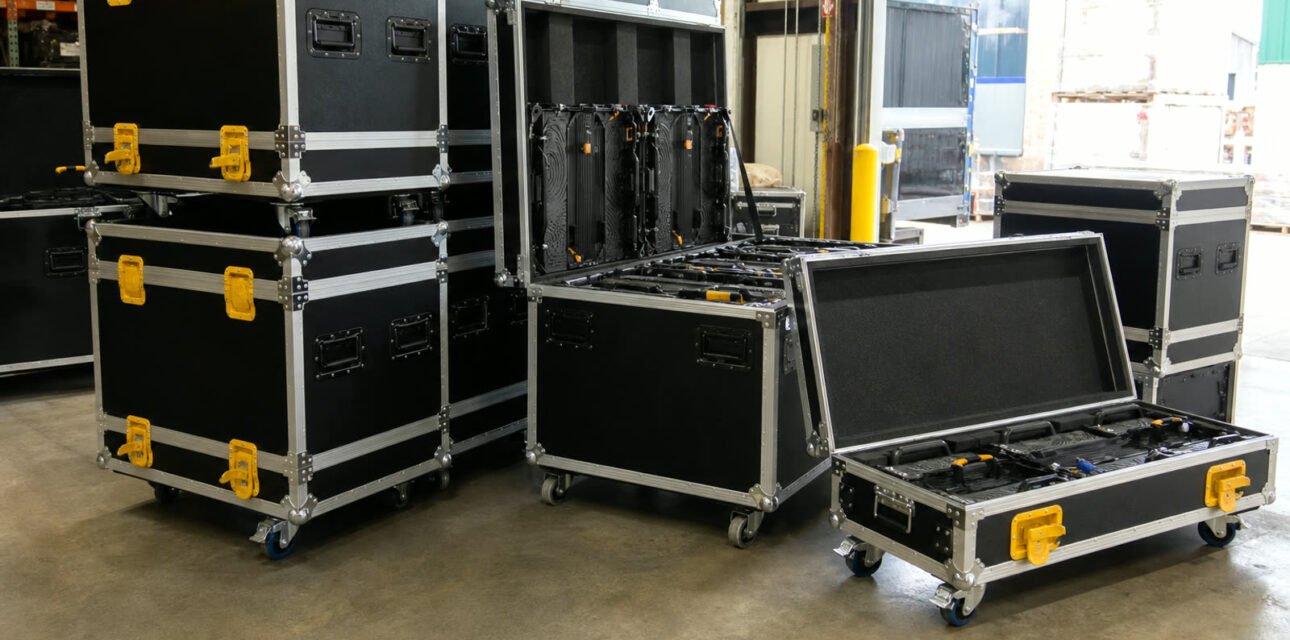
The rent vs buy LED wall decision is an event-count problem first and a pixel-pitch problem second. If you need a wall four times a year, a local rental house is usually cheaper than owning cases, a truck, and a spare kit. If you are the rental house — or a church, hotel, or brand that will light the same rectangle every week — buying cabinets can make sense. A working planning rule is a break-even around 10–20 paying uses, not a promise. Used walls look cheaper until the color does not match. New inventory should include 5–10% same-bin spares. A practical first purchase is still P3.91, P2.9, and P2.6, not every pitch in a catalog.
SFxDisplay sells rental LED screens and trailer LED screens. We do not run a local hire desk. This article is for people deciding whether to buy touring-style cabinets.
A planning break-even around 10–20 uses
Rental houses price a wall by the day or the weekend, plus crew, trucking, and sometimes processing. Purchase price is cabinets, cases, processor, spares, and the people who will hang it.
A crude planning sketch (illustrative, not a quote):
- Suppose a 6 m × 3.5 m indoor wall hires at a number your market actually charges — in many cities that is a four-figure day rate once crew is included, sometimes more for outdoor IP65.
- The same rectangle purchased as die-cast rental cabinets might sit in the middle of the $900–$1,800 per m² equipment band discussed in our 2026 cost notes, plus cases and a processor. For ~21 m² that is a five-figure to low six-figure kit before a truck.
Divide kit cost by the fully loaded hire rate you would have paid. Landing in the 10–20 use zone is common when you include cases and a spare kit and you do not include a dedicated extra hire of staff you already employ. Land higher if you need a truck you do not own, storage, insurance, and slow winter months. Land lower if you already have crew, a warehouse, and processing.
Treat 10–20 as a planning rule, not a payback guarantee. Utilization is the variable that breaks amateur inventories: a wall that works 25 Saturdays in the brochure and 6 Saturdays in the calendar is still a rented wall that you happened to purchase.
Buy when:
- You can name the next 12–24 dates (your own events or signed hire work).
- You have storage, cases, and at least one person who can hang, map, and strike.
- You will keep the same pitch family long enough to learn it.
Keep renting when:
- Dates are irregular or last-minute.
- Outdoor vs indoor changes every job (unless you are ready to stock both).
- You would be buying a trailer’s worth of screen for two parades a year — in which case look at a trailer only if those dates are real.
Used walls and why color matching fails
Used touring stock is where a lot of “we can buy it for half” plans die.
LED modules are binned. A wall shipped together in 2023 shares a lamp batch, a mask, and a calibration. A wall assembled in 2026 from three Facebook lots does not. Under house lights the mismatch can be subtle. Under camera, or at low gray, you get a patchwork.
Common used-wall problems we would rather you hear from the factory than from a Saturday load-in:
- Color and brightness drift between cabinets from different years or factories.
- Receiving cards and hub boards that do not match, so a spare from lot B will not boot on lot A.
- Missing cases, so the “cheap” wall starts eating corners immediately.
- No spare modules in the same bin, which means the first dead module becomes a visible repair.
Resale value on coarse pitch has also compressed as finer pitch got cheaper. A used P6 or P10 wall can be a poor match for what clients now expect on a 10 m backdrop. If you buy used anyway, buy one complete wall from one owner, insist on a spare ratio, and budget a full recalibration. Do not mix that wall with new cabinets on the same hang.
New production from one order is the straightforward way to get a single bin. That is a large part of what you pay for.
Budget 5–10% same-bin spares
Plan the spare kit in the original PO:
- About 5–10% extra modules from the same LED bin and the same run.
- A few spare power supplies and receiving cards of the exact models in the wall.
- Hub cables and locks; they fail on the truck more often than the LEDs.
Five percent is a minimum for a wall that lives in cases. Ten percent is more realistic if the inventory will be rented hard, stacked by mixed crews, or hung outdoors. Buying spares two years later is how you get a “close enough” module that is obvious on IMAG.
Label every spare with batch and bin. Keep them in the same climate as the wall. A spare that sat in a hot trailer for a summer may not match either.
A practical rental lineup: P3.91, P2.9, P2.6
You do not need five pitches in year one. Three cover most paying work.
| Pitch | Where it earns | Notes |
|---|---|---|
| P3.91 | Outdoor stages, large indoor backdrops, festivals | Workhorse. Outdoor IP and high nits. First-row distance is usually comfortable from ~8–10 m. |
| P2.9 | Corporate ballrooms, churches, indoor galas | All-round indoor hire. Close enough for 4–8 m viewing without P2.6 cost on every job. |
| P2.6 | Closer indoor, higher-rate corporate, IMAG-heavy rooms | Sharper at 3–6 m. More pixels, more cabinets per m², more to hang. Add this when P2.9 jobs keep asking for tighter pitch. |
SFxDisplay rental screens are offered indoor and outdoor in P3.91 / 2.9 / 2.6 / 1.9 / 1.5, 500 × 500 mm or 500 × 1,000 mm die-cast, hanging or stacking. For a first container, most rental shops are better served by outdoor P3.91 plus indoor P2.9, then P2.6 when the book supports it. P1.9 and P1.5 are close-view products; they are easy to overbuy.
Refresh: if your clients bring cameras, specify 3840 Hz as a floor and 7680 Hz when the jobs are concerts, worship IMAG, or broadcast. That decision belongs on the PO with the pitch, not as a firmware afterthought.
Cabinet size: 500 × 500 mm packs and hangs flexibly; 500 × 1,000 mm is faster on large rectangles. Many inventories mix both in one pitch so a 6 m wall does not become an odd module puzzle.
When a trailer is the inventory
Some “LED wall” demand is really mobile outdoor display: parking lots, fairs, roadside, sports overflow. Stacking P3.91 every time is slow and needs a structure. A purpose-built LED trailer or truck face — including double-sided units and country-specific road lighting — can be the product you rent or deploy, not a wall you rebuild.
Trailers have their own cost stack (chassis, hydraulics or lift, generator, brakes, signage law). They do not follow the 10–20 indoor-gala break-even. Count outdoor mobile dates and local permitting, then quote the vehicle and the screen together.
Fast-setup SKUs: tri-fold posters and DJ booths
Not every hire is a 6 m wall. Rental shops lose small jobs when the only answer is 20 cabinets and a truss.
Two factory SKUs fill that gap without a second blog’s worth of engineering:
- Tri-fold LED screens — foldable poster-style units (GOB-protected modules, pitches in the fine indoor range) that one or two people can stand up for registrations, photo moments, and small stages. They are not a substitute for a concert wall. They are a fast indoor hire that does not need a hang.
- LED DJ booth / counter screens — floor-standing booth or counter shapes for clubs, weddings, and brand activations. They travel as a known object, not as a custom ground stack.
Stock a small number of these next to the P3.91/P2.9/P2.6 wall kit. They protect the main inventory from being cut down into awkward little hangs, and they give sales a SKU for jobs that would otherwise go to a TV on a stick.
FAQ
Is 10–20 uses a payback promise? No. It is a planning band so you do not buy a wall for three galas. Your rates, crew, and idle months will move it.
Should I mix indoor and outdoor cabinets in one hang? No. IP, nits, and thickness differ. Hang one type. Stock both if your book needs both.
Can I start with P3.91 only? Yes, if most dates are outdoor or long-throw indoor. You will lose some close corporate work until you add P2.9 or P2.6.
What processor should a new inventory standardize on? Pick one family and stay there so every wall boots the same way. We commonly ship NovaStar; other brands are optional if your operators already know them.
Do tri-folds replace 500 mm rental cabinets? No. They are a different hire: fast, indoor, small footprint.
Buy a kit you can hang twice this month
If the dates are real, send a target rectangle, indoor vs outdoor, and whether cameras will shoot. We will spec a P3.91 / P2.9 / P2.6 package, a spare ratio, and cases. Contact SFxDisplay.